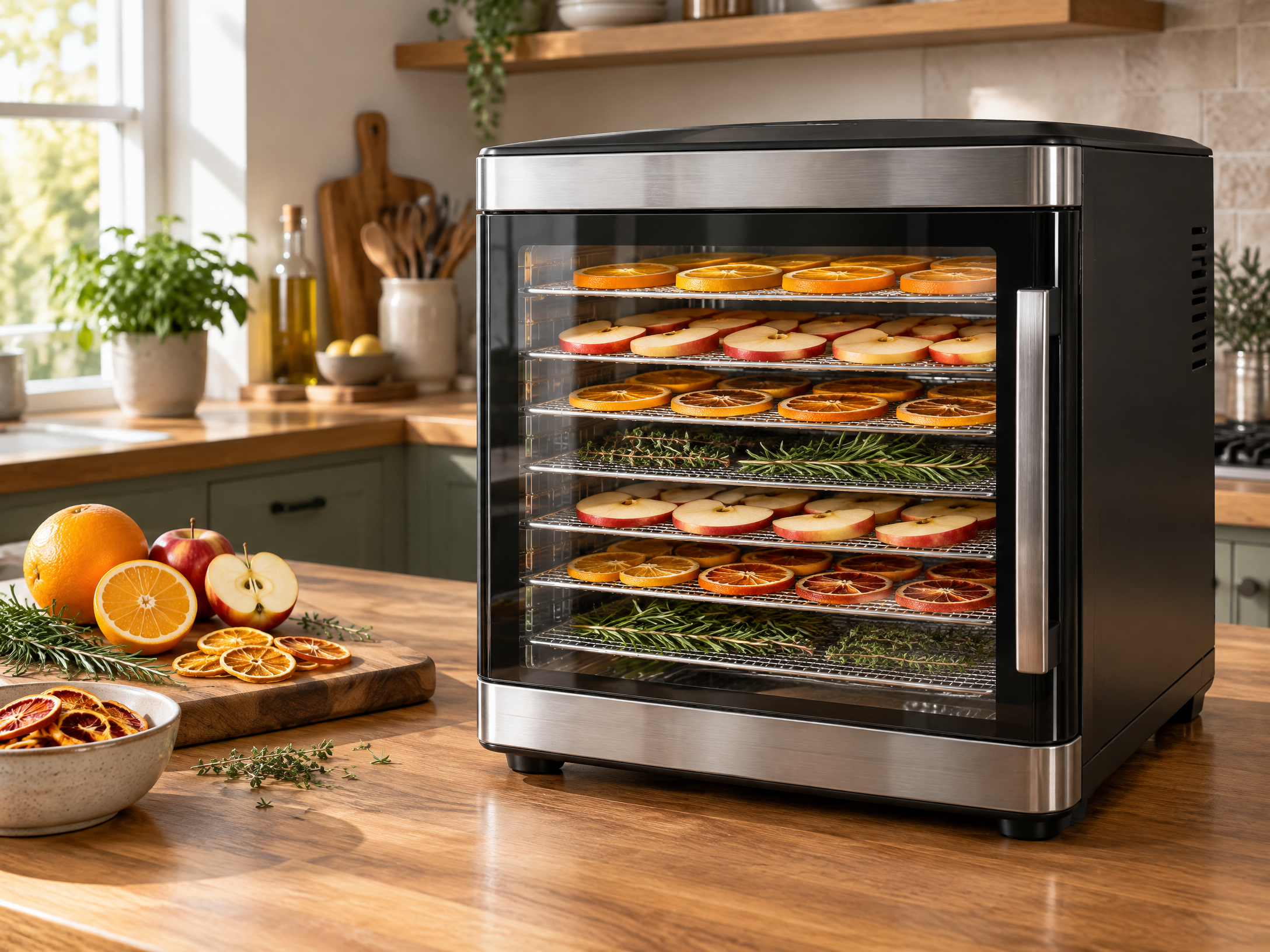
Target Keywords: food dehydrator manufacturer; food dehydrator supplier; food dehydrator OEM; food dehydrator tray material; food dehydrator horizontal airflow; food dehydrator vertical airflow; food dehydrator timer range
Direct answer: Brief the supplier with a controlled product definition, not a performance promise: identify the intended food uses and destination market; choose the airflow architecture; define trays and controls; and require evidence, samples and change control for the final configuration. Make each requested feature traceable to a drawing, bill of materials, sample review or validation activity.
A dehydrator can look straightforward at a trade show: a housing, fan, heater, trays and controls. For a private-label buyer, however, a quotation is not a buildable specification. Risk often sits at the interfaces: a new tray geometry can alter an air channel, a timer display can change controls and instructions, and a market change can change required documentation.
This guide deliberately takes an OEM sourcing and manufacturability angle. It does not try to duplicate the broader product-use and specification discussion in UZYVO’s food dehydrator specification guide. Its purpose is to help a buyer turn a brand concept into a brief a manufacturer can quote, prototype, document and control in series production. The principles apply to the final configuration only: appliance variant, voltage/frequency, materials, accessories, labeling, instructions and destination market all matter.
1. Set the commercial decision before requesting a quotation
Start by describing the decision the project must support. Is the buyer selecting a platform for a branded launch, adapting an existing platform with new trays and graphics, or commissioning a materially different enclosure and control arrangement? Each path asks a food dehydrator manufacturer to take a different level of design, sourcing and documentation responsibility. Treating all three as “custom” produces ambiguous quotations and hard-to-compare proposals.
Give the team a one-page scope statement before sharing a target appearance. State the sales channel, user, intended food uses, target markets, voltage/frequency variants, accessories and packaging language needs. These are planning inputs, not drying-outcome claims. The supplier should flag existing-platform features and items needing engineering or tooling review.
| Buyer decision | What to state in the brief | Why it changes the OEM discussion |
|---|---|---|
| Product route | Existing platform, modified platform, or new development | Establishes whether drawings and approved parts already exist. |
| Sales geography | Each destination country or region and channel | Determines which product, food-contact, labeling and documentation questions must be reviewed. |
| Variant strategy | Electrical version, tray count, accessory set, color and branding | Prevents an approval or sample from being assumed to cover a different final variant. |
| Evidence goal | Documents, sample review, factory records or qualified third-party work requested | Separates an evidence request from an unsupported guarantee. |
| Change authority | Named buyer approver and supplier change-notification route | Keeps material or firmware substitutions from becoming invisible after approval. |
A useful request defines the comparison unit. Ask every candidate to quote the same tray count, material assumptions, airflow type, control type, packaging level and market package. Mark alternatives separately rather than blending them into the base offer.
The question for the procurement team is not “Which factory says yes?” It is “Which candidate can identify the final configuration, explain the build assumptions and show how it will be controlled?” That is the beginning of a defensible supplier comparison.
2. Convert brand language into a controlled OEM brief
Words such as “even drying,” “premium tray” or “easy clean” are aspirations, not manufacturing instructions. Ask the food dehydrator OEM to answer an itemized Product Requirements Document (PRD) covering commercial, construction, electrical/control, packaging and documentation requirements. Give every requirement an identifier that links to the supplier answer, drawing revision and sample observation.
For airflow, trays and timers, distinguish a requested feature from an outcome requiring validation. “Rear fan with lateral plenum and removable tray stack” is a design direction. “No tray rotation ever needed” is an outcome claim requiring an agreed method, load and review of results.
| Brief field | Buyer should specify | Supplier should return |
|---|---|---|
| Air system | Proposed air entry and exit locations; architecture preference; intended tray stack | Cross-section or layout, fan/heater/control assumptions, and any design constraints. |
| Tray assembly | Tray count, nominal usable footprint, rim style, mesh/solid inserts, removal approach | Part drawings or samples, material identification, assembly method and cleaning considerations. |
| Timer control | Digital or mechanical interface, start/stop behavior, display/marking needs, power-interruption preference | Control description, user-flow proposal, component status and requested decisions. |
| User-facing surfaces | Food-contact areas, handling points, cleaning access and warning locations | Material and finishing proposal plus instruction/label inputs. |
| Brand pack | Logo locations, language versions, carton and instruction ownership | Artwork template, print constraints, version-control process. |
The requested food dehydrator tray material should be described by its function and traceability needs, not only a marketing name. Identify whether it is intended for direct food contact, whether it is a structural tray, a mesh insert, a drip component or a silicone-like accessory, and whether a colorant, coating or marking is involved. This lets the supplier assemble the correct bill of materials and lets the buyer ask targeted evidence questions.
Also include “not decided” fields. Assign an owner and decision date rather than silently assuming a behavior such as display retention after a supply interruption.
3. Choose airflow architecture as a sourcing decision
Airflow is a system decision: fan, heater, ducts or plenum, tray geometry, leakage paths, exhaust openings and loading pattern interact. Specify the preferred architecture and ask the OEM to show the physical air path; do not rely on a generic diagram or listing phrase.
In a food dehydrator horizontal airflow layout, air is commonly introduced from a side or rear zone and moves across the tray plane before exiting through another path. The commercial advantage is often that the tray stack can be designed around a shared lateral air path. In a food dehydrator vertical airflow layout, air is directed upward or downward through the stack. That can simplify a stacked form factor but makes the relationship between the air source, tray openings and top/bottom zones especially important. Neither label alone establishes uniformity, noise, energy use, food safety or user experience.
| Architecture question | Horizontal airflow brief | Vertical airflow brief | Buyer evidence request |
|---|---|---|---|
| Air path | Identify fan-side/rear zone, plenum, inlet and outlet locations. | Identify fan location, flow direction, central/edge passages and exhaust. | Section view with the tray stack installed. |
| Tray interface | Define side openings, rails and how trays align to ducts. | Define perforation pattern, center opening if any, and stacking orientation. | Tray drawing and an assembled sample. |
| Cleaning | Show access to areas behind trays and near the air outlet. | Show access around the fan cover, lower/upper intake and stack interfaces. | Cleaning instructions and disassembly limits. |
| Load assumptions | State what loading arrangement will be used in any evaluation. | State the same; do not presume a full or empty stack represents every use. | Written method before any buyer relies on a result. |
Ask the supplier to identify failure-sensitive interfaces: warped tray edges, an incorrectly oriented tray, debris at an intake, or a door/gasket affecting the designed path. This is more useful than a vague assurance of “uniform airflow.”
The brief can say: “Propose the final airflow path and document tray orientation, allowed stack configurations and service-cleaning access.” Agree any performance verification separately for the final configuration, defined load, conditions, acceptance criteria and reviewer.
4. Specify tray materials, geometry and cleanability together
Trays are not cosmetic. Their material, ribbing, mesh, wall thickness, support features and stack position influence stiffness, airflow passages, handling and cleaning. A material acceptable in isolation may be impractical in the finished housing or with a removable liner.
For an EU-bound appliance, food-contact materials placed on the market must comply with the EU food-contact framework, and must be made in accordance with applicable good manufacturing practice; there are also material-specific rules and national provisions depending on the material. [1] In the United States, FDA describes food-contact substances as including processing equipment and food-preparation surfaces; where a substance is a food additive, the intended use must be authorized before marketing. [2] These points do not turn a generic material name into proof for a specific tray. Ask for evidence that maps the final formulation, use conditions and market to the applicable requirement, and use qualified review where necessary.
| Tray option to explore | Manufacturability questions | Evidence or review questions |
|---|---|---|
| Molded polymer tray | Resin grade, colorant, rib pattern, gate/warpage risk, tool ownership, marking location | Material identification, supplier declaration and suitability review for the final intended use. |
| Metal tray with mesh or perforations | Grade, edge finishing, joint method, mesh retention, corrosion/cleaning considerations | Component specification, food-contact basis where applicable, and sample inspection of edges and joints. |
| Polymer mesh insert | Aperture geometry, support frame, snap-fit retention, removal force, debris traps | Material/colour masterbatch identity and an assembled use sample. |
| Solid sheet or liner accessory | Thickness, fit, heat exposure assumptions, curling risk, storage and replacement strategy | Material information and final-use review; avoid implying compliance from a visual resemblance. |
A buyer should request a component map: every food-contact or potentially food-exposed part, material family, supplier, part number, color/finish and revision. It becomes the basis for documents, incoming checks and change control.
Define nominal dimensions, handles, locating features, maximum stack, orientation markings and interchangeability. Ask the manufacturer to propose critical-to-function dimensions and controls rather than dictating mold tolerances. Review a tray sample in the actual housing and accessory set.
5. Brief timer operation as a user interface and control-system requirement
A food dehydrator timer range is more than a number printed beside a knob. It affects the control method, display or dial markings, instructions, restart behavior, component availability and buyer support content. Begin with the user decision: should the appliance run until a user-selected end point, provide fixed presets, require manual stop, or offer a combination? Then write the operating logic that accompanies the selected interface.
For a mechanical timer, confirm scale, pointer readability, return-to-off behavior and its relationship to heater/fan functions. For a digital timer, define display units, increments, selectable limits, indicators and behavior after power loss. Do not assume a label, brochure or sample display shows final firmware logic.
| Control decision | Example of a briefable requirement | What not to assume |
|---|---|---|
| User range | “Supplier to propose selectable range and increments for buyer approval.” | That an advertised maximum applies to every voltage/version. |
| End-of-cycle behavior | “Describe fan, heater, display and audible/visual behavior at timer end.” | That “auto-off” has one universal technical meaning. |
| Interrupted power | “State expected behavior after a supply interruption; buyer approval required.” | That settings are retained or that operation restarts safely. |
| Marking | “Show labels, units and language-dependent instructions on the artwork proof.” | That a control graphic is acceptable in all markets. |
| Variant control | “Identify control-board and firmware revision by model.” | That two visually similar panels use the same logic. |
Ask the OEM for a simple state table—off, setting, running, end-of-cycle, any fault indication and recovery after interruption. It turns user-experience discussions into reviewable control behavior.
Do not turn time and temperature settings into marketing claims until the final appliance is assessed by an agreed method. Brief the selector range, proposed evidence, sensor placement and control logic, then decide what claims and instructions are supportable.
6. Build a manufacturable configuration, not a collection of options
Once the buyer selects a direction, the factory needs a controlled configuration record. A capable food dehydrator supplier ties approved appearance, electrical version, airflow layout, tray part numbers, material declarations, controls, labels, carton, manual and accessories to one model or variant code.
Ask for a revision-controlled package identifying common and differing variant parts. A “220–240 V version” and a “120 V version” may differ in components, control settings, markings, cord/plug, carton and documentation. A photographed sample is not a substitute for this list; evaluate any lab document against its model identity, test basis and final-build relationship.
A practical change-control clause requires notice before changes to material formulation, tray supplier/tool, fan/heater/control board, firmware, food-contact or safety-critical components, labels, instructions or production site, and defines needed evidence or approval.
For a broader view of working models and responsibilities, see UZYVO’s OEM/ODM sourcing overview. The immediate deliverable for this project is narrower: a configuration register that can be handed from sourcing to quality, packaging, regulatory review and launch operations without losing the assumptions made during negotiation.
Mid-article CTA — need a structured OEM brief? Share your target market, intended variant and current drawings with UZYVO’s sourcing team. We can help organize an evidence-led discussion with the final configuration in view; no outcome or approval can be presumed before review.
7. Ask for evidence in stages and compare suppliers fairly
Use evidence proportionate to project stage. At early sourcing, ask a candidate for its platform, engineering contacts, configuration control, traceability approach and record examples. At pre-production, verify the approved component and document set; before release, review evidence for the specific model and market. A certificate, statement or passed sample is not blanket approval for later versions.
| Project stage | Useful buyer request | Care point |
|---|---|---|
| Initial screening | Platform summary, factory quality-process description, preliminary configuration assumptions | A capability description is not proof for the final model. |
| Technical alignment | Drawings, bill-of-material proposal, tray/control samples, open-issue log | Mark all provisional decisions and revision dates. |
| Pre-production | Final artwork proof, component identity, agreed inspection criteria, relevant documentation package | Check that documents identify the final model or a justified family relationship. |
| Shipment release | Purchase-order match, sampling/inspection records as agreed, packaging check, shipment identifiers | Inspection is a snapshot; it does not replace the manufacturer’s conformity responsibilities. |
In the EU, the Low Voltage Directive requires manufacturers of in-scope electrical equipment to ensure design and manufacture meet safety objectives, draw up technical documentation and carry out the conformity assessment procedure; it also addresses identification, instructions and series-production procedures. [3] The applicable scope and route must be checked for the final product, and other legislation may apply. Do not ask a factory merely to “provide CE.” Ask what legislation, product identity, evidence, declaration and document retention apply, then obtain qualified advice for the destination market.
A structured comparison removes false precision. Record whether the supplier supplied the current drawing, identified open decisions, gave material traceability, disclosed configuration differences and accepted change control; do not turn a brochure review into a numerical “quality score.”
8. Connect the OEM brief to market access and product information
Market access should be opened at the same time as product definition, not appended just before shipment. For EU sale, electrical equipment within the Low Voltage Directive’s scope may be placed on the market only when it meets the Directive’s safety objectives; manufacturers must prepare technical documentation and, once conformity is demonstrated through the applicable procedure, issue an EU declaration of conformity and affix CE marking. [3] The Directive also requires clear, understandable instructions and safety information in the language determined by the Member State. [3]
EU food-contact rules are relevant to trays and other parts intended to contact food, while the applicable pathway is dependent on the material and use. [1] RoHS also restricts certain hazardous substances in electrical and electronic equipment unless an exclusion applies; the Commission notes that products with an electrical/electronic component must comply unless specifically excluded. [4] These are reasons to create a component/material map early, not a reason to make unqualified compliance claims.
| Information area | Brief owner | Final-configuration question |
|---|---|---|
| Product identity | Buyer + OEM | Do model, rating label, carton, declaration and records point to the same identifiable product? |
| Electrical safety | OEM + qualified reviewer | Which standards/evidence and national differences are relevant to the target version and market? |
| Food-contact materials | OEM/component maker + qualified reviewer | What material, intended contact/use conditions and supporting documentation apply to every relevant part? |
| Environmental obligations | Brand/importer + adviser | What obligations attach in each market to EEE, packaging or producer responsibility? |
| Consumer information | Brand + OEM | Are warnings, instructions, languages and cleaning/use limits consistent with final controls and components? |
IEC 60335-1:2020 is titled *Household and similar electrical appliances—Safety—Part 1: General requirements* and is within the IECEE system; check national differences and other applicable parts. [5] The EU General Product Safety Regulation also requires technical documentation based on internal risk analysis, identification and understandable information where needed. [6]
Preserve identifiers and required information in the launch file. Re-evaluate document mapping after changes to brand, tray material, electrical version or claims. Applicability depends on final configuration, destination market and qualified review; this is a procurement framework, not legal advice or a declaration of conformity.
9. Use samples, inspections and a buyer checklist to control risk
A sample should answer a defined question. An appearance sample may approve color, logo position, tray feel and assembly; an engineering sample may review fit, air-path layout, control logic or packaging. Neither becomes “the approved production product” unless buyer and OEM agree its status, configuration and remaining differences.
Before sign-off, run a cross-functional review. Use evidence to identify unknowns, not create a false pass/fail conclusion. Inspections and shipment checks are useful when scope, sampling, criteria and records are agreed; they neither prove identical performance of every unit nor transfer statutory responsibilities.
Buyer handoff checklist
- [ ] Product code, voltage/frequency version and target markets are fixed or visibly marked as open.
- [ ] The selected airflow architecture is shown in a layout or section view, including tray orientation and cleaning access.
- [ ] Every tray, mesh, liner and food-exposed component has a part number, revision and material/source record.
- [ ] The proposed food dehydrator timer range, interface, end-of-cycle behavior and interrupted-power behavior are documented for review.
- [ ] Artwork, labels, carton and instructions match the control logic and intended markets.
- [ ] The supplier has identified proposed evidence and the buyer has checked whether it maps to the final configuration.
- [ ] Change notification, sample status and release authority are written into the project controls.
- [ ] Incoming, in-process and pre-shipment checks are defined only where they are meaningful and feasible.
For manufacturing review topics to raise during due diligence, visit UZYVO factory capabilities. It does not substitute supplier qualification. Keep a decision log with agreed and pending items and configuration revision.
10. Buyer FAQs on OEM airflow, trays and timers
Does horizontal airflow always mean better drying than vertical airflow?
No. Food dehydrator horizontal airflow and food dehydrator vertical airflow describe layouts, not verified outcomes. Either may suit the final fan, heater, ducting, enclosure, trays, loading pattern and instructions. Ask the OEM for the proposed air path and define any performance evaluation for an agreed final configuration and method.
Which food dehydrator tray material should we select for a private-label model?
Start with intended use, architecture and target market. Document the material/formulation and support at component level. EU food-contact rules require applicable materials and articles to meet the framework and good manufacturing practice requirements; U.S. status also depends on intended use and applicable authorizations. [1][2] Obtain qualified review rather than relying on “food grade.”
How much detail should we give a food dehydrator manufacturer before asking for a price?
Enough for a common comparison basis: product route, markets, electrical variants, tray count/material direction, airflow preference, timer interface, branding/packaging scope and expected evidence. List undecided points as open and ask each supplier to state its assumption.
Can we use an existing test report or declaration for a new branded variant?
Possibly, but do not assume it. Review product identity, variant differences, applicable legislation, test basis, documentation and declaration responsibility for the final configuration and market. EU rules require documentation and product identification, and manufacturers must account for design or characteristic changes in series production. [3][6]
What should be in the first meeting with a food dehydrator OEM?
Bring the controlled brief, markets, draft architecture, tray/timer decisions, visual direction, packaging expectations, requested documents and open questions. Ask the OEM to identify platform components, engineering questions, configuration dependencies, available evidence and decisions needed for a firm proposal.
11. Conclusion: make the brief auditable before making it ambitious
A controlled brief gives a buyer more leverage than an exhaustive aspiration list. Select airflow where the physical path, tray stack and cleaning access are understood; tray materials where function, identity and market relevance are documented; and timer behavior where interface, logic, instructions and variant control are visible. Connect these decisions to samples, change notification and market review.
The result is not a drying or certification promise, nor a claim that a platform document covers every configuration. It is a purchasing record for finding open decisions early and evaluating evidence for the actual product. For product context, review the NutriDry Pro food dehydrator route, then translate applicable features into the controlled brief.
Closing CTA — ready to turn a concept into a supplier-ready brief? Contact info@uzyvo.com with your target market, current product concept and required variant. UZYVO can help frame the sourcing conversation around the final configuration, evidence and practical manufacturing decisions.
Image recommendations
| Insertion point | Purpose | English caption | ALT text | English AI image prompt |
|---|---|---|---|---|
| After Module 2 | Show the brief as a cross-functional sourcing tool. | “A controlled OEM brief connects tray, airflow and control decisions.” | “Product manager and factory engineer reviewing a food dehydrator component drawing” | “Editorial B2B photography, diverse product manager and appliance factory engineer reviewing a printed food-dehydrator exploded drawing and tray sample on a clean meeting table, neutral factory-office setting, realistic, no brand logos, no text overlays.” |
| After Module 3 | Make the architecture comparison visually intelligible without making performance claims. | “Air-path layout should be reviewed with the final tray stack installed.” | “Cutaway illustration comparing horizontal and vertical airflow paths in tray food dehydrators” | “Clean technical editorial illustration of two unbranded countertop food dehydrators in cutaway, one with rear-to-front horizontal airflow and one with bottom-to-top vertical airflow, arrows only to show path direction, removable trays visible, white background, no performance numbers or claims.” |
| After Module 9 | Reinforce configuration control and pre-release review. | “Samples and documents should be tied to one controlled configuration.” | “Quality specialist checking food dehydrator trays, label artwork and component records” | “Realistic B2B factory quality-control scene, specialist inspecting unbranded food-dehydrator trays beside a configuration checklist, label proof and organized component folders, bright neutral lighting, no logos, no certification marks, no text overlays.” |
References
Put the buyer guide into a practical sourcing path.
Bring this framework into your next product brief.
Share your target market, appliance category, annual volume, and launch window. We will discuss a practical sample, documentation, and production path for the final configuration.
Email info@uzyvo.com