Short answer: Specify the airflow architecture, not only “fan assisted”; a measurable temperature-control envelope with test points and loaded-tray acceptance criteria; and an application-specific instruction package. Horizontal, rear/side airflow is usually the lower-risk choice when users may dry mixed fruit, herbs and jerky because it can improve tray-to-tray consistency and reduce flavour transfer or drips toward the heater. A vertical model can be commercially suitable when capacity, footprint and tray cost matter, but its airflow path, drip management and tray-rotation instructions must be proved on samples. For a jerky positioning, do not treat a display setpoint as a food-safety process. Require instructions that distinguish a verified pre-heating step from subsequent drying, consistent with the target market’s guidance, and validate the final manual against the final appliance.
Introduction
A food dehydrator looks simple on a line card: heater, fan, trays, timer and a control. In a private-label program, it is a system question. Air must pass through a changing food load, the controller must work in a warm, moist chamber, and the manual must turn those conditions into repeatable use.
That is particularly important when a buyer wants one SKU to cover fruit, herbs and jerky. Fruit and herbs typically reward gentle, even drying and low cross-flavour risk. Raw-meat jerky changes the brief because the instruction pathway matters as much as the cabinet temperature. USDA guidance says to heat meat to 160°F (71°C) and poultry to 165°F (74°C) before dehydrating, then maintain 130–140°F (54–60°C) during drying; it also notes that many dehydrators do not reach temperatures high enough to perform the preceding heating step. [2] The commercial implication is clear: “jerky function” is not a feature label to copy from a catalogue. It is an instruction, temperature-capability and claim-review decision.
This is procurement guidance, not product-specific legal or food-process advice. Before placing a model on a market, determine applicable electrical, food-contact, labelling, language, packaging and related requirements for the final selling countries.
1. Start the RFQ with the application boundary, not a feature list
The best RFQs open with intended consumer use: fruit snacks, culinary herbs, pet treats, home jerky or mixed use. This determines shelf layout, control range, manual content, cleaning, accessories and the evidence needed from the supplier. It prevents selecting a low-cost fruit dryer and adding “jerky” after design freeze.
The appliance itself is only one part of the user result. Ingredient thickness, loading density, ambient humidity, pre-treatment and the user’s chosen time affect drying. Your specification should therefore ask for repeatability within defined test conditions, not an unqualified promise that every batch will finish at the same time.
| Intended positioning | Primary product requirement | Instruction emphasis | Procurement risk if omitted |
|---|---|---|---|
| Fruit snacks | Consistent air path across fully loaded trays; flexible tray spacing | Slice thickness, spacing, rotation policy, dryness checks and storage guidance | Uneven drying, long cycles and complaint-driven returns |
| Culinary herbs | Low, stable setpoints and gentle airflow; easy-clean fine mesh | Small-item retention, aroma separation, low-temperature examples and cleaning | Herbs blow around, cross-odour and perceived overheating |
| Home jerky | Defined temperature capability, timer and transparent airflow; removable drip-control parts | Raw-meat handling, pre-heating pathway, thermometer use and cleaning after meat | Unsafe implication, unclear process and hygiene complaints |
| Mixed family use | Separation of wet and dry foods plus accessible controls | Food-category tables, tray placement and “do not mix” cases | User confusion and flavour transfer |
State supported uses, maximum tray count, expected food load, drying area and prohibited implications. If the product is not validated as a raw-meat lethality appliance, its packaging and manual should not suggest that a selected dehydrator temperature alone makes raw meat safe. Require separate fruit, herb and jerky workflows in the final documentation.
2. Choose horizontal or vertical airflow by product mix and service model
A dehydrator needs heat, circulating air, trays and often mesh or sheet accessories. [2] The buyer’s central mechanical choice is where the fan and heater sit and how the air exits the chamber. The National Center for Home Food Preservation distinguishes horizontal airflow—heater and fan at the side—from vertical airflow units with heater and fan at the base. It identifies equal heat penetration across trays, reduced flavour mixing and reduced risk of liquids dripping into the heating element as horizontal-flow advantages. [1]
Horizontal airflow normally sends air from a rear or side plenum across each shelf. It suits rectangular cabinets, slide-in trays and mixed-food use, but the final geometry can still create edge or rear-to-front variation.
Vertical airflow uses a central or peripheral path through stacked trays. A base-mounted fan/heater can support an economical, compact product, but liquid and crumb control deserve closer review. A top-mounted arrangement is a separate architecture. In either case, specify condensate paths, food entry risk at the fan/heater, and tray rotation expectations.
| RFQ choice | Horizontal rear/side airflow | Vertical stack airflow | What to require as evidence |
|---|---|---|---|
| Mixed fruit and herbs | Usually favourable because airflow crosses shelves and odours are less likely to mix | Can work for single-food batches; mixed loads need a specific trial | Simultaneous apple, herb and empty-tray run with observations |
| Juicy fruit | Lower design risk when heater is outside the drip path | Requires deliberate drip shielding and cleaning access, especially with base heat | Tilt/drip observation, disassembly and residue-cleaning review |
| Capacity expansion | Cabinet footprint and shelf count are fixed by housing | Extra stack trays may be a selling point, but can change airflow resistance | Run baseline and maximum approved tray count |
| Consumer handling | Pull-out trays and door are intuitive; cabinet volume can be higher | Stack alignment and hot tray handling require clear guidance | Ergonomic review with filled trays and normal kitchen gloves |
| Service and cleaning | Door, rails, rear plenum and fan cover need access | Tray interfaces, centre chimney and base need inspection | Cleaning demonstration after sticky fruit and jerky trial |
Do not specify “horizontal airflow = no tray rotation.” Instead, require the supplier to declare a rotation policy based on the agreed maximum tray count and food load. If rotation is required, it should be a concise, feasible instruction: which trays move, when and why. If it is not required, confirm that position with a loaded drying-uniformity test rather than an empty-cabinet temperature reading.
3. Turn temperature control into a measurable performance specification
A control panel can look premium while providing weak process control. Specify range, setpoint increment, sensor location, stabilisation rule, timer logic, display behaviour and acceptance test. “Adjustable thermostat” is not enough. The National Center for Home Food Preservation lists an enclosed thermostat from 85–160°F (about 29–71°C), a temperature-regulating dial and a timer among desirable dehydrator features. [1] That is useful context, not a universal pass/fail standard for a private-label model.
First choose your commercial temperature envelope. A fruit-and-herb-focused model may need a lower usable setpoint than a basic fruit dryer. A jerky-supporting product should be able to maintain the post-preheat drying temperature required by its intended instructions. USDA’s cited 130–140°F drying range makes a stable 54–60°C operating band relevant for a U.S.-oriented jerky workflow. [2] The maximum displayed setpoint must not be represented as evidence of food internal temperature or pathogen reduction.
| Control item | RFQ language to use | Why it matters |
|---|---|---|
| Setpoint range | “State minimum and maximum selectable chamber-temperature setpoints in °C and °F.” | Avoids vague “low-temperature drying” language |
| Increment | “State adjustment increment and whether the display rounds measured temperature.” | Determines meaningful herb and fruit settings |
| Timer | “State minimum increment, maximum duration, end-of-cycle action and power-interruption behaviour.” | Prevents surprises during overnight use |
| Sensor/control method | “Identify sensor position, controller type and fan/heater behaviour at setpoint.” | Helps interpret overshoot and cabinet variation |
| Display | “Distinguish selected setpoint from measured chamber temperature, if both are shown.” | Prevents consumers reading a setpoint as proof of product temperature |
| Over-temperature protection | “Provide design description and final-model verification evidence appropriate to destination-market requirements.” | Keeps protective function separate from normal control |
Define a repeatable thermal test. An illustrative protocol conditions the sample at 20–25°C ambient, stabilises for 30 minutes, logs calibrated probes every five minutes, and tests low, mid and high setpoints at designated shelf coordinates. Repeat at the maximum approved tray count with an agreed food simulant or food load. Agree the numerical deviation and tray-to-tray spread in the purchase specification; they are more meaningful than “accurate temperature.”
Record the input voltage and frequency, ambient conditions, sample serial number, tray count, controller setpoint, probe IDs and calibration status. If the product has a removable door or expandable trays, include the exact configuration in the report. A test report without those fields cannot reliably support production comparison later.
4. Specify airflow uniformity, moisture removal and food-load tests
Air temperature alone is not drying performance. The fan must move air through a partially blocked chamber, carry moisture away and avoid harsh local jets that disturb lightweight herbs. Treat airflow uniformity as a system test covering shelves, vents, trays and real loading patterns.
Use two test families: an engineering map with calibrated probes at front/rear, left/right and upper/middle/lower positions; and a drying run with equal masses and thicknesses on every tray. Compare before/after weight distribution. This does not establish food safety; it exposes hot, cool, wet or stagnant zones.
| Test | Suggested sample setup | Acceptance conversation | Deliverable to retain |
|---|---|---|---|
| Empty-cabinet thermal map | Minimum, middle and maximum settings; all approved trays installed | Agree stabilisation time, probe grid and allowed spread | Raw logger file, probe calibration IDs and plot |
| Loaded drying-uniformity run | Identical fruit slices or agreed non-food simulant on each tray | Compare final mass loss, visual condition and required rotation | Before/after weights, photos and tray-position map |
| Herb retention run | Lightweight dried herb or safe surrogate on fine mesh | No material reaches inaccessible fan/heater areas; mesh retains pieces | Video/photos, cleaning observations |
| Sticky-load cleanability run | Sugared fruit or equivalent sticky residue | Residue is removable using the stated user cleaning process | Cleaning time observation and component photos |
| Drip-path assessment | Juicy fruit placed at highest practical load | No unacceptable liquid route into electrical or inaccessible areas | Inspection photos before and after cleaning |
Ask the factory to show the best case and worst approved configuration. A three-tray run is not evidence for an eight-tray product. Widely spaced slices also mask blockage from dense loading. Define load density, slice thickness, liner use and door status.
Do not require “all foods dry equally.” Require consistency within the approved operating window and make the manual match the evidence. If the top shelf finishes later, choose a design revision, rotation instruction or narrower claim.
5. Make tray, liner and cleanability requirements part of the airflow brief
Trays are air-distribution components. Open mesh promotes through-flow but may not retain herbs or small fruit pieces. Fine mesh improves retention but adds resistance and lengthens drying. Solid fruit-roll sheets enable purées but obstruct vertical flow and create sticky cleaning work. Specify the accessory set, maximum simultaneous use and permitted shelf locations.
For food-contact parts, lock down material identity rather than accepting a generic “BPA free” statement. Ask for the tray, mesh sheet, fruit-roll sheet, drip tray, door-seal contact edge and any coating material specification. Request applicable declarations and test evidence for the destination market and intended conditions of use, including temperature, repeated use and food types. In the EU, the framework regulation applies to finished materials and articles intended or reasonably expected to contact food, and treats traceability as the ability to follow them through manufacture, processing and distribution. [4]
| Component | Buyer specification questions | Sample-review check |
|---|---|---|
| Main tray | What polymer/metal grade, open area, rail engagement and maximum supported load? | Flex, sharp edges, tray seating, washability and rack interchangeability |
| Fine mesh insert | What aperture retains herb fragments without excessive airflow loss? | Retention test, warpage after heat exposure and removal with wet fingers |
| Solid sheet | Is it food-contact suitable for the stated temperature and repeated use? | Fit, spill containment, cleaning corners and effect on adjacent tray drying |
| Drip tray/base | Is it removable without tilting residue into inaccessible areas? | Juice-path test and cleaning access around the fan/heater zone |
| Door and seal | What is the expected fit after heat cycling? | Closing force, leakage gaps, handle clearance and odour retention |
This is where small details affect returns. During sample review, remove every food-contact component with warm, damp hands; reassemble it without instructions; then clean it using only the manual’s stated method. A step requiring a tool, exceptional reach or ambiguous sequence belongs back in engineering review.
6. Build jerky-use instructions around a verified process, not a preset name
Jerky deserves a separate instruction-development gate. The USDA warns that pathogens can survive the 130–140°F temperatures commonly used in a dehydrator and recommends heating meat to 160°F and poultry to 165°F before dehydration. It then calls for a dehydrator with an adjustable dial that will maintain 130–140°F throughout drying. [2] That distinction should appear plainly in the final manual, recipe card and online product copy when the buyer targets U.S. consumers.
A robust jerky brief identifies whether the user must heat meat in a separate oven or another validated wet-heat method before loading the dehydrator. It should require a food thermometer for the stated pre-heating step, make raw-meat refrigeration and clean-equipment messages prominent, and separate “drying time” from “safe heating.” USDA further says marination alone does not make raw meat safe. [2] Do not let a marinade illustration or a high setpoint substitute for this explanation.
| Instruction element | Requirement for a jerky-capable positioning | What not to imply |
|---|---|---|
| Pre-treatment | State the pre-heating pathway, food-thermometer verification and whether it applies to meat or poultry | That dehydrator air temperature alone confirms the food reached a safe internal temperature |
| Drying | State the verified selectable range, timer use, loading thickness and visual/tactile endpoint language | A universal fixed drying time for all cuts and loads |
| Hygiene | Include handwashing, clean equipment, cold handling, refrigerator marination and post-use cleaning | That drying removes the need for raw-meat hygiene |
| Cross-use | State whether trays used for raw meat should be cleaned before fruit/herb use | That ordinary appearance proves a part is clean |
| Claims review | Obtain market-specific review of packaging, recipes and web wording | “Makes jerky safe,” “kills bacteria,” or unqualified shelf-stability promises |
Plan country and language versions early. Under the EU Low Voltage Directive, manufacturers must provide clear, intelligible instructions and safety information in the language determined by the Member State concerned; it also sets documentation and conformity-assessment duties before an EU declaration of conformity and CE marking where applicable. [3] Do not leave translations until artwork lock.
Mid-article CTA — Turn your concept into a testable RFQ. Share your target countries, product mix, target tray count and desired jerky positioning with UZYVO. Request a specification worksheet that converts those choices into sample tests, manual inputs and shipment checkpoints before tooling or artwork approval.
7. Convert the design brief into a factory sample and test plan
A sample is evidence only when tied to a controlled configuration. Identify each pre-production sample by model, voltage/frequency, rated power, controller version, fan/heater part number, tray material, door revision and software/firmware version if present. A prototype with a substituted fan or control board is not a production benchmark.
Use staged samples. Concept samples assess size, airflow and interaction; engineering samples assess thermal behaviour, loads and cleanability; pilot samples check production alignment. Keep a buyer-approved golden sample with signed photos and a configuration sheet for inspections.
| Stage | Purpose | Minimum buyer review | Stop/go question |
|---|---|---|---|
| Concept sample | Confirm product-market fit | Cabinet dimensions, tray arrangement, control layout, cord exit and accessory concept | Does the architecture support the intended applications? |
| Engineering sample | Confirm functional design | Temperature map, loaded drying run, timer, noise observation, cleaning and drip path | Are the temperature and airflow targets achievable? |
| Compliance/documentation sample | Align final construction and evidence | Rating label, plug, instruction draft, warnings, material list and test-plan traceability | Does the sample match the documentation being reviewed? |
| Pilot-run sample | Verify repeatable production | Assembly consistency, control setting, tray fit, packaging and functional sampling | Can the approved configuration be reproduced at run scale? |
Ask for raw data, not a pass statement. A temperature report needs a graph, probe positions, setpoints, elapsed time, load and deviations; a drying report needs tray-by-tray weights and photos. If a sample fails, document cause, correction, revised part number and retest before accepting a cosmetic “improvement.”
8. Plan installation, preparation and consumer instructions before artwork lock
The manual is an engineered component of the product. It must accurately show the model the buyer will ship, the plug and voltage variant, the correct tray count and the actual button names. It should not reuse generic recipes or safety pages from a different cabinet architecture.
For installation and first use, cover stable placement, ventilation, cord routing, proximity to water, supervision, cleaning and end-of-cycle behaviour. Do not insert arbitrary clearances: engineering should define and validate them for the final enclosure and vents. Any empty initial cycle or odour procedure should be validated and stated accurately.
| Manual section | Buyer approval criteria | Factory evidence to request |
|---|---|---|
| Identification and ratings | Model, voltage, frequency, power and importer/market fields align with final label plan | Controlled artwork and sample photos |
| Setup | Diagrams show final cord, vent, door and tray orientation | Usability review against physical sample |
| Controls | Every icon, setpoint increment and timer action matches actual firmware | Video of each control function |
| Food preparation | Advises washing, cutting, spacing and category-specific loading without unsupported outcomes | Recipe/usage review against sample results |
| Jerky | Clearly separates safe pre-heating from dehydration where the intended guidance requires it | Food-safety and legal review record |
| Cleaning and storage | Components, water exposure limits and prohibited cleaning methods are precise | Post-test disassembly and cleaning demonstration |
For North American and European launches, create an artwork matrix by market: language, electrical variant, plug, rating label, warnings, carton marks, manual version and economic-operator details as applicable. Retain version history so an inspected carton can be traced to its manual and batch.
9. Limitations and decision caveats buyers should document
No universal airflow architecture, temperature range or recipe booklet makes a food dehydrator right for every market. Horizontal airflow can reduce several predictable risks, but it does not itself prove uniform drying. Vertical products can deliver a compelling value proposition, but maximum-stack performance and cleaning must be demonstrated. A high display maximum does not prove food temperature, safety outcome or a legal marketing claim.
Performance depends on voltage, ambient temperature, tray count, food moisture, slice thickness, liners, door opening and sensor position. Do not extrapolate an empty-tray test to a loaded consumer batch, or assume food-contact paperwork covers a substituted resin, colourant, coating or mesh.
Regulatory scope is market- and model-specific. In the EU, CE marking is the manufacturer’s indication of conformity with applicable Union harmonisation legislation, not a substitute for determining applicable rules. [3] Keep compliance review separate from sourcing claims. Verify documents for the final electrical variant, bill of materials, labelling and intended market.
Finally, do not market a domestic dehydrator as a commercial food-processing control system without a separate assessment. This article addresses consumer small-appliance procurement. Professional food production, retail food preparation and meat-processing operations can introduce different process controls, legal duties and validation needs.
10. Frequently asked questions
1. Is horizontal airflow always better than vertical airflow?
No. Horizontal rear/side airflow is often the safer default for mixed foods because the air crosses shelves and the heater is outside the direct drip path. [1] Vertical models may be appropriate for a compact, expandable or value-led SKU if loaded-tray uniformity, drip protection and cleaning are confirmed.
2. What temperature range should an RFQ request?
Request the range required by your stated applications and specify how it will be verified. For a U.S.-oriented jerky workflow, the appliance should be capable of maintaining the 130–140°F drying range stated by USDA after the separate pre-heating step. [2] Do not use a maximum setpoint alone as a safety claim.
3. Can a “jerky preset” replace food-safety instructions?
No. A preset is a user-interface label. The final manual should state the required pre-heating, thermometer, hygiene and drying steps applicable to the intended market and final model. USDA specifically distinguishes pre-heating meat or poultry from later dehydration. [2]
4. Should the buyer require tray rotation instructions?
Require the supplier to prove whether rotation is needed under the maximum approved tray count and representative load. If it is needed, include a simple, tested rotation pattern in the manual. Do not promise “no rotation” based on an empty-cabinet test.
5. What is the most useful factory test for airflow?
Use both a multi-point thermal map and a loaded drying-uniformity run. The first identifies chamber variation; the second reveals how trays, food density and moisture removal behave together. Retain raw data, position maps and photographs.
6. What food-contact evidence should be requested for trays and sheets?
Request material identification, supplier traceability and applicable food-contact declarations or reports for the target market and stated conditions of use. For EU supply, traceability across manufacture, processing and distribution is an explicit framework concept. [4]
7. When should manuals and packaging be reviewed?
Before artwork lock and again against the pilot-run sample. Confirm that control icons, rated values, accessories, warnings and market-language versions match the final production configuration.
8. Does an inspection at shipment replace sample validation?
No. Pre-shipment inspection checks whether the goods resemble the approved specification. It cannot retrospectively validate an untested airflow design or repair incorrect jerky instructions. Establish the engineering evidence first, then inspect production against it.
11. Conclude with a controlled RFQ and shipment-release decision
The strongest food dehydrator RFQ makes the user outcome testable. It states airflow architecture and maximum tray configuration; defines a usable temperature window and test method; separates fruit, herb and jerky instructions; identifies food-contact components; and assigns sample, document and production approvals.
For a mixed-use private-label SKU, a rear/side horizontal airflow cabinet is a sensible starting specification when the brand wants multi-tray consistency, lower cross-flavour risk and a drip path away from the heater. It is not an automatic answer. A vertical model can be selected when the factory demonstrates acceptable loaded performance, safe residue management and instructions that match its real operating behaviour. In both designs, buy the evidence—not the marketing adjective.
Before shipment release, inspect against the golden sample and signed specification. Confirm model/electrical variant, tray count, door fit, control and timer action, cleanable parts, rating/traceability marking, manual version, accessories, cartons and agreed functional sampling. Record lot or batch identifiers. For EU electrical equipment, the framework also expects an identifying type, batch, serial number or equivalent traceability element, with alternatives when size or nature prevents it. [3]
Closing CTA — Specify before you source. UZYVO can support an RFQ conversation around target markets, use cases, tray format, airflow design, temperature tests, instruction inputs and packaging requirements. Bring your product brief and target price tier; then require the final model, documentation and test evidence to be reviewed before mass-production approval.
---
AI Image Recommendations
1. Product and application hero image
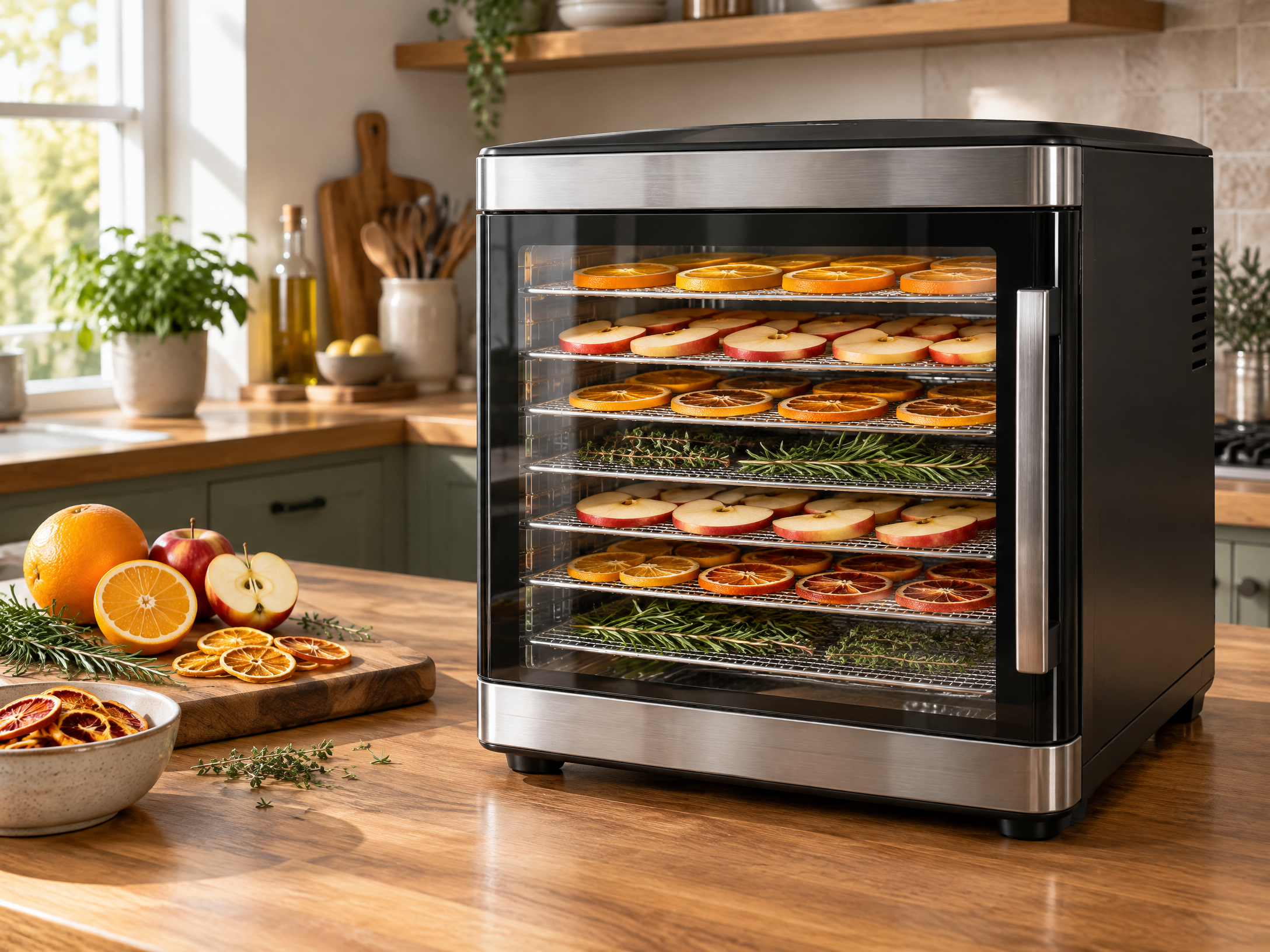
Purpose: Establish the article’s mixed-use, professional procurement context without implying a particular brand or model. Insertion point: Immediately below the short-answer block. English caption: A buyer-ready food dehydrator concept with separate fruit, herb and jerky loading examples. ALT text: Unbranded countertop food dehydrator with trays of fruit slices, herbs and jerky in a modern test kitchen. Detailed English AI image-generation prompt: Photorealistic editorial B2B product scene in a bright, modern test kitchen: an unbranded rectangular countertop food dehydrator with transparent door, rear-airflow-inspired cabinet geometry and multiple slide-in stainless-look mesh trays. Show three distinct trays with apple slices, herb sprigs and thin jerky strips, carefully separated. A procurement notebook, digital thermometer and sample tray sit nearby, but no readable text. Neutral white, charcoal and brushed-metal palette, soft daylight, clean professional composition, realistic food texture, no people, no trademarks, no logos, no readable labels, no certification marks, no watermark.
2. Factory temperature and airflow sample test
Purpose: Visualise measurable validation rather than feature-led sourcing. Insertion point: In Module 4, after the airflow test table. English caption: Engineering samples should be tested at defined shelf positions and representative tray loads. ALT text: Technician measuring temperatures inside an unbranded food dehydrator during a loaded tray test. Detailed English AI image-generation prompt: Photorealistic small-appliance factory laboratory scene: a quality engineer wearing plain light-grey lab coat and heat-safe gloves places thin probe leads into multiple shelf locations of an open, unbranded food dehydrator loaded with uniform fruit slices. On the bench are an unlabeled data logger with blank display, calibrated-looking probe accessories and a tray-position diagram with no legible text. Include a second closed sample in the background. Clean Shenzhen-style appliance test lab, realistic stainless benches and controlled lighting, documentary B2B photography, no visible company identity, no logos, no readable text, no certification marks, no watermark.
3. Instruction and sample-review workshop
Purpose: Show that manuals, controls and accessories are reviewed together before artwork lock. Insertion point: In Module 8, after the manual approval table. English caption: The instruction set should be reviewed against the actual controls, trays and electrical variant. ALT text: Sourcing team reviewing an unbranded food dehydrator sample, tray accessories and instruction layout. Detailed English AI image-generation prompt: Realistic B2B product-development meeting at a clean conference table beside a small-appliance sample room. Two diverse adult sourcing professionals, viewed from the side and back, examine an unbranded countertop food dehydrator, a fine mesh insert, a solid fruit sheet and a blank instruction-layout proof with deliberately unreadable placeholder lines. Show a voltage plug sample and colour chips without markings. Natural office light, restrained corporate style, detailed hands and materials, no brand names, no trademarks, no readable text, no certification symbols, no watermark.
4. Pre-shipment quality inspection image
Purpose: Support the final module’s shipment-release and traceability discussion. Insertion point: In Module 11, before the closing CTA. English caption: Pre-shipment checks compare production units, accessories and cartons with the approved specification. ALT text: Inspector checking unbranded food dehydrator cartons and accessories at a warehouse quality-control station. Detailed English AI image-generation prompt: Photorealistic warehouse quality-control scene: an inspector in a plain navy work jacket conducts a pre-shipment inspection of several unbranded boxed food dehydrators. One unit is open on a table with removable trays, mesh insert, power cord and blank instruction booklet arranged for count verification. Background contains sealed plain kraft cartons on pallets with blank labels and no readable markings. Include a clipboard with intentionally blurred or empty pages. Professional global sourcing atmosphere, accurate packaging details, no logos, no trademarks, no readable text, no certification marks, no watermark.
References
UZYVO inquiry
Next step for your sourcing team. Share your target market, product category, expected volume, and launch timing. UZYVO can help structure the next factory discussion around your final product brief, sample, documentation, and quality-control requirements.
Email: info@uzyvo.com
Put the buyer guide into a practical sourcing path.
Bring this framework into your next product brief.
Share your target market, appliance category, annual volume, and launch window. We will discuss a practical sample, documentation, and production path for the final configuration.
Email info@uzyvo.com