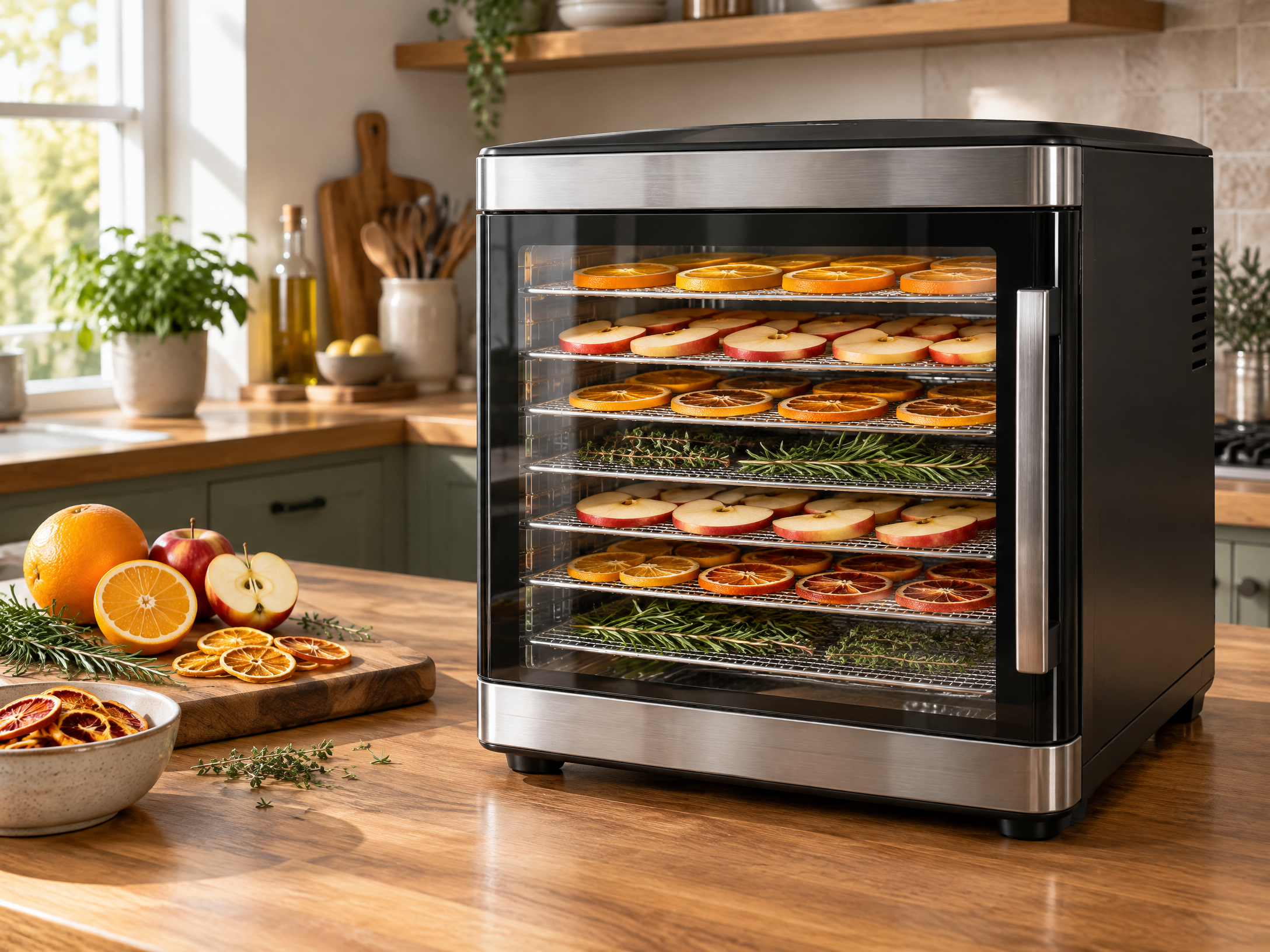
Target Keywords: food dehydrator digital controls; food dehydrator tray capacity; food dehydrator food contact compliance; small appliance electrical insulation test; small appliance dielectric strength test; small appliance temperature rise test; small appliance CB scheme
Direct answer: Validate a digitally controlled food dehydrator as a finished, market-specific configuration—not as a generic platform. Freeze the bill of materials, ratings, control firmware, tray stack, plug and labelling; then plan safety, temperature, dielectric/insulation, EMC, food-contact and production-control evidence against the applicable destination-market requirements. A passed bench check or a certificate for a similar model is useful input, but not proof for the final sellable unit.
A buyer assessing a dehydrator should separate two related jobs. Product planning decides airflow, recipes, interface and the user experience. Pre-production validation asks whether the released configuration continues to operate safely and consistently when its heater, fan, timer, display, trays, materials and mains supply interact. This guide addresses the second job. For airflow, operating ranges, instructions and broader product specification, see UZYVO’s food dehydrator specification guide.
The key discipline is configuration control. A new display board, a revised heating element, a different tray polymer, a plug change or a firmware update may alter the evidence a buyer needs. The appropriate test programme, acceptance criteria and regulatory path depend on the final configuration, intended use, supporting evidence and destination market. A qualified laboratory, regulatory adviser and the responsible economic operator should confirm market-specific applicability before launch.
1. Start with a configuration baseline, not a test wish list
The phrase food dehydrator digital controls can cover very different architectures: a mechanical thermostat plus display, a microcontroller with a relay, a touch panel with a switch-mode supply, or a connected appliance. Do not begin with “test the dehydrator.” Begin with a version-controlled description of exactly what will be tested and sold.
Build a configuration dossier that assigns a unique model identifier and records the following:
- rated voltage, frequency, input rating, plug, cordset and destination-market variants;
- enclosure, heater, fan motor, thermal cut-outs, fuse, wiring, power-supply board and earthing arrangement;
- controller board revision, display/touch-panel assembly, firmware version and programmed limits;
- tray count, tray geometry, material grades, food-contact surfaces and any accessories;
- labels, warnings, instructions, packaging and intended-use statements; and
- approved component list, drawings, critical suppliers and controlled change process.
This dossier turns a commercial sample into a traceable test article. It also prevents a common sourcing failure: the laboratory tests a prototype, while production uses a later board or material substitution. Require the supplier to identify every unit submitted, photograph its rating label and internals, preserve test specimens where practical, and link the report to the BOM and firmware version.
For EU electrical equipment within the directive’s voltage ranges, the Low Voltage Directive (LVD) applies to household appliances and the manufacturer remains responsible for the relevant conformity assessment; a voluntary certificate is not, by itself, the legal means of demonstrating EU compliance.[2] That does not mean every destination uses the same route. It means the buyer must name the market and final electrical variant before treating any report as reusable.
| Buyer decision | Evidence to request before testing | Why it matters |
|---|---|---|
| One global platform or regional variants | Ratings matrix by country, plug/cord drawings, differences register | A voltage, plug or component difference can change the assessed product. |
| Digital interface scope | Board schematic, firmware ID, control-state diagram, wireless declaration | It defines functional and EMC review questions. |
| Heated airflow configuration | Heater, fan, thermal-protection and air-path drawings | These items affect abnormal-operation and temperature assessment. |
| Food-contact assembly | Material list by tray, liner, handle and accessory | The buyer can match evidence to actual food-contact parts. |
2. Translate the destination market into a validation brief
A supplier’s test list should not be accepted without a market brief. State where the first shipment will be placed on the market, who is the importer or other responsible party where applicable, whether the appliance is mains-powered only, and whether it has radio functionality. Ask a competent lab to identify the currently applicable standards, editions, national differences and documentation route for that exact target.
For an EU mains appliance, LVD covers electrical equipment operating from 50 to 1,000 V AC or 75 to 1,500 V DC; the European Commission notes that references to harmonised standards published in the Official Journal can provide a presumption of conformity with the directive’s safety objectives.[2] The applicable standard set and its test conditions still require confirmation for the product and market. Digital electronics can also create EMC obligations: the EMC Directive addresses both emissions that could disturb other equipment and immunity to interference when used as intended.[3]
For the United States, do not assume that a European report answers every question. Digital logic commonly brings an appliance into the FCC’s description of an unintentional radiator, subject to the applicable Part 15 framework and any relevant exemptions; an added Wi-Fi or Bluetooth function changes the analysis further.[7] Separately, safety and food-contact pathways must be considered for the intended U.S. product. This is a planning observation, not a legal conclusion.
A clear validation brief should specify scope, test article, markets, requested standards/editions, supply conditions, operating states, sample quantities, report language, marking review and change-control triggers. It should also state what is deliberately outside scope. For example, a non-connected control panel should not be described as a wireless product merely because it has a display.
| Question for the lab or adviser | Buyer-ready answer |
|---|---|
| What final configuration is assessed? | Exact model, BOM, software, ratings and plug/cord variant. |
| What market is in scope? | Named country or region and planned placement date. |
| What does the report cover? | Test article, conditions, standard editions, deviations and verdicts. |
| What needs follow-up after a design change? | A written impact-assessment and retest decision process. |
3. Validate the control system as a safety-relevant function
A digital panel is not only a cosmetic feature. In a heated appliance, its commands can determine when energy is applied, how a timer expires and what happens after a supply interruption. The buyer should request a control-state matrix before sending samples to a laboratory. It need not expose supplier intellectual property; it should make the intended behaviour testable.
Include at least power-on, start, set-temperature change, timer change, pause, completion, user cancel, supply interruption and restoration. Add states for sensor open circuit, sensor short circuit or implausible reading if the architecture uses sensing. Document the expected display indication, heater command, fan command, audible signal if fitted, and reset or recovery behaviour. Confirm whether the appliance resumes automatically after a power interruption, and ensure the intended behaviour is reflected in the final instructions and risk review.
Treat firmware as a controlled component. Record the executable version, checksum or another meaningful identifier; retain the release note; and prohibit production flashing from an unapproved image. If the supplier can revise a parameter such as maximum setpoint, timer limit or sensor offset, identify who may authorize it and how the change is recorded. A firmware update can invalidate an earlier functional assessment even when the PCB revision is unchanged.
Functional validation is not a substitute for the safety standard’s required test sequence, nor should a factory engineer self-declare a safety conclusion. It is a buyer acceptance layer: run the released interface through representative operating states, compare actual behaviour to the approved state matrix, save evidence and escalate deviations. IEC 60335-1 is the general safety standard for household and similar electrical appliances within the IECEE system; its country and national-difference information should be checked with the relevant national certification body rather than assumed.[1]
4. Plan insulation and dielectric checks as part of the complete safety assessment
A small appliance electrical insulation test is not a single universal pass/fail ritual. It concerns whether insulating systems and separation between hazardous live parts, accessible parts and other circuits are suitable under the applicable requirements and test conditions. The correct procedure, test points, voltage, duration and acceptance criteria come from the applicable standard and the laboratory’s method—not from a generic buyer spreadsheet.
The buyer’s role is to make the product intelligible to the test team. Supply a wiring diagram, PCB layout or assembly drawing as needed, insulation-system details, heater and motor data, protective-device specifications and photographs of routing, terminations and strain-relief. Call out line-voltage tracks near low-voltage control circuits, terminals behind the display, conductor passage through heated zones, wire sleeving and any adhesive, grommet or barrier that contributes to separation.
The small appliance dielectric strength test should similarly be requested against the correctly identified standard and final build. It is not a durable substitute for good clearance, creepage, insulation selection, assembly control or change management. Ask the laboratory to identify the test specimen, relevant circuits and any preconditioning or test sequence that affects its result. If a report lists a variant, verify that the power board, heater, wiring harness, mains lead, enclosure and protective features are within that report’s documented scope.
Production checks may complement type testing, but they do not automatically replicate it. Define which routine electrical checks will be performed on each production unit or on a justified sample, who maintains the equipment, how calibration is controlled, what results are recorded and what happens after a failure. The production instruction must protect operators and prevent a routine check from being represented as complete market-access evidence.
5. Evaluate heat, airflow and loaded-tray conditions together
The small appliance temperature rise test must represent the finished appliance’s intended operating configuration, as directed by the applicable requirement. Buyers should not prescribe a universal setpoint or acceptance temperature in a purchase order. Instead, ask the lab to document supply conditions, ambient conditions, operating mode, stabilization approach, thermocouple locations where applicable, tray arrangement, load or no-load condition and any abnormal or fault conditions required by the identified standard.
Here, food dehydrator tray capacity becomes a validation variable rather than a catalogue number. A claim such as “five trays” does not establish the loading arrangement used in test, nor does it tell the test team whether added tray height, tray density or accessory geometry changes airflow around the heater, motor or thermal protector. If the product will be offered with an expansion stack or multiple tray variants, have the supplier declare compatible combinations and ask the competent evaluator whether each is within the assessed configuration.
Review the likely temperature-sensitive locations without predetermining outcomes: accessible surfaces, handle areas, tray supports, enclosure adjacent to the heater, wiring and connectors near hot zones, control board, thermal protection, motor area and mains lead entry. The control system also belongs in this review. A sensor position, firmware limit or fan failure response can change how heat is managed.
A useful evidence package includes lab observations, photographs or diagrams locating sensors where available, the exact tray stack, the control settings used, report conclusions and records of corrective actions. Avoid converting a single result into a broad performance claim. A passed temperature assessment for one configuration does not demonstrate drying uniformity, food safety outcomes or suitability for a different load, market or future revised design.
6. Link digital controls to EMC, power quality and failure behaviour
The controller, display board, switch-mode supply, relay/triac, fan motor and harness form an electrical system. Screen display flicker, resets, unexplained heater commands or a frozen interface may be quality issues; depending on circumstance, they may also need review within the relevant safety and EMC assessment. The EU EMC framework requires equipment to limit electromagnetic disturbance and to have adequate immunity when used as intended.[3]
Before formal testing, request an engineering review of grounding, cable routing, filtering, switching components, suppression parts, board spacing and enclosure shielding where applicable. It is not an invitation to redesign after every sample anomaly. It is a structured way to identify what changed and to decide whether formal retest or specialist assessment is needed. Capture the chosen power supply and firmware revision, because both can affect conducted or radiated behaviour.
Test planning should cover intended modes rather than only a default screen: heating at a representative setting, fan operating, display active, timer transitions and any wireless functionality enabled when relevant. During immunity-related observations, define what counts as an acceptable response—for example, a temporary display disturbance versus an unsafe output state—and how recovery is verified. The applicable test methods and verdicts belong to the identified standards and competent lab.
Need a configuration-review starting point? Send your product brief, target market and current BOM to UZYVO’s team. We can help structure questions for a supplier discussion; final compliance and test applicability require qualified review for the specific product and destination.
For a connected model, distinguish an appliance’s control-function testing from radio authorization, data/privacy obligations and cybersecurity expectations. Those topics may each require separate expert review. For a non-connected digital product targeted to the U.S., the FCC explains that many products using digital logic are unintentional radiators and that the applicable equipment-authorization procedure depends on device classification.[7]
7. Keep food-contact evidence tied to the actual trays and accessories
Food dehydrator food contact compliance should be handled as a material-and-use evidence task, not as a generic “food-grade” assertion. Identify every part that reasonably contacts food in normal use: trays, mesh inserts, liners, fruit-roll sheets, covers, containers, removable accessories and any coating or colorant used on those components. Record material grade, supplier, part number, intended food-contact conditions and destination market.
In the EU, food-contact materials must comply with the framework Regulation (EC) No 1935/2004 when placed on the market, and must be made under applicable good manufacturing practices; specific Union rules apply to some material groups, with national rules for others.[5] In the United States, FDA describes food-contact substances as including food-preparation surfaces and processing equipment, and notes that an applicable food additive use needs authorization before marketing.[6] Neither overview turns a supplier declaration into a universal approval.
Ask for material declarations, relevant compliance declarations, test reports where appropriate, traceability information, supplier identity and intended-use restrictions. Then match them to the final part and foreseeable exposure: food type, time, temperature, repeated use and cleaning instructions. Do not assume a declaration for a raw resin covers an altered formulation, recycled content, masterbatch, coating, adhesive or finished tray without evidence showing the relevant identity and use conditions.
Keep this work connected to heat validation. A tray material may be acceptable only under stated conditions, while its actual use near heated air depends on the product configuration. The buyer should avoid legal conclusions such as “FDA approved” or “EU certified” unless the qualified responsible party can substantiate the exact statement.
8. Use the CB Scheme strategically, without calling it a global passport
A small appliance CB scheme strategy may reduce duplicated evaluation effort, but it does not erase national differences or local marks, documentation and market obligations. IECEE describes the CB Scheme as an international system for mutual acceptance of test reports and certificates for electrical and electronic components, equipment and products, involving participating countries and accepted national certification bodies.[4]
For a multi-market project, ask whether a CB Test Certificate and CB Test Report are appropriate for the final model, and have the chosen national certification body or destination-market expert confirm what it will recognize and what national differences, deviations, samples or follow-on actions apply. The product description must be exact. A report for a related heater or control board may support component evaluation, but it does not automatically cover the finished dehydrator.
| CB-related buyer question | Good evidence or action | Avoid |
|---|---|---|
| Is the destination within a relevant recognition route? | Written confirmation from the appropriate certification body or market expert | Assuming every country accepts every report unchanged |
| Does the report cover the finished model? | Model list, ratings, photos, BOM/critical components and report scope | Matching only by product appearance |
| Are national differences addressed? | A documented gap review for each target market | Treating an IEC report as the full national approval |
| What happens after a change? | Change notice and impact assessment agreed before implementation | Silent substitutions after report issue |
The value of this process is traceable evidence and clearer conversations with certification bodies—not a promise of approval or time-to-market. Maintain the report, certificate, national addenda if any, marking artwork, instructions, declarations and change records together in the technical file.
9. Build validation gates into sampling and production release
The best pre-production plan creates decisions, owners and stop points. It does not simply accumulate reports. Use stages such as engineering sample, compliance sample, pilot run and production release, each with a named configuration and a clear rule for moving forward. The supplied factory-capability evidence and inspection methods should be reviewed alongside the product’s control plan; see UZYVO’s factory capabilities for the questions a buyer can use to structure that discussion.
At engineering-sample stage, verify the control-state matrix, assembly drawings, component approvals and intended configuration. At compliance-sample stage, lock the test article and submit the complete dossier. At pilot stage, compare line-built units with the assessed construction: PCB version, programmed firmware, heater, fan, thermostat/thermal protection, wiring, tray material, label and packaging. At release, confirm that deviations are closed or formally dispositioned by the responsible technical and commercial stakeholders.
| Gate | Buyer acceptance question | Hold point if unclear |
|---|---|---|
| Design freeze | Are BOM, firmware, ratings and materials version-controlled? | Any undocumented substitution or untracked software. |
| Lab submission | Is the test sample traceable to the supplied dossier? | Incomplete model/variant or market scope. |
| Pilot build | Does line-built construction match the assessed configuration? | Component, routing, program or tray-material mismatch. |
| Shipment release | Are required records, labels and corrective actions reviewed? | Open safety-critical or market-access questions. |
Supplier quality records should identify who inspected what, under which work instruction and with what calibrated equipment. They should not be treated as independent proof that every legal or standard requirement has been met. A pre-shipment inspection can confirm agreed observable attributes of a production lot; it cannot recreate all type tests or settle destination-market compliance. For broader buyer questions, the UZYVO FAQ is a useful starting point.
Buyer FAQs
Should a buyer repeat all safety testing after a firmware update? Not automatically, but never presume “no impact.” First compare the released firmware with the assessed version and review whether it changes heater control, timing, fault response, interface behaviour, power states or EMC-relevant operation. Obtain a documented impact assessment from the appropriate technical and compliance parties; they should determine whether targeted testing, full retest or no retest is justified.
Can tray count be changed after a report is issued? Only after determining whether the revised stack, geometry, airflow, materials and instructions remain inside the report’s scope and the destination-market requirements. More or different trays can change the tested configuration. Preserve the original evidence and obtain written confirmation or additional assessment as appropriate.
Does a CB report mean the product can be CE marked or sold everywhere? No. The CB Scheme is a mutual-acceptance system that can facilitate national certification work, not a universal market-access guarantee.[4] In the EU, CE marking follows the conformity-assessment procedure under the applicable legislation; the Commission specifically warns that voluntary certificates are not themselves recognized proof of conformity under EU harmonisation legislation.[2]
Can one food-contact declaration cover every market? Not safely by assumption. Evidence must be checked against the actual material, finished part, intended use and market. EU and U.S. frameworks differ, and additional national or material-specific requirements may apply.[5][6]
10. Specify the evidence pack and make it usable after launch
Ask for a controlled electronic evidence pack before production release, organized by model and revision. It should contain the approved specification, drawings, BOM, change log, firmware identifier, component criticality list, final labels and instructions, test reports, food-contact records, market-specific declarations or certificates where applicable, calibration records for relevant routine checks, pilot/inspection reports and corrective-action history.
Create an evidence index with columns for document title, revision, issue date, model/variant, market, owner, source, expiry/review date if relevant and linked change notice. This simple register makes it easier to answer a retailer, marketplace, customs, market-surveillance or incident inquiry without reconstructing the product from email attachments. Limit access to confidential design data while keeping decision-makers able to verify scope.
Three contextual visuals can help a buyer use this guide without suggesting that a particular factory or product has passed a test:
- Purpose and insertion point: After Module 1, show configuration control. Caption: “A validation dossier links the test sample to the final rated, programmed and labelled appliance.” ALT: “Engineer comparing a food dehydrator bill of materials, circuit board revision and rating label.” AI image prompt: “Photorealistic B2B product-validation scene in a clean small-appliance engineering office, unbranded digital food dehydrator beside a controlled BOM sheet, circuit board revision tag and rating-label mock-up, neutral lighting, no readable brand logos, no safety-pass claims.”
- Purpose and insertion point: After Module 5, explain test configuration. Caption: “Test conditions should identify the installed tray stack, control setting and measured configuration.” ALT: “Laboratory technician documenting tray arrangement on a food dehydrator during a monitored evaluation.” AI image prompt: “Realistic independent appliance laboratory scene, technician in appropriate lab attire documenting an unbranded food dehydrator with stacked trays and external measurement leads, neutral equipment, no visible result screens or certification marks, editorial technical photography.”
- Purpose and insertion point: Before Module 10, reinforce release records. Caption: “A production-release file connects controlled parts, firmware and evidence to the shipped model.” ALT: “Quality manager reviewing controlled digital records beside boxed unbranded food dehydrators.” AI image prompt: “Professional factory quality-control office, quality manager reviewing a revision-controlled digital checklist beside plain unbranded food-dehydrator cartons, clean organized environment, no logo, no factory-capacity or compliance claims, realistic documentary style.”
11. Conclusion: buy validation evidence for the released configuration
A digitally controlled dehydrator should be validated as an integrated heated appliance, not as a collection of separately “approved” parts. Freeze the final configuration first; turn the destination market into a scoped validation brief; assess control behaviour, insulation/dielectric considerations, temperature conditions, EMC and food-contact evidence; then use a disciplined pilot and change-control process to protect that evidence through production.
The most useful buyer question is not “Does the supplier have a certificate?” It is “What exact model, electrical variant, firmware, tray system, material set, market and conditions does this evidence cover?” That question keeps a commercial programme anchored to traceable facts and exposes where qualified review is still required. It also respects the boundary between pre-production validation and the separate work of selecting airflow, recipes and overall product features.
Ready to organize a market-specific validation brief? Share your target countries, proposed model configuration and desired launch sequence with info@uzyvo.com. UZYVO can help structure supplier and documentation discussions; final requirements and conformity decisions must be confirmed for the finished product and destination market.
References
Put the buyer guide into a practical sourcing path.
Bring this framework into your next product brief.
Share your target market, appliance category, annual volume, and launch window. We will discuss a practical sample, documentation, and production path for the final configuration.
Email info@uzyvo.com