Target Keywords: coffee grinder grind settings; coffee grinder retention specification; coffee grinder static control; coffee grinder hopper capacity; coffee grinder motor specification; coffee grinder food contact compliance; small appliance pre compliance testing
Direct answer: Validate a grinder by converting each commercial statement—retention, static, hopper size, motor capability, usable settings, and material suitability—into a written method with a defined sample, coffee, environment, operator sequence, measurement, and acceptance rule. Compare like-for-like evidence from the exact proposed configuration rather than a supplier’s generic demonstration. Then hold the approved configuration through change control, destination-market review, and production inspection. A test result is meaningful only for the configuration and conditions it actually represents.
A coffee grinder can look highly comparable on a quotation while differing substantially in adjustment geometry, burr assembly, chute, hopper, motor control, removable parts, and regional electrical build. For a private-label buyer, the central problem is not choosing a burr over a blade platform—that purchasing decision is addressed in UZYVO’s burr vs. blade coffee grinder private-label guide. It is deciding whether the proposed grinder’s measurable behavior and material documentation support the intended brief.
This guide provides an evidence-led sourcing workflow. It does not certify a grinder, set universal acceptance limits, or promise a performance outcome. Final suitability depends on the final bill of materials (BOM), burr and chute geometry, electrical variant, controls, accessories, claim wording, destination market, and qualified review of the supporting evidence.
1. Establish the validation boundary before requesting samples
Start with a one-page validation charter. Its purpose is to stop a quotation-stage descriptor—such as “low retention,” “anti-static,” “large hopper,” or “powerful motor”—from becoming an untestable expectation later. The charter should name the SKU, model revision, intended consumer, brewing methods, target destination, plug and voltage variant, optional accessories, pack-out, proposed claims, and the decisions the evidence must support.
The buyer should first decide what is being validated. A grinder positioned for single-dose workflow raises different questions from a family countertop grinder that stores beans. A range that is described through coffee grinder grind settings must also state what those settings are expected to cover: for example, an agreed reference use case and adjustment range, not an unsupported promise that every setting produces a defined beverage result.
Use a claim-to-evidence matrix before the first formal sample:
| Buyer question | Evidence to request | Decision owner | What changes invalidate the evidence? |
|---|---|---|---|
| Does the adjustment mechanism cover the intended use case? | Setting map, agreed reference coffee and sample-grind records | Product and quality | Burrs, carrier, adjustment thread, calibration point |
| Is retained coffee acceptable for the workflow? | Controlled-dose mass-balance record and test photos/video | Product and quality | Chute, declumper, burr set, grounds bin, cleaning method |
| Is static manageable under defined conditions? | Observation log, collection-area photos, ambient conditions | Product and industrial design | Chute material, grounding, coatings, ionizer or dosing accessory |
| Does the hopper fit the intended consumer proposition? | Dimensional drawing, filled-volume demonstration, material declaration | Product and packaging | Hopper geometry, lid, material, bean profile assumption |
| Is the electrical build appropriate for the launch region? | Final electrical BOM, applicable evidence and labels | Compliance owner | Motor, PCB, cord, plug, switch, rated voltage |
A statement without a method belongs in an exploration column, not an approved specification. Record any supplier-side test as supplier evidence, including its limits, rather than treating it as independent verification. This simple distinction makes later technical, commercial, and regulatory decisions more defensible.
2. Turn the consumer proposition into a controlled product brief
The useful product brief connects a consumer action to an observable product response. “Espresso capable,” “low mess,” or “easy to dial in” may be marketing directions, but they are not release criteria until decomposed. Specify the reference coffee or a defined bean class, roast range if relevant, conditioning approach, dose, grinder preparation, adjustment position, output collection method, and the target observation.
For coffee grinder grind settings, avoid defining quality through the setting count alone. The count may describe a user interface but does not by itself establish particle distribution, repeatability, or suitability for a brewing method. Instead, agree an adjustment-range map: identify the physical zero/reference point, the direction of adjustment, increments or positions, the intended reference windows, and how the unit returns to a selected position after normal use. If the supplier uses a calibration convention, capture it in the sample record; do not assume another production unit shares it without validation.
A practical brief separates three types of requirement:
| Requirement type | Example wording | Evidence that makes it usable |
|---|---|---|
| Design input | “Grounds should enter the supplied cup with minimal scatter.” | Agreed collection setup, observation criteria, photos |
| Measurable characteristic | “Mass retained after the defined sequence will be recorded.” | Written mass-balance method and raw data |
| Conditional claim | “Claim language may be considered after evidence review.” | Final configuration, method, result, claim/legal review |
Attach a configuration manifest to every sample: model code, revision, burr type and material, motor and control board identifiers, hopper and chute materials, voltage/frequency, plug, firmware if applicable, and the date assembled. Ask for component revision identifiers, not merely a product name. The manifest enables a buyer to identify whether a test sample and a pre-production sample are actually comparable.
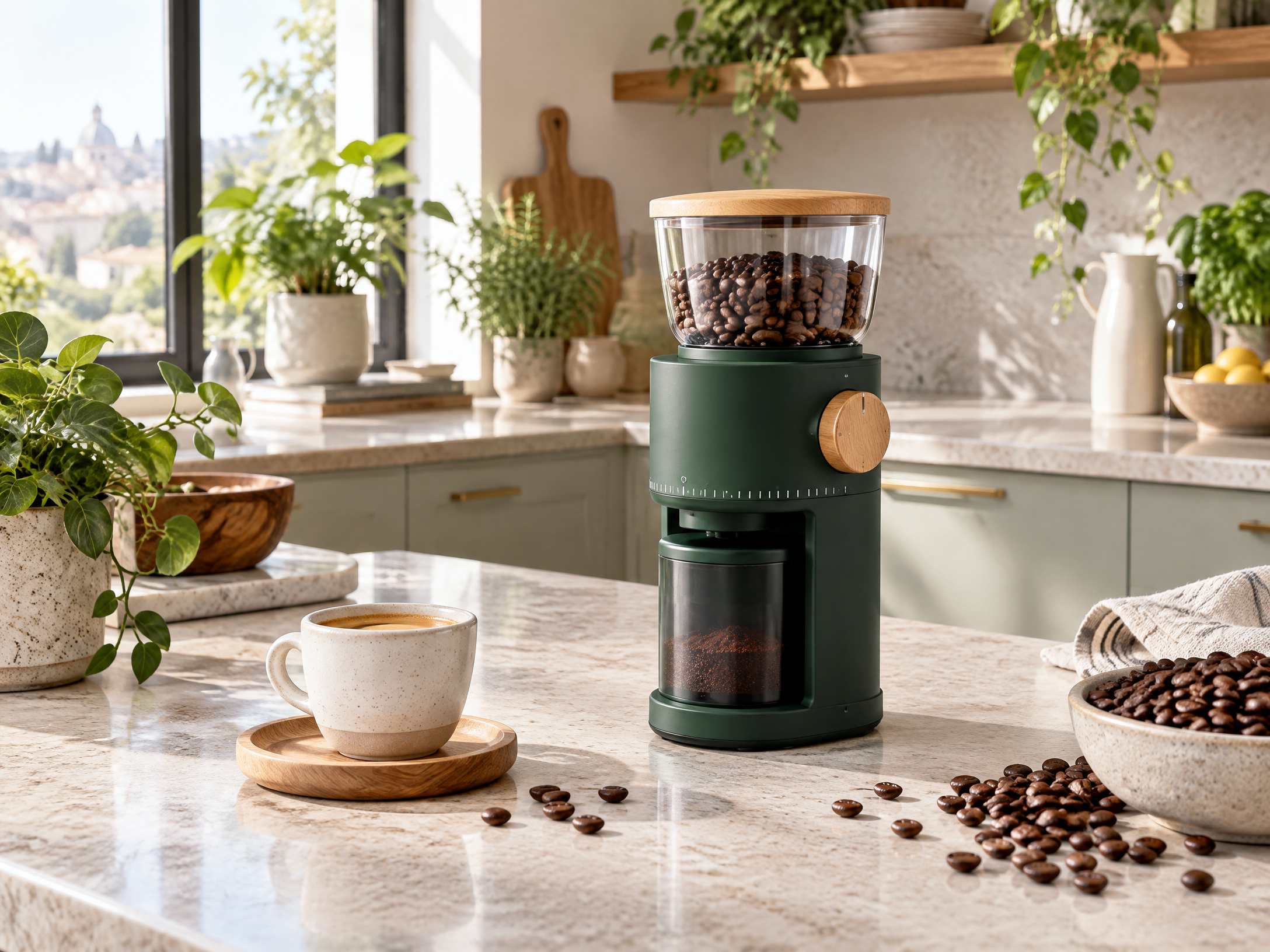
The UZYVO BrewMill conical-burr coffee grinder platform illustrates the correct sourcing direction: agree the burr set, adjustment mechanism, hopper, chute, grounds container, motor, cord, plug, target market, and sample-calibration brief before treating any performance statement as commercially usable.
3. Define a coffee grinder retention specification as a mass-balance method
A coffee grinder retention specification should describe a repeatable measurement process, not a headline number. “Retention” can mean coffee remaining after a dose, coffee later released into the next dose, grounds left in a removable cup, or all coffee not recovered at a chosen point in the process. Each definition can produce a different result. Buyers should therefore say precisely which mass is in scope.
A basic comparative protocol can use an input mass and a recovered-output mass, recorded on the same suitable scale. Before test, document the machine’s initial state: new, cleaned, purged, or already seasoned according to an agreed sequence. Record the coffee identity, lot, bean condition, dose, setting, operator actions, collection vessel, time window, and whether tapping, bellows, brushing, or purging is permitted. Then calculate and retain the raw figures; do not rely on a selectively rounded demonstration result.
| Protocol decision | Why it affects interpretation | Buyer instruction |
|---|---|---|
| Initial grinder condition | Residual coffee can alter the first result | State clean/purged/conditioned state and repeat sequence |
| Coffee and dose | Bean properties and dose size can affect flow | Use the agreed reference coffee and recorded dose |
| Setting and adjustment movement | Geometry and movement may change flow | Identify the exact setting and movement direction |
| Allowed operator actions | Tapping or bellows can change what is collected | Permit, prohibit, or separately report each action |
| Collection boundary | Grounds in cup, chute, bin, or outside area may be counted differently | Define the mass boundary and photo record |
| Repeats | One run can be an outlier | Run the agreed number of repetitions and retain each result |
Consider two related measures: immediate mass difference after the planned dose and carry-over into a subsequent defined dose. Label them separately. The latter can be relevant where the brand wants to understand dose-to-dose transfer, but it must never be presented as a universal consumer outcome.
Use this protocol to compare candidate samples, not to manufacture certainty. Scales, moisture, ambient conditions, operator technique, cleaning, and component variation can influence outcomes. If a buyer needs a performance claim, an appropriate technical or legal reviewer should assess whether the final method, evidence, configuration, and destination-market rules support that claim. Maintain the test worksheet and sample photos with the approved product file.
4. Test coffee grinder static control as an observed behavior, not a label
Coffee grinder static control is often discussed as if it were a single component feature. In practice, grounds behavior can be influenced by coffee condition, ambient environment, grind setting, burr/chute path, materials, collection vessel, operator handling, and cleaning state. A supplier can show a tidy demonstration without proving that the same result will occur across all coffee and environmental conditions. The buyer’s job is to define a useful, limited comparison.
Build a static observation log with fields for date, ambient temperature and relative humidity if measured, coffee identification, dose, setting, machine state, collection vessel, and operator actions. Add a simple agreed visual classification for grounds adhering to the chute, body, lid, cup exterior, or surrounding work surface. Photos from consistent camera positions are more useful than a claim that a unit is “mess-free.” If a mitigation feature is proposed—such as a revised chute, grounded element, coating, or accessory—test the baseline and proposed configuration under the same planned sequence.
A buyer should also distinguish between product behavior and cleaning experience. Grounds that remain inside a removable bin may be acceptable for one positioning but unacceptable where users are expected to dose directly into a narrow accessory. Make acceptance criteria workflow-led. Ask: Where must grounds land? Which surfaces may require wiping? What normal intervention may a user perform? How will the manual describe cleaning safely? This produces a more actionable result than asking whether the grinder is “anti-static.”
Do not extrapolate a controlled demonstration into a broad marketing promise. Static observations are supporting evidence for product design and user-experience decisions, not a substitute for claim substantiation. Retest when the defined grounds path, material, burrs, or collection accessory changes.
5. Size coffee grinder hopper capacity around the intended workflow
Coffee grinder hopper capacity should be specified in more than one way. A nominal volume can be useful for engineering fit, while a bean mass can be more intuitive for the sales proposition. Neither should be published as a generic result without defining the hopper, lid, bean type or density assumption, fill boundary, and whether the grinder is intended to retain beans in the hopper between uses.
For procurement, request a dimensional drawing and a defined fill demonstration. The method should identify the hopper revision, fill line or physical boundary, coffee used, lid state, and whether beans bridge or feed normally during the demonstration. It should also clarify whether a stated capacity includes the throat or only the visible container. A transparent hopper adds visual merchandising questions, whereas an opaque hopper may direct attention toward durability and fill guidance; neither is automatically better.
| Workflow | Hopper brief questions | Validation focus |
|---|---|---|
| Single-dose or frequent bean changes | Is a hopper needed, and does it support controlled loading? | Loading, removal, bean change and grounds-path cleanliness |
| Household shared use | How many preparation events should one fill support? | Fill boundary, feed behavior, lid fit and consumer handling |
| Retail coffee set | Does the visual silhouette align with accessory and packaging choices? | Dimensional fit, accessory clearance and pack-out |
| Subscription or roaster program | Will the hopper direction match the proposed coffee format and instructions? | User guidance, label/manual consistency and final claim review |
Food-contact considerations apply to the surfaces intended to contact beans or grounds, including the hopper, lid, grounds container and potentially the burr path. In the EU, food-contact materials placed on the market must comply with Regulation (EC) No 1935/2004 and good manufacturing practice requirements; material-specific requirements can also apply.[1] In the United States, FDA describes food-contact substances as including food preparation surfaces and processing equipment, with intended use central to the regulatory framework.[2] This is why “food-grade plastic” alone is not a sufficient buyer record.
6. Make the coffee grinder motor specification testable and market-specific
A coffee grinder motor specification should begin with the exact electrical design rather than an isolated wattage figure. Record the motor type, rated input information, voltage and frequency version, control components, thermal or overload provisions where applicable, switch, cord, plug, and the intended duty or operating sequence as defined by the product brief. The supplier should identify the component revisions represented by the sample.
Do not infer grinding quality, noise, life, or safety solely from a nominal power value. Compare motor-related evidence in the same configuration and under the agreed functional sequence. A useful buyer worksheet records starting behavior, expected operating sequence, adjustment and burr state, any observed interruption, user-facing controls, and post-test condition. It is a tool for technical comparison and sample approval, not a replacement for the applicable safety evaluation.
For EU electrical equipment within the relevant voltage range, the Low Voltage Directive framework assigns conformity-assessment, technical-documentation, declaration, marking, and information obligations; the final product’s scope and compliance route must be confirmed for the actual electrical version and market.[3] The EU EMC Directive addresses both emissions and immunity for electrical and electronic equipment when placed on the market.[4] These frameworks make it risky to treat a test on one cord, plug, motor control board, or voltage version as evidence for another.
Mid-article CTA: Send UZYVO your target market, grinder configuration, and draft validation questions for a structured sourcing discussion: info@uzyvo.com.
If the product includes an electronically controlled motor or other electronic content, obtain the relevant BOM and declaration trail early. For EU-bound EEE, RoHS restricts specified hazardous substances, subject to its scope and exemptions; the Commission notes that electrical and electronic products with a component are generally within scope unless specifically excluded.[5] A qualified reviewer should determine applicability to the final model. Retain supplier declarations and supporting records as part of the component file; do not turn a general declaration into an unsupported product-level conclusion.
7. Use staged samples and small appliance pre compliance testing to reduce rework
Small appliance pre compliance testing is a risk-reduction activity before formal release, not a certification outcome and not a substitute for market-access analysis. Its practical value is finding configuration gaps early: an unclear rating label, a regional cord mismatch, incomplete instructions, a material declaration gap, an unexpected control behavior, or a component change that needs evidence review.
Stage validation so that each sample has a defined job:
| Stage | Buyer objective | Typical controlled outputs |
|---|---|---|
| Concept/engineering sample | Confirm that the brief is physically represented | Configuration manifest, key dimensions, initial method feasibility |
| Functional validation sample | Compare retention, static, setting behavior, hopper and controls | Raw records, photos, deviations, proposed updates |
| Compliance-review sample | Check the destination version is ready for the intended evidence route | Electrical BOM, labels, instructions, declarations, test plan |
| Pre-production/golden sample | Lock the approved product reference | Signed configuration, change-control trigger list, inspection points |
| Production surveillance | Verify the approved reference has not drifted | Traceability, agreed functional checks, packaging and document review |
The General Product Safety Regulation requires economic operators in the EU to make only safe products available, and its safety assessment considers design, technical features, composition, packaging, instructions, foreseeable use, and other relevant aspects.[6] It also says manufacturer technical documentation should be based on an internal risk analysis and contain information necessary to demonstrate safety.[6] For a brand owner, that supports a disciplined document trail, but it does not mean a generic sample test automatically establishes market conformity.
Create a deviation register. Each issue should state the sample identifier, observed condition, agreed requirement, evidence location, owner, proposed correction, verification method, and closure decision. An unresolved difference—such as changed chute material or motor control board—should not disappear into email. It is a reason to reconsider whether previous evidence still represents the intended final configuration.
For more broadly applicable process controls, review UZYVO’s factory capabilities and align the validation plan with incoming-part, in-process, finished-goods, packaging, and traceability checks. The inspection plan can confirm agreed observable conditions; it cannot replace performance validation or a competent regulatory assessment.
8. Build coffee grinder food contact compliance into the BOM, not the artwork phase
Coffee grinder food contact compliance should be a materials-and-intended-use workstream. First map the food-contact path: bean hopper, lid, feed throat, burrs, internal carrier surfaces that contact beans or grounds, chute, declumper, grounds container, dosing cup, seals, and any cleaning brush where relevant. Then map each part to material, grade, colourant or additive information where relevant, supplier, part number, manufacturing process, and intended contact conditions.
Request declarations and supporting evidence that are specific enough to evaluate the proposed material and use. The right form and evidence depend on the destination market and material. For example, EU requirements describe food-contact materials broadly and note specific Union legislation for certain materials such as plastics and ceramics, alongside national rules for other materials.[1] FDA similarly frames the analysis around the particular substance and intended food-contact use.[2] Do not accept a vague statement as a universal passport across all markets.
A buyer material file can contain the following:
- a food-contact map linked to the final BOM and drawings;
- supplier declarations identifying the part, material, intended use, and relevant destination market;
- evidence or test reports where called for by the applicable material and market framework;
- a change-control requirement for resin, masterbatch, additive, metal grade, coating, adhesive, seal, or food-path geometry changes;
- cleaning, care, and use instructions checked against the proposed materials and intended use; and
- a reviewer’s conclusion on what the available documentation does and does not support.
Treat high-temperature or unusual uses cautiously. A domestic grinder normally contacts dry food materials, but a buyer must still evaluate its own actual configuration and foreseeable use. Contact surfaces should not be assumed equivalent merely because they have similar appearance. The final product team, importer, and qualified advisers should determine applicable requirements and the adequacy of evidence for the final configuration and destination market.
9. Control the evidence pack, claims, and production changes
Evidence loses value when its relationship to the sold product is unclear. Give each file a controlled identifier and link it to the SKU/version. The release pack should index: approved brief; drawings; BOM; sample manifests; setting map; retention and static records; hopper method; motor/electrical information; food-contact map and declarations; labels; instructions; destination-market review; approved claims; inspection plan; and change log.
Claims need a separate approval gate. “Low retention,” “static control,” “large capacity,” and “precision settings” can be attractive shorthand, but the permitted wording should follow the evidence that the final configuration actually supports. Review advertising, retailer, packaging, and manual language together. If retail photography shows an accessory or hopper use not contained in the approved pack-out, correct it before release.
A compact change-control matrix is useful:
| Change | Re-open which evidence? | Minimum decision before release |
|---|---|---|
| Burr set, carrier, adjustment mechanism | Setting map, retention record, functional comparison | Determine whether samples and claims remain representative |
| Chute, declumper, grounds bin or coating | Retention/static observation and cleaning review | Re-test comparative workflow as agreed |
| Hopper resin, colour, lid or food path | Food-contact file and fit demonstration | Obtain revised material evidence and review |
| Motor, PCB, switch, cord or plug | Electrical/compliance assessment, labels and instructions | Confirm destination-version evidence route |
| New destination market | Full market-access, language, documentation and claims review | Qualified approval before sale |
Maintain traceability through production, but do not portray a routine inspection as proof of all performance or compliance. Inspection can check identity, workmanship, assembly, packaging, labelling and agreed functional points. It cannot validate a claim outside the scope of its method. This distinction protects both the buyer and the eventual consumer proposition.
10. Buyer FAQs
How many coffee grinder grind settings are enough for a private-label brief?
There is no universal number. Begin with the intended brewing workflow and user interface, then define an adjustment map and agreed reference checks. A setting count alone does not demonstrate grind uniformity, repeatability, or suitability for a specific beverage. Capture the final adjustment hardware and calibration convention in the approved sample record.
Is a supplier’s low-retention video enough to approve a coffee grinder retention specification?
No. It can be useful exploratory evidence, but approval should rest on a written method that identifies coffee, dose, setting, initial condition, operator actions, collection boundary, repeats, raw measurements, and sample configuration. Determine whether the video represents the final configuration before relying on it for product or claim decisions.
Can anti-static wording be used after one clean demonstration?
Not safely as a broad conclusion. Static and grounds scatter may depend on conditions and product configuration. Record the observation conditions, compare the proposed production configuration, and have claim wording reviewed against the actual evidence and destination-market expectations.
What documents should accompany food-contact components in a grinder?
Start with a mapped final BOM, supplier declarations tied to identifiable parts and intended use, and supporting evidence required by the applicable market/material framework. The EU and U.S. frameworks differ in structure; verify the final destination and product configuration with qualified reviewers rather than accepting a generic “food-safe” statement.[1][2]
11. Make the sourcing decision from a configuration-controlled evidence package
A sound decision uses a frozen commercial proposition, measurable requirements, a controlled method, comparative evidence, closed deviations, and change control.
Use the final decision table before issuing a purchase order:
| Decision gate | Release only when… | Hold or re-open when… |
|---|---|---|
| Product brief | Workflow, settings, hopper, motor and accessories are clear | Consumer proposition is still a slogan rather than a requirement |
| Functional evidence | Retention/static/hopper records use the agreed method | Sample, coffee, method or configuration is not identified |
| Materials | Food-path map and market-relevant records are reviewed | Part/material or intended-use information is missing |
| Market readiness | Final destination version and documents have been assessed | Voltage, plug, electronics, labels, instructions, or market changes |
| Production control | Golden sample, BOM, inspection points and change process align | An unreviewed component or process change is proposed |
Validate the coffee grinder as a system, not a string of sales descriptors. Link retention, static, hopper behavior, motor configuration, food-contact materials, and market preparation to the final configuration and destination market. Re-open evidence when that configuration changes.
Closing CTA: Need a coffee-grinder validation brief that connects sample evidence, final configuration, and sourcing controls? Email info@uzyvo.com with your target market and proposed platform. For recurring procurement questions, visit the UZYVO buyer FAQ.
AI Image Recommendations
- Purpose: Show the evidence-led sample-validation process without implying a specific test result. Insertion point: After Module 3. Caption: “A controlled grinder validation setup documents sample configuration, coffee dose, collection vessel, and raw measurement records.” ALT text: “Coffee grinder, scale, collection cup, coffee beans, and a validation worksheet on a test bench.” AI image prompt: “Photorealistic B2B product-validation bench for a domestic burr coffee grinder: neutral studio light, grinder with an unbranded hopper, digital scale, dosing cup, labelled coffee-bean container, clipboard with blank test fields, clean factory laboratory setting, no logos, no legible proprietary data, no performance claims.”
- Purpose: Explain the food-contact path and BOM-review conversation. Insertion point: After Module 8. Caption: “Food-contact review starts by mapping the bean and grounds path to identifiable components in the final BOM.” ALT text: “Exploded coffee grinder view showing hopper, burrs, chute, grounds bin, and component callouts.” AI image prompt: “Technical editorial illustration of a domestic burr coffee grinder in a clean exploded view, hopper, lid, burr pair, feed throat, chute, grounds container and seals separated with generic numbered callouts, light background, no brand marks, no certification symbols, accurate but non-claiming B2B design aesthetic.”
- Purpose: Reinforce change control from approved sample to production. Insertion point: Before Module 11. Caption: “An approved configuration stays useful only when component revisions, evidence, and production checks remain connected.” ALT text: “Quality specialist comparing an approved coffee grinder sample with component records on a production line.” AI image prompt: “Documentary-style photo of a quality engineer in a small-appliance factory comparing an unbranded coffee grinder sample with a component checklist and traceability labels, orderly production line in background, realistic safety attire, no readable confidential data, no logos, no claims of certification.”
References
Put the buyer guide into a practical sourcing path.
Bring this framework into your next product brief.
Share your target market, appliance category, annual volume, and launch window. We will discuss a practical sample, documentation, and production path for the final configuration.
Email info@uzyvo.com