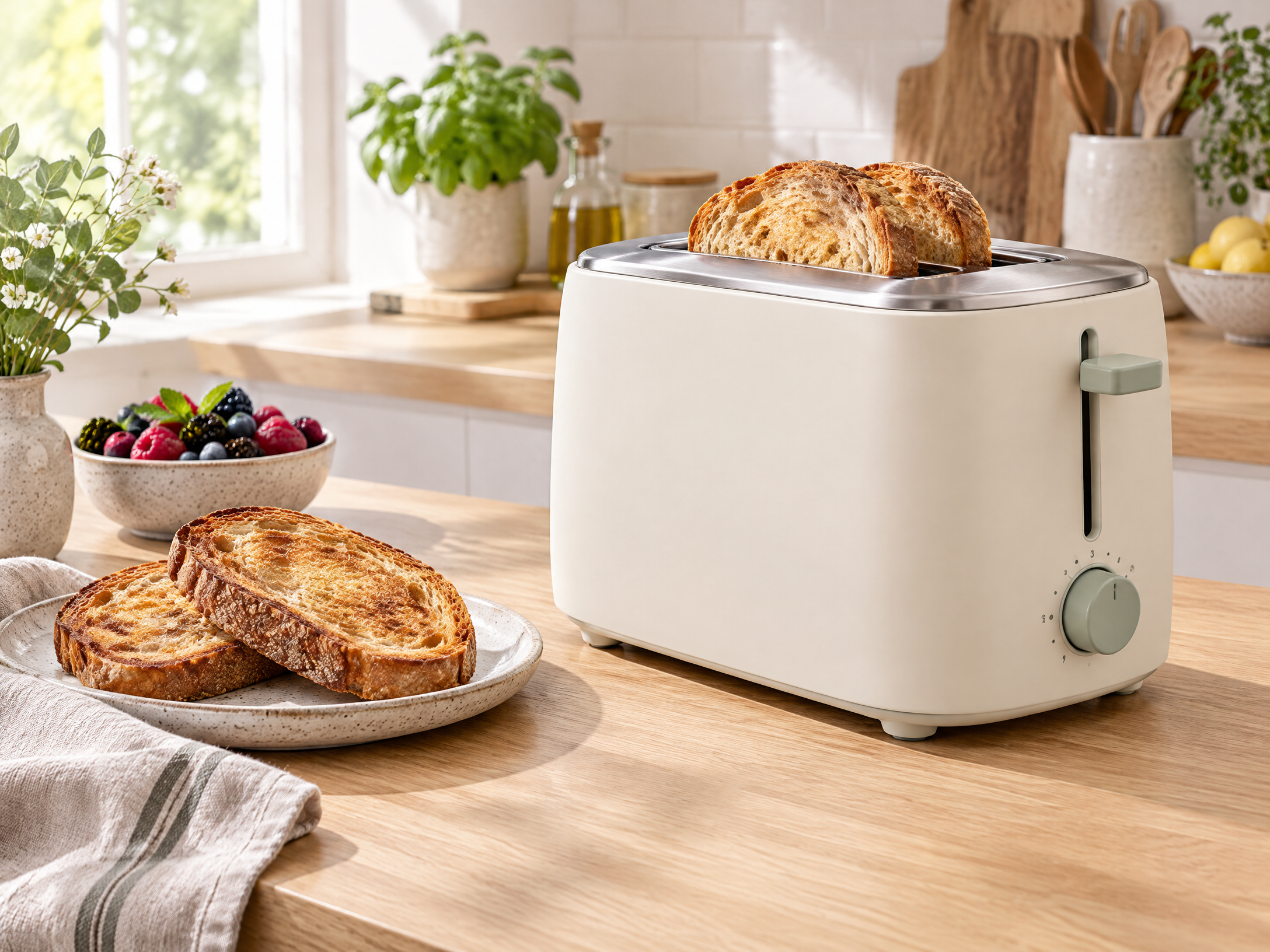
Target Keywords: toaster crumb tray design; toaster lift lever mechanism; toaster defrost function; toaster bagel setting; toaster electrical safety; small appliance abnormal operation test; small appliance flammability testing
Direct answer: Validate a private-label toaster as one controlled, market-specific configuration—not as a catalogue platform or a single attractive sample. Start with a locked bill of materials, rated electrical version, firmware or control revision, and intended functions. Then sequence functional trials, safety evidence review, abnormal-operation assessment, material review, and production-release checks around that exact version. The relevant route, evidence, and acceptance criteria depend on the final configuration and destination market; a competent laboratory, regulatory adviser, and responsible economic operator should confirm what applies before release.
A toaster can look finished long before validation is complete. Smooth lever action, an illuminated bagel icon, or a substantial tray does not establish how the final model behaves through a defined sequence, after interruption, or after a material substitution.
This guide focuses on test sequencing for functions and safety under abnormal operation, not RFQ comparison of bread fit, browning, cleaning, and quotation inputs. For that upstream work, see UZYVO’s toaster RFQ specification guide. The question here is how to organize proof before production and shipment.
IEC 60335-1 addresses reasonably foreseeable hazards for household and similar electrical appliances and is used with the appropriate product-specific Part 2.[1] IEC 60335-2-9 is the product-specific standard for grills, toasters, and similar portable cooking appliances; its published scope includes electric portable cooking appliances rated at not more than 250 V.[2] These references help structure a discussion, but they are not a universal approval or a replacement for the current national or regional requirements applicable to the product.
1. Establish the exact configuration that is being validated
Treat “the toaster” as a controlled identity, not a product-family name. Before a laboratory booking or trial, issue a configuration sheet with unique model and revision, covering housing/polymer grades, heater and wiring, control board or timer, lever and carriage, tray, cord/plug, rated supply, markings, manual, carton, and functions. Preserve drawings, component identifiers, revision-controlled artwork, and sample photos.
Evidence only has meaning if its tested object is traceable to the sellable object. A 220–240 V version, 120 V version, and version with a different control module are not automatically interchangeable. List fixed parts and permitted variants separately, and require the supplier to declare what needs review after a part changes.
| Control field | Buyer should lock | Evidence to retain | Release question |
|---|---|---|---|
| Product identity | Model, revision, slot count, exterior finish | Dated photos, drawing and BOM revision | Does the sample match the production reference? |
| Electrical variant | Rated supply, plug, cord, rating label | Label artwork, circuit information, variant matrix | Is this the destination-market version? |
| Function set | Shade control, cancel, reheat, defrost, bagel, high lift | User-flow matrix and instruction draft | Are all claimed modes represented? |
| Critical materials | Tray, nearby polymers, wire insulation, control parts | Supplier declarations, grade/colour references | Has the exact grade been reviewed? |
| Change control | Trigger and approval owner | Engineering-change record | What must be re-evaluated after a change? |
The MorningCraft smart toaster platform is a useful starting point for defining a configuration, but it should not be treated as proof that a buyer’s final branded variant is compliant or appropriate for every market. The released configuration, its supporting evidence, and the intended destination must always be reviewed together.
2. Convert functions into observable, repeatable checks
Functional validation should specify inputs, conditions, expected behaviour, and records—not labels such as “works well.” Before judging samples, build one function matrix covering relevant cold/warmed states, the rated supply, bread or load condition, control setting, sequence, indicators, carriage, and reset state.
A functional trial is a reproducible check, not a marketing demonstration. Name the test bread or document its dimensions and condition; state whether frozen or split products are included; and define internal-development repetitions. Do not invent universal cycle counts: agree a risk-based plan with the technical team and keep it separate from any laboratory procedure.
| Function | Define before the trial | Record during the trial | Escalate when |
|---|---|---|---|
| Basic toast | Selected shade position, bread condition, start state | Lever engagement, time, ejection, control reset | Result differs from approved sequence or controls are inconsistent |
| Cancel | Input location and expected stop/raise behaviour | Stage of cycle, response, final state | Heater or carriage response is unclear or inconsistent |
| Reheat | Eligibility, indicator, expected user flow | Selection and completion behaviour | Mode differs from the manual or leaves an unexplained state |
| High lift | Actuation, smallest intended slice, retrieval expectation | Measured exposed height and user-access observation | Required retrieval action is not achieved without entering the slot |
| Indicator/UI | Icon, legend, brightness expectation, failure indication | Visible state in agreed ambient lighting | Artwork or control logic does not match the approved manual |
This approach makes functional defects visible early. It also limits a common sourcing error: allowing a representative video to stand in for a named configuration and written protocol. Store raw observations, photos, and any deviations beside the sample revision rather than transcribing only a pass/fail summary.
3. Examine the lever, carriage, and crumb path as a system
The toaster lift lever mechanism couples user input, latch/control logic, carriage, centring, and release. Map movement from lever actuation to completed-cycle or cancel response. Review normal loading, intended no-load actuation, partial insertion, repeat operation, and states the instructions prohibit; do not improvise with metal implements or unsafe probes.
Record force or feel only when a method and limit have been specified. Otherwise, record whether the carriage engages, latches, releases, returns freely, and leaves the intended next-use state. Treat rubbing, loose fasteners, unintended contact, sharp edges, or other construction concerns as technical deviations, not merely cosmetic issues.
The toaster crumb tray design should be reviewed as part of the same system. Define its insertion orientation, retained position, removal route, stop feature if any, edges and finger clearance, and how the manual instructs cleaning. The goal is not to promise “crumb-free” use. It is to show that the tray used in the trial is the tray in the BOM, seats in the intended position, can be removed and refitted according to the instructions, and does not introduce a new interference condition. Capture the tray material and any coatings in the configuration record.
| Area | Sample check | Controlled output |
|---|---|---|
| Lever and latch | Engage, cancel, release, and reset using the approved sequence | Function record by unit and sample revision |
| Carriage | Observe alignment and travel with stated representative loads | Photos/video and deviation log |
| Crumb tray | Insert, remove, clean as instructed, and refit | Tray drawing/BOM reference and usability observation |
| Interfaces | Check tray-to-housing, lever-to-housing, and accessible edges | Engineering review or corrective-action record |
Avoid transforming a cleaning observation into a safety or performance claim. The final product’s instructions, materials, destination rules, and qualified technical review determine which warnings and evidence are necessary.
4. Prove special modes through defined user journeys
Special functions are especially prone to ambiguous requirements because the icon suggests a result without stating the control logic. For a toaster defrost function, identify the user action, the eligible bread condition, the indicator, the relationship to shade selection, the expected completion state, and what occurs after cancellation or loss of power. The functional record should prove that the final interface and instruction draft tell the same story; it should not claim a particular defrosting outcome unless the buyer has a defensible, agreed method and evidence.
The same discipline applies to a toaster bagel setting. First define the intended use in the product brief: for example, whether it is a selectable control mode for a defined cut bread format. Then set out what users select, which slots or orientations are allowed by the instructions, the indicator state, and the completion/reset behavior. Do not infer a heating pattern merely from an icon or carry a claim from another platform into the new model. A new control board, heater layout, or program may require renewed review.
Use a user-journey sheet rather than a feature checklist:
- Set up the exact electrical variant and sample revision.
- State the bread/load condition and required control setting.
- Record every user input, visible indicator, lever position, and final state.
- Repeat the defined sequence after a normal completion, a cancel event, and an allowed restart condition.
- Compare the observed journey with the final proposed manual and label artwork.
If a mode only works with unstated assumptions, it is not ready to be treated as a consumer-facing function. Resolve the instruction, hardware, control logic, or claim before golden-sample approval. This protects both the validation sequence and the later inspection plan.
5. Build the electrical-safety evidence path around the destination market
Toaster electrical safety is not established by a generic report title, a CE symbol on a photo, or an assurance that a similar unit was tested. Start with the destination countries, supply characteristics, plug/cord arrangement, product classification, and selling channel. Then ask a qualified laboratory or regulatory adviser to identify the current applicable requirements, test basis, national differences, documentation, and responsible parties for the final model.
For an EU route within its voltage scope, the Low Voltage Directive describes manufacturer obligations to ensure design and manufacture meet the safety objectives, prepare technical documentation, perform the applicable conformity assessment, draw up an EU declaration of conformity, and affix CE marking after compliance has been demonstrated.[3] It also requires procedures for series production to remain in conformity and identifies the importance of product identification and instructions. Those duties are not a shortcut to use a report from another configuration; applicability must be assessed for the final electrical equipment and market.
A sensible evidence-review pack can contain the items below. Its content and sufficiency should be confirmed case by case, not assumed from this list.
| Evidence item | Buyer review purpose | Configuration link |
|---|---|---|
| Applicable-requirements map | Shows what is being assessed for each market | Country, voltage, plug, function set |
| Test plan and report | Identifies method, sample, deviations, and conclusions | Model/revision, markings, critical parts |
| Circuit/BOM information | Supports identity and component traceability | Heater, thermal controls, wire, plastics |
| Labels and instructions | Aligns rated data, warnings, and user flows | Language, market, electrical version |
| Declaration/certification documents where applicable | Supports the responsible party’s release process | Exact model and declared regulations/standards |
| Change history | Identifies post-test differences | Date, part/revision, technical disposition |
In the United States, a manufacturer or importer of a general-use product subject to applicable consumer product safety rules must issue a written General Certificate of Conformity based on testing of each product or a reasonable testing program; the responsible party remains responsible for the certificate.[7] That statement does not decide whether a particular toaster is subject to a particular rule. It does reinforce why buyers should assign evidence ownership and traceability before import.
6. Sequence abnormal-operation review without inventing a “torture test”
A small appliance abnormal operation test should be treated as a controlled safety evaluation, not as a dramatic internal demonstration. The applicable standard, product design, market, and laboratory procedure determine the relevant abnormal conditions, setup, duration, instrumentation, and acceptance criteria. Do not create pass/fail thresholds from a purchasing checklist, and do not publish an unqualified “safe under all misuse” claim.
The buyer can still make the review disciplined. Begin with a hazard-oriented workshop involving engineering, quality, and the intended laboratory. Consider reasonably foreseeable operating states associated with the appliance’s design and instructions: interrupted cycles, no-load or unusual-load states where relevant to the formal test route, blocked or impaired motion, control malfunction scenarios considered by the applicable requirements, or loss and restoration of supply. The team must decide what is appropriate; an untrained team should not replicate hazardous conditions.
Then use the following sequence:
| Stage | Decision | Record |
|---|---|---|
| Identify | Map possible conditions to the final construction and intended use | Risk/evidence matrix and exclusions |
| Confirm route | Ask the qualified laboratory to confirm applicable procedures | Lab quotation, standard edition, deviations/national differences |
| Test controlled sample | Use identifiable, documented samples | Sample receipt, configuration photos, test record |
| Review outcomes | Assess observations against the applicable procedure | Report, nonconformity, corrective-action plan |
| Verify corrective changes | Decide whether component or whole-product reassessment is needed | Revised BOM, engineering change, review decision |
IEC 60335-1 expressly concerns reasonably foreseeable hazards, while IEC 60335-2-9 supplies particular requirements for the toaster product category.[1][2] Use that framework to ask better questions, not to self-declare compliance. If a design or component is changed after testing, evaluate the impact before release. CPSC guidance likewise notes that material changes may warrant retesting for affected requirements and that the appropriate testing program depends on the product and supply-chain variability.[7]
Need a configuration-led validation discussion? Share the target market, rated electrical version, proposed functions, sample revision, and evidence already available with info@uzyvo.com. UZYVO can help structure the product, sample, quality, and shipment checkpoints; final compliance decisions remain configuration- and market-specific.
7. Treat flammability as material-and-construction evidence, not a label
Small appliance flammability testing starts with a parts map. Identify polymers, wire insulation, internal barriers, overlays, adhesives, coatings, and components near heat or ignition sources. For each, record supplier, grade, colour/formulation reference where relevant, location, thickness or geometry where relevant, and supporting document. A generic material-family name is too weak to prove the supplied production part is the reviewed part.
IEC 60695-11-10 describes small-scale laboratory procedures for comparing burning behavior of materials exposed to a nominal 50 W flame. Its horizontal method determines linear burning rate under specified conditions, while its vertical method assesses self-extinguishing properties under specified conditions.[4] That is valuable material-screening context, but it is not a blanket statement that a finished toaster will meet every appliance safety requirement. The test specimen, thickness, orientation, conditioning, final construction, and applicable product standard all matter.
| Question | Better buyer request | Avoid |
|---|---|---|
| What material is used? | Exact grade, supplier, colour/formulation reference, part location | “Heat-resistant plastic” without traceability |
| What evidence exists? | Relevant report or data sheet with specimen identity and conditions | Treating a trade name as a flammability result |
| Does it apply to this part? | Review thickness, process, colour, and final BOM mapping | Assuming a different thickness or grade transfers automatically |
| What changed after review? | Engineering-change notice and impact assessment | Silent resin, pigment, adhesive, or wire substitution |
| Is finished-product assessment needed? | Seek qualified route advice for the final design and market | Using material screening as a finished-product approval |
For any component that could contact food under intended use, add a destination-specific food-contact review. In the EU, the food-contact-material framework requires materials not to release constituents at levels harmful to health or change food composition, taste, or odour unacceptably; it also provides for compliance documentation and traceability.[5] In the United States, FDA describes food-contact substances as substances that contact food, including food-preparation surfaces and cookware, and explains that intended use matters to its review framework.[6] Do not assume that a crumb tray is regulated the same way in every market or that a material declaration alone covers the final use.
8. Keep documents, labels, and change control synchronized
Validation can fail operationally even when development tests were well organized. The usual cause is document drift: the report names a previous sample, the label shows a different rating, the manual describes a function that has changed, or the line uses an unapproved component. Prevent this by running a release register with one owner, document revision, source, approval status, and link to the exact product configuration.
For EU electrical equipment within the Directive’s scope, technical documentation and the EU declaration of conformity are to be retained for 10 years after the equipment is placed on the market.[3] That is a market-specific legal obligation, not a generic retention recommendation for every destination. Elsewhere, retention, labelling, certification, and importer documentation should be confirmed with the appropriate authorities or qualified advisers.
At minimum, reconcile these items before production release:
- Model number, voltage/frequency, rated input, plug, and traceability mark across sample, label, carton, report, and manual.
- The final function names and icons against the validated user-journey sheet.
- Critical-component identifiers against the reviewed BOM and supplier evidence.
- The laboratory sample description against the production configuration and any approved deviations.
- Manual cleaning and use instructions against actual tray, lever, and control operation.
- A change-control trigger for heater, thermal protection, electronics, cord/plug, polymer grade, tray, control legend, or processing change.
This is where a buyer should review UZYVO factory capabilities: the useful question is how approved samples, parts, inspection criteria, packaging, and records remain connected, rather than whether a factory offers a generic certificate list. Documentation review is evidence management, not a claim that every risk has been eliminated.
9. Use sample gates to connect engineering, laboratory work, and production
Use clear gates: engineering sample for construction and open questions; functional sample for user journeys and interface/lever/tray issues; evidence sample for the laboratory and documentation route; golden sample for the visual, functional, packaging, and document baseline; and production release/inspection for linkage to that baseline.
Gates clarify what a sample is fit to decide. Do not approve retail packaging against an unfinished control panel, rely on a laboratory sample after the BOM changes, or treat a pre-shipment function check as a replacement for an applicable safety evaluation.
At Gate 5, agree an inspection sheet that uses observable checks: product identity; appearance against the golden sample; lever actuation; selected basic and special function checks; tray fit; label/cord/plug verification; manual and carton revision; and batch traceability. The sampling plan, functional settings, and acceptance criteria should be appropriate to the actual order and agreed in advance. If an inspection identifies a difference, trace it back to the configuration record and decide whether it is cosmetic, functional, evidence-relevant, or all three.
Contextual AI image recommendations
| Insertion point | Purpose | English caption | ALT text | English AI image prompt |
|---|---|---|---|---|
| After Module 1 | Show configuration traceability without implying certification | “A controlled toaster configuration links the sample, BOM, label, and validation records.” | “Engineer reviewing toaster sample, component list, label artwork, and traceability records” | “Editorial B2B product-validation scene, an unbranded two-slot toaster on a clean engineering desk beside neutral BOM sheets, label artwork, calipers and a revision log, realistic studio light, no logos, no certificates, no claims, landscape” |
| After Module 3 | Clarify mechanical review of the crumb path and carriage | “Mechanical checks should connect lever motion, carriage travel, and the removable tray.” | “Close view of an unbranded toaster lever, carriage opening, and removable crumb tray during inspection” | “Technical product-inspection photograph, unbranded stainless two-slot toaster, removable crumb tray partly withdrawn and lever visible, gloved technician documenting fit with a checklist, clean factory quality desk, no safety labels or performance claims, landscape” |
| After Module 9 | Visualize a staged validation workflow | “Sample gates keep engineering, evidence, and production aligned to one released model.” | “Product team reviewing toaster samples through engineering, laboratory, golden-sample, and production gates” | “Professional B2B workflow illustration, four neutral stages for toaster development: engineering sample, functional review, laboratory documentation review, production release, unbranded appliances and paper records, restrained blue and gray palette, no logos, no certification badges, landscape” |
10. Buyer FAQs for functional and safety validation
Is a successful browning trial enough to release a toaster?
No. It can be one useful functional observation under a specified bread and electrical condition, but it does not by itself demonstrate the final product’s electrical safety, abnormal-operation performance, material suitability, market documentation, or production consistency. Keep a browning protocol and its results in the functional record, then separately follow the applicable safety and market-access route for the final configuration.
Can a supplier’s report for a similar toaster be reused?
It may be useful background, but not presumed to apply. Compare model identity, electrical version, ratings, heater/control arrangement, thermal-protection parts, wiring, plastics, cord/plug, functions, labels, and market route. A qualified laboratory or adviser should decide whether the evidence is relevant or further assessment is needed. IEC 60335-2-9 notes national and group differences; confirm current destination requirements with the relevant authority, member body, or certification body.[2]
What change should trigger re-evaluation?
Trigger a documented impact review for changes that could affect safety, function, materials, claims, or configuration identity. Examples include a control board or timer change, heater or thermal-control change, wiring or cord/plug change, polymer grade or colourant change, crumb tray construction change, new function, different rated electrical version, or altered label/manual. CPSC’s general-use guidance specifically notes that a material design, process, or component-source change that could affect compliance may warrant retesting for affected requirements.[7] The exact response depends on the change and market.
Does a material flammability result certify the whole appliance?
No. IEC 60695-11-10 is a small-scale material test procedure used to compare burning behavior under specified conditions.[4] It does not automatically represent every thickness, orientation, formulation, assembled construction, or finished-product requirement. Match the evidence to the actual part and seek qualified advice on the final appliance’s applicable route.
What should a pre-shipment inspection check?
Use the released baseline. Typical checks can include model identity, visual comparison with the golden sample, selected agreed functional checks, lever and tray fit, cord/plug and rating label, manual/carton revisions, pack-out, and traceability. A pre-shipment inspection is an order-control activity; it cannot replace a product-specific safety evaluation or cure a mismatch between production and the configuration used for evidence.
Who is responsible for market documentation?
Responsibility depends on market and commercial roles. The EU Low Voltage Directive assigns manufacturer obligations around technical documentation, conformity assessment, declaration of conformity, and CE marking for equipment in scope.[3] In the U.S., the manufacturer or importer remains responsible for a required GCC, even if another party assists with drafting or testing.[7] Allocate roles in the supply agreement and obtain qualified advice for the actual importer, brand owner, and destination.
11. Release only the version that was actually evaluated
The most useful output of validation is not a folder of generic reports. It is a release decision that answers four questions: What exact toaster was evaluated? What functions and conditions were checked? What evidence supports the destination-market route? What will stop unreviewed production changes? If the team cannot answer one of these questions with a traceable record, the configuration is not yet controlled.
Use this closing buyer checklist before authorizing mass production or shipment:
- The final model/revision, electrical variant, function set, BOM, labels, manual, and carton are identified and mutually consistent.
- Lever, carriage, tray, basic toast, cancel, high lift, and any defrost or bagel modes have written user journeys and retained functional records.
- The applicable electrical-safety and abnormal-operation route has been confirmed for the final configuration and destination, with qualified review where needed.
- Material evidence is mapped to actual parts; flammability screening is not overstated as finished-appliance approval.
- Food-contact questions, if relevant to the intended materials and market, have been reviewed separately.
- Laboratory documents, declarations/certificates where applicable, and corrective actions are traceable to the released configuration.
- Production and pre-shipment controls compare goods to the golden sample and authorized change log.
Ready to turn a toaster brief into a controlled validation sequence? Email info@uzyvo.com with the destination market, electrical version, required functions, sample revision, and available evidence. UZYVO can help organize the sourcing and quality workflow around the final SKU; market access, testing, and compliance conclusions require review of the final configuration and destination.
References
Put the buyer guide into a practical sourcing path.
Bring this framework into your next product brief.
Share your target market, appliance category, annual volume, and launch window. We will discuss a practical sample, documentation, and production path for the final configuration.
Email info@uzyvo.com