
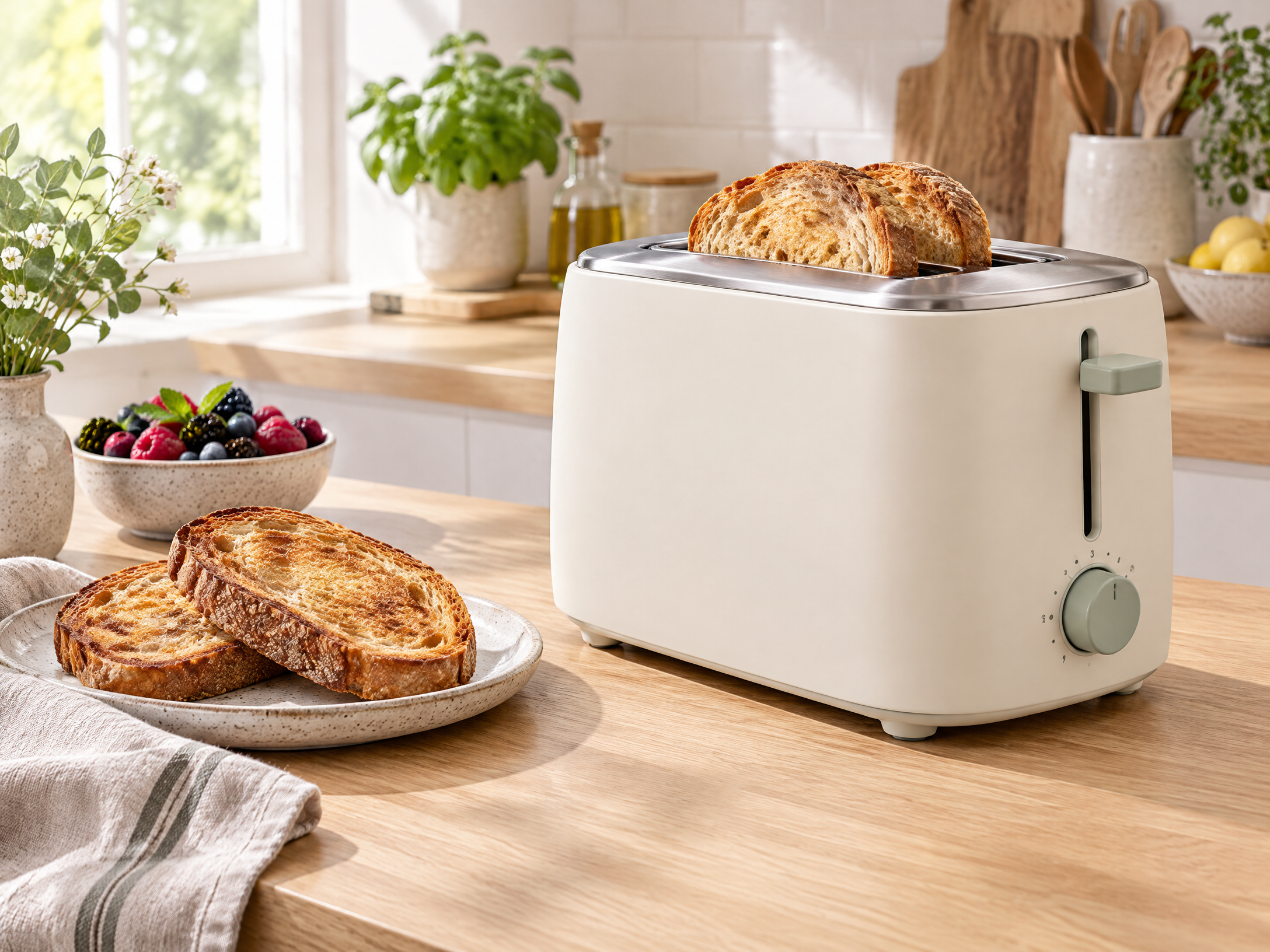
Target Keywords: toaster manufacturer; toaster supplier; toaster OEM; difference between toaster and toaster oven; pop up toaster vs toaster oven; toaster slot dimensions; toaster browning control
Direct answer: Choose the toaster format before comparing factories. A private-label buyer should match the target occasion, bread envelope, controls, cleaning approach, and destination-market evidence to a stable platform; then qualify the supplier’s engineering, change-control, sample, and documentation discipline. Do not treat a catalogue image, a single pre-production sample, or a voluntary certificate as proof that the final configured product is suitable for every market. The applicable obligations and evidence depend on the final configuration and destination market.
A toaster is familiar, but its buying risk is not simple. Styling, slice count and features follow a more fundamental choice: whether a compact pop-up, long-slot, or oven-style appliance fits the range’s job-to-be-done. The platform changes interaction, packaging, documentation and the supplier capability to validate.
This guide focuses on supplier and platform selection. It deliberately does not replace a detailed toaster RFQ, performance-test plan, or market-access assessment. Buyers who are ready to translate their selected platform into acceptance criteria can continue with UZYVO’s toaster RFQ specification guide.
1. Start with the buying decision, not the catalogue
The first question is not “Which toaster manufacturer has the most models?” It is “What repeatable consumer task must this appliance serve in the target channel?” That framing keeps a sourcing team from comparing an entry two-slot toaster, a four-slot unit and a compact toaster oven as if they were interchangeable substitutes.
Build a one-page category hypothesis before issuing enquiries. State the target user, selling market, intended bread and bakery types, counter-space expectation, expected daily use, intended retail position, and whether the product must support a broader breakfast range. Keep assumptions visible rather than allowing them to become unspoken requirements. For example, a buyer focused on ordinary sandwich bread may prioritise familiar loading and easy crumb disposal. A buyer targeting artisan loaves may need a different bread envelope and should validate the claimed fit with physical samples.
| Buyer decision | Questions to settle | What it changes in supplier screening |
|---|---|---|
| Use occasion | Quick breakfast, shared household, or small-batch cooking? | Format, capacity, user controls, heat exposure and carton messaging |
| Bread envelope | What real slice shapes, thicknesses and lengths will be used? | Slot geometry, centring mechanism, sample set and validation method |
| Range role | Entry-price staple, design-led hero, or companion appliance? | Tooling, finishes, service parts and customisation depth |
| Market route | Which destination markets and sales channels are planned? | Plug, rated information, instructions, conformity documentation and retailer gates |
| Control position | Mechanical shade dial only, or digital settings and connected functions? | Electronics scope, EMC/RF evaluation and supplier engineering records |
The output should be ranked non-negotiables and preferences. Recast “fits oversized bread” as a defined slice set and acceptance approach, and “premium browning” as behaviour reviewed on representative samples. This prevents marketing language becoming an untestable engineering request.
2. Choose the format by task: pop-up, long-slot or oven-style
The difference between toaster and toaster oven is primarily functional rather than cosmetic. A pop-up toaster generally browns bread in vertical slots and raises it for removal. An oven-style toaster uses a small enclosed chamber or rack arrangement and can suit a wider range of cooking tasks. Their intended use, user interaction, heating geometry and cleaning surfaces are different, so their sourcing briefs should not be merged casually.
The practical pop up toaster vs toaster oven decision should start with the range strategy. A pop-up format may give a clearer, quicker bread-toasting proposition and a smaller counter footprint. An oven-style format may better suit buyers who genuinely need an enclosed chamber and associated accessories. Neither is inherently better; the selection should follow the documented use case, retail expectation and evidence package for the final product.
| Platform | Best fit when the brief centres on | Buyer advantages to investigate | Questions that prevent false comparisons |
|---|---|---|---|
| Two-slot pop-up | A compact everyday bread-toasting task | Familiar loading, simple message, smaller product footprint | Which bread samples fit and centre? How does the lift mechanism behave? |
| Four-slot pop-up | Shared use or a range with higher simultaneous capacity | Capacity story and family-range coherence | Are controls shared or independent? Does the layout alter usable bread fit? |
| Long-slot pop-up | Longer or differently shaped sliced bread | Potentially distinct bread envelope | What usable length and width are evidenced, rather than merely opening dimensions? |
| Oven-style toaster | A defined small-batch cooking proposition | Broader cooking format where the strategy supports it | What accessories, cleaning surfaces, controls and intended uses are included? |
Ask each candidate to identify whether the unit is an existing ODM platform, a modified platform, or a new development. “OEM” can mean very different degrees of buyer control. The sourcing route should specify who owns drawings, artwork release, bills of material, firmware where present, and change approval. For a broader comparison of these development models, review the OEM / ODM workflow. A stable platform with disciplined controlled changes can be lower risk than a nominally exclusive design with incomplete evidence.
3. Translate bread fit into a usable slot brief
Toaster slot dimensions are a starting point, not a consumer-fit claim. An opening can be measured accurately while still failing to accommodate a target slice because of internal guides, centring elements, heating surfaces, carriage travel or a shape that narrows below the top. Conversely, a large visual opening is not automatically useful if the product does not guide the bread consistently.
Make the bread envelope buyer-owned. Obtain and identify representative destination-market samples, then agree whether the assessment concerns entry, centring, safe removal, or all three. These are comparative samples, not universal food-performance proof.
| Brief element | Define it in the buyer document | Evidence to request |
|---|---|---|
| Opening geometry | Width, length and visible opening with measurement method | Dimensioned drawing and sample measurement record |
| Usable internal envelope | Available space during normal operation, including guides | Section view or engineering drawing plus physical sample review |
| Bread set | Named, retained representative slices and their physical characteristics | Photographs, sample log and agreed evaluation notes |
| Centring and carriage | Expected positioning and lift behaviour for the selected bread set | Demonstration on the requested configuration; disclose exceptions |
| Removal | Whether high-lift, tongs, or a user instruction is expected | Control description, instructions draft and observed sample behaviour |
Avoid adopting a generic “extra-wide slot” statement until it has a defined basis. If the buyer wants to use a bread-fit claim at retail, a qualified reviewer should confirm the claim wording, evidence and destination-market requirements. The sample should carry the same slot arrangement, carriage, controls and relevant production-intent components expected for the approved configuration. A result from a different slot tooling or a prior generation model is a lead, not equivalent evidence.
4. Specify browning controls as a system, not a dial label
A toaster browning control combines the user interface, control logic or mechanism, heat delivery, bread positioning, power characteristics, and the user’s selected bread. A number scale marked one through six is not a universal measure of colour. It is therefore unsafe to assume that matching dial numbers across models produces matching results.
For selection, decide what kind of experience the brand needs: a straightforward shade selector; dedicated reheating, defrost, or bagel functions; separate zone controls; a display; or a combination. Every added function should have a use case, expected display or indicator behaviour, instruction implication and verification approach. A feature copied from a competitor without a buyer acceptance criterion can create avoidable ambiguity after sample review.
A controlled comparison uses the same bread set, preparation state, relevant conditions, selected settings and observation record across platforms. Record observations rather than claim a universal colour outcome: selected-slice evenness, control response, release action and expected indicators. Set tolerances only after engineering and quality agree they suit the platform and market.
| Control choice | Commercial reason | Engineering and approval question |
|---|---|---|
| Mechanical shade selector | Familiar, low-complexity interaction | How is repeatability reviewed across approved samples and component changes? |
| Digital display | Premium positioning or explicit user feedback | What software/firmware version is controlled and what EMC evidence applies? |
| Defrost or reheat | A defined bread-use occasion | What behaviour will the brand describe, and how will it be checked? |
| Bagel-style setting | A stated one-side/usage proposition | Which side is intended to heat differently, and how is the function communicated? |
| Independent pairs | Household flexibility on a four-slot format | What is independently controlled and how is this demonstrated? |
Do not let a supplier substitute “tested” for a traceable record. Ask for the test plan, configuration identification, actual observations, deviations and responsible reviewer. Consumer variation does not excuse an unclear brief; it means the buyer should define a sensible, reproducible comparison method rather than promise an absolute aesthetic result.
5. Build a short list of suppliers around controlled capability
A capable toaster supplier is not identified by a broad catalogue. Assess whether it can maintain the selected platform from enquiry to shipment: engineering ownership, approved-component control, in-process checks, corrective action, sample identification, documentation, packaging and after-sales support. Evidence should concern the proposed unit or a clearly related platform.
Ask each candidate to map the product into functions and controlled assemblies: housing, slot/carriage, heating elements, thermal protection, mains cord or plug, control board if present, crumb tray, labels, packaging, and any accessories. Then ask which parts are made in-house, supplied externally, and subject to incoming or production checks. This creates a more meaningful comparison than asking only whether the factory is “experienced.”
| Qualification area | Evidence to examine | Warning sign |
|---|---|---|
| Platform ownership | Revision-controlled drawings, BOM, disclosed development route | Ambiguous answer on who may alter parts or tooling |
| Component discipline | Approved supplier list, incoming criteria, change-notice process | Part description changes without an approval path |
| Sample governance | Serial or revision identity and comparison to production intent | Samples cannot be tied to records or later production |
| Quality response | Defect classification, containment and corrective-action examples | Only verbal assurances or generic inspection sheets |
| Service readiness | Replaceable parts list, fault-data route, packaging-spares approach | No owner for field feedback after shipment |
A desk review should lead to a risk-based audit or remote evidence review where the programme justifies it. UZYVO’s factory capabilities page outlines the kinds of development and quality checkpoints buyers may wish to discuss. It is not a substitute for qualifying the actual factory, platform and production line used for the order.
6. Align market-access evidence with the final configuration
Destination-market review must begin early, but it should not be reduced to a request for a “certificate.” For EU products within the relevant voltage range, the Low Voltage Directive applies to electrical equipment between 50 and 1,000 V AC or 75 and 1,500 V DC and includes household appliances; the manufacturer is responsible for conformity assessment under that framework.[1] The European Commission also explains that only references of harmonised standards published in the Official Journal provide presumption of conformity under the LVD.[1]
A toaster is within the subject matter of IEC 60335-2-9, covering grills, toasters and similar portable cooking appliances for household and similar purposes at rated voltage not exceeding 250 V.[2] The applicable edition, national deviations, test scope and market route must still be checked for the final configuration. Read any IEC or laboratory document for product identity, ratings, components, limitations and issue date—not as blanket approval for a similar unit.
Digital controls can add an EMC workstream. The EU EMC Directive seeks to limit emissions and ensure immunity when equipment is used as intended.[3] In the United States, equipment with digital logic may fall within FCC Part 15 considerations, while a wireless function can trigger a different authorization analysis; the FCC says the applicable procedure depends on the device functions and technical categorisation.[4] These are reasons to disclose every control, display, power supply and radio feature before testing or documentation is commissioned.
For EU electrical and electronic equipment, RoHS restrictions apply unless an exclusion applies; the Commission lists ten restricted substances and advises that EEE with electrical/electronic components must comply unless specifically excluded.[5] A buyer should request a configuration-specific material and component declaration path rather than infer compliance from an unrelated model report.
| Configuration change | Recheck with qualified reviewers | Supporting records to control |
|---|---|---|
| New mains cord, plug, rating, heater or thermal part | Electrical safety scope and product identity | BOM, drawings, report applicability, labels |
| New display, digital logic or power board | EMC/FCC analysis as applicable | Schematics, firmware version, test configuration |
| Wireless function | Radio and market-specific route | Radio module details, integration evidence, labels |
| New coating, polymer, metal finish or electronics | Material/chemical documentation route | Supplier declarations and controlled part identity |
No table can determine compliance. The importer, manufacturer, brand owner and other economic operators should obtain qualified market-specific advice and retain the records required for their route to market. In the U.S., CPSC states that manufacturers and importers must test many consumer products and certify compliance with applicable safety requirements; applicable general-use products may require a General Certificate of Conformity.[6]
7. Request evidence that is comparable, traceable and decision-ready
Ask a candidate toaster OEM to provide a document index, then assess the documents against the buyer’s actual configuration. A complete-looking dossier can be useless if its model number, voltage, plug, control board, heating parts, material or brand label differs from the offered product. Treat evidence review as a matching exercise: claimed product, intended market, configuration, standard or rule, test article, result, limitations and document owner.
A practical pack may contain controlled drawings, BOM/critical-component list, instruction and label drafts, relevant reports and declarations, packaging specification, sample/change history, and production plan. The final product and destination market determine the set. Do not use “CE” as shorthand for a complete evidence process: the Commission cautions that voluntary certificates are not recognised proof for EU market-surveillance or customs checks, and CE marking cannot simply appear on a certificate.[1]
| Review stage | Buyer question | Useful output |
|---|---|---|
| RFQ | What evidence exists for this base platform and which differences are proposed? | Gap register, not a pass/fail marketing sheet |
| Engineering sample | Does the sample match the declared configuration and drawings? | Annotated sample review and configuration log |
| Pre-production | Are changes since the engineering sample disclosed and assessed? | Revised BOM/drawings and change approvals |
| Production release | Does the final document set identify the shipped configuration? | Signed release checklist and document archive |
| Post-launch | Can a complaint be traced to build date, components and revision? | Traceability and corrective-action pathway |
The principle is simple: a test report can support a decision, but it cannot replace configuration control. If a supplier cannot make the link between a report and an offered toaster intelligible, pause the release rather than filling the gap with assumptions.
Planning a toaster comparison? Send your target format, destination markets, bread envelope, desired controls, and anticipated annual programme context to info@uzyvo.com. UZYVO can help turn those inputs into a supplier-comparison conversation without treating preliminary evidence as approval.
8. Use samples to reduce uncertainty without over-claiming results
Samples answer specific questions; they do not guarantee mass-production performance. Start with an engineering sample to review industrial design, bread entry, control usability, crumb-tray access, markings, cord/plug presentation, packaging concept and disclosed configuration. Keep photos and an issues log. Move to a revised sample only when changes are identified, not merely because time has passed.
A disciplined buyer creates a golden-sample decision after the brief, evidence route, functional review and artwork mature. Identify the sample by date/revision/serial, record its BOM and drawings, and define its permitted relationship to production. Require disclosure and evidence-applicability review if components, firmware, heater parts, thermal protection, coatings, slot tooling or packaging change.
Do not confuse pre-shipment inspection with regulatory validation. Inspection can detect defined observed defects in a shipment sample; it cannot establish every legal requirement, universal performance, or continued safety-assessment applicability after a component change. Use it alongside engineering controls, market review and traceability.
| Gate | Decision owner | Minimum buyer question |
|---|---|---|
| Concept sample | Category and product team | Does this platform meet the chosen use case before custom work proceeds? |
| Engineering sample | Engineering/quality and brand team | Which gaps remain in fit, controls, safety evidence and instructions? |
| Golden sample | Cross-functional approvers | What exactly is frozen, and what needs written change approval? |
| Pre-shipment review | Quality/release owner | Does the agreed inspection plan show release, hold or corrective action? |
For a deeper process structure, link the product programme to a controlled OEM / ODM workflow, then tailor it to the toaster’s own configuration and commercial risks.
9. Compare commercial proposals on total decision risk
A guide should not give universal prices or lead-time promises: they depend on the specification, order profile, materials, tooling, destination and schedule. Compare quotations for transparency. Require suppliers to separate base-unit scope, custom changes, finish, plug/rating, packaging, documentation, spare parts, sample stages, controls and commercial assumptions.
The cheapest unit quotation can be the least comparable offer if it omits components, packaging protection, approvals, artwork control or service obligations. Conversely, a more expensive quote is not automatically lower risk. The purpose of a comparison matrix is to make omissions visible before negotiation.
| Comparison line | Ask for | Decision use |
|---|---|---|
| Product configuration | Revision-marked specification and included functions | Ensures quotations describe the same platform |
| Customisation boundary | What changes are cosmetic, functional, tooling-dependent or not offered | Separates brand intent from feasible scope |
| Documentation deliverables | Named documents, ownership, update route and exclusions | Prevents assumptions about evidence availability |
| Packaging and logistics | Carton design basis, inserts, marks and test approach if requested | Reveals channel-specific work still to be done |
| Change control | Notice period, approvals, cost treatment and revalidation trigger | Protects a frozen, reviewed configuration |
| After-sales | Spare-parts assumptions, complaint data and response path | Links sourcing to post-launch support |
Score candidates against the category hypothesis rather than rewarding the longest feature list. Give a critical issue such as uncontrolled safety components or unverifiable evidence more weight than a colour option. Record why a preferred toaster manufacturer was selected, what open risks remain, and who owns their closure. That record is valuable when staff change or the programme expands to a second market.
10. Buyer FAQs: resolving recurrent toaster-sourcing questions
Is a toaster oven always a better private-label product than a pop-up toaster?
No. The difference between toaster and toaster oven changes the product proposition; it does not create a universal hierarchy. Select the format that supports the documented customer task, channel, available counter space, accessory expectation, operating instructions and destination-market review. A pop-up toaster may be the clearer choice for a focused bread-toasting brief; an oven-style product should be justified by a real broader-use strategy rather than an assumption that more functions sell better.
What toaster slot dimensions should a buyer ask a supplier to guarantee?
Ask for dimensioned drawings and physical review against the buyer’s defined bread set, but avoid asking for a broad “guarantee” that lacks a test method. The useful question is which physical envelope is available in the final configuration and how representative slices enter, centre and can be removed. If retail claims will be made, obtain qualified review of the final wording and supporting evidence.
Can a browning dial be approved from one sample?
One sample can support an early usability review; it does not establish a universal output claim or long-term production consistency. Document the bread, settings, conditions, sample revision, observations and exceptions. Then connect the decision to controlled components, a final configuration, agreed verification and change control. This is especially important when the proposed toaster browning control uses electronics, software or multiple functions.
Does an IEC test report automatically permit sale in every market?
No. IEC 60335-2-9 is relevant to toasters and similar portable cooking appliances, but a report must be evaluated for its exact product identity, scope, edition, national differences, configuration and destination-market route.[2] Local requirements, labelling, documentation, responsible economic operator duties and other applicable rules may differ. Obtain qualified advice for the final product and market.
What should a buyer ask a toaster supplier before requesting a custom finish?
Ask whether the finish affects housing material, coating process, heat-adjacent parts, labels, cleaning guidance, evidence applicability, MOQ, tooling or inspection criteria. Obtain a retained colour/finish standard, define acceptable cosmetic limits, and require a written change path. A finish decision should not quietly alter the production-intent configuration after the evidence review.
11. Conclude with a controlled supplier-selection path
The most defensible route is to select the platform deliberately, rather than choose a catalogue and reverse-engineer the brief. Define the use occasion and suitable format, translate bread fit and controls into observable sample questions, then assess platform ownership, component control, documentation, sample traceability and change disclosure.
Use market access as a design and sourcing input, not a late document chase. Electrical safety, electromagnetic compatibility, radio functions, chemical restrictions, product certification and labelling can all turn on the final configuration and destination market. A generic certificate, a prior model report or a supplier statement does not make those questions disappear. Align evidence to the final proposed product, preserve the links between drawings, BOM, sample and documents, and use qualified local review where needed.
Finally, keep supplier selection distinct from complete RFQ development. This guide establishes how to choose a platform and a partner; it does not prescribe every bread-fit, browning, cleaning, safety or packaging acceptance criterion. Once a candidate is selected, turn the decisions into a controlled RFQ, sample plan and production-release file.
Ready to structure a toaster OEM comparison? Email your brief to info@uzyvo.com with the format, slot/bread priorities, control concept, destination markets and stage of sourcing. The next step should be a configuration-led discussion, with claims and market access reviewed for the product actually being launched.
AI Image Recommendations
- Insertion point: After Module 2, “Choose the format by task.”
Purpose: Help commercial buyers distinguish product-format discussions without suggesting performance results. Caption: “Three countertop toaster formats reviewed during an early private-label platform comparison.” ALT text: “Two-slot pop-up toaster, long-slot toaster and compact oven-style toaster on a neutral product-review table.” AI image prompt: “Photorealistic B2B small-appliance sourcing review, three unbranded countertop toaster formats—two-slot pop-up, long-slot pop-up, and compact oven-style unit—arranged on a clean neutral studio table with technical sketches nearby, soft daylight, no logos, no text, no exaggerated claims.”
- Insertion point: After Module 3, “Translate bread fit into a usable slot brief.”
Purpose: Illustrate controlled physical sample review and measurement, not a guarantee of fit. Caption: “A buyer documents representative bread samples and slot geometry during platform assessment.” ALT text: “Quality reviewer measuring a toaster slot beside labelled bread sample shapes.” AI image prompt: “Realistic product-engineering bench scene, unbranded toaster with digital calipers measuring a slot opening, several plainly labelled representative bread-shape samples nearby, neutral professional lighting, documentation clipboard, no brand logos, no visible performance claims.”
- Insertion point: After Module 7, “Request evidence that is comparable, traceable and decision-ready.”
Purpose: Show the configuration-to-documentation control concept. Caption: “Configuration records, drawings and sample identification should be reviewed together.” ALT text: “Procurement and quality professionals reviewing toaster drawings, a controlled component list and a labelled sample.” AI image prompt: “Professional B2B procurement meeting at a small-appliance engineering table, two diverse professionals reviewing unbranded toaster technical drawings, component list, test-report index and a labelled sample unit, realistic documentary photography style, no logos, no readable confidential text.”
References
Put the buyer guide into a practical sourcing path.
Bring this framework into your next product brief.
Share your target market, appliance category, annual volume, and launch window. We will discuss a practical sample, documentation, and production path for the final configuration.
Email info@uzyvo.com