
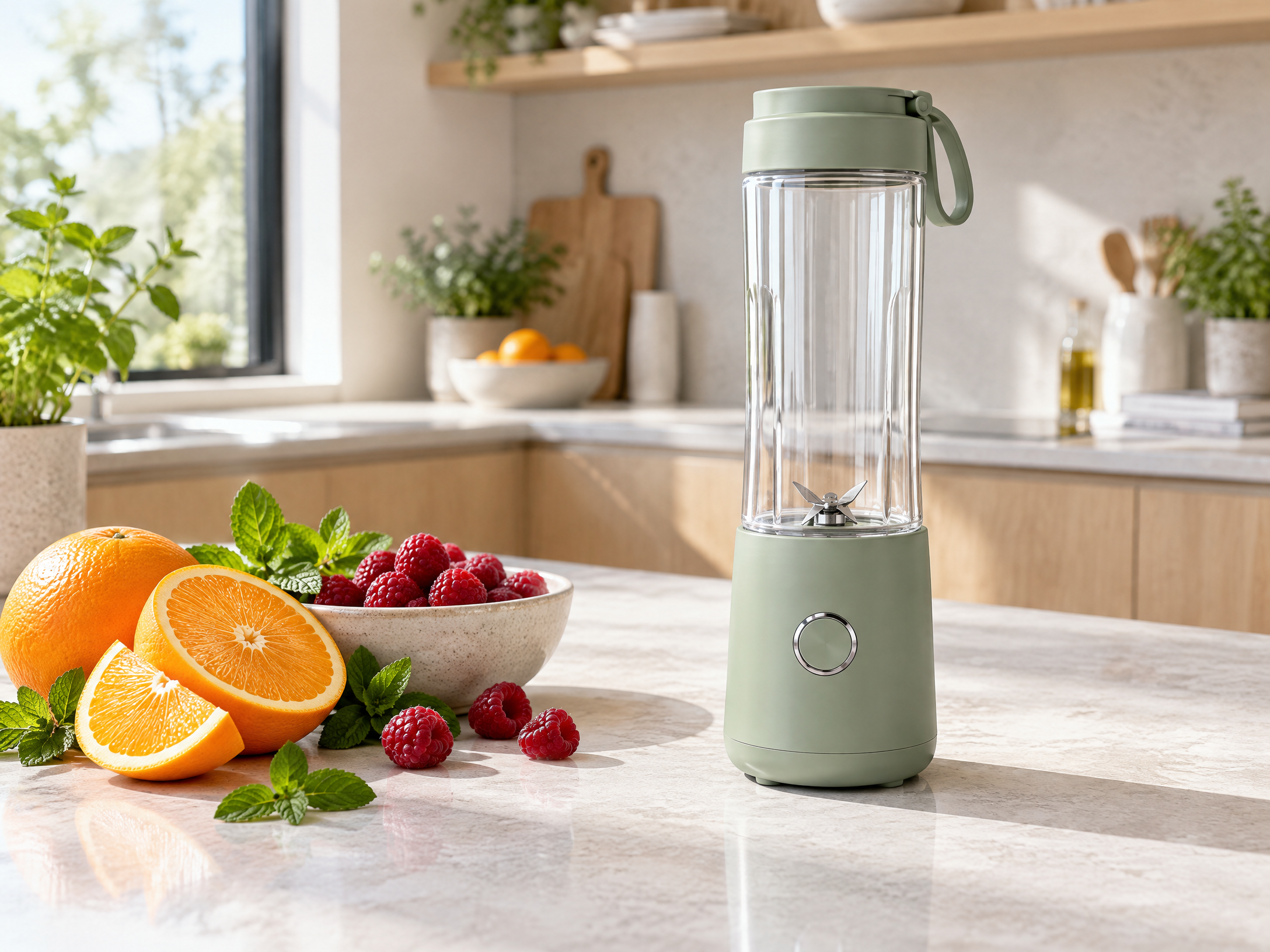
Target Keywords: portable blender manufacturer; portable blender supplier; portable blender OEM; portable blender private label; personal blender manufacturer; portable blender comparison; portable blender cup material
Direct answer: A useful portable blender OEM comparison does not start with a catalogue photo or a single motor claim. Start by defining the intended drink, user, channel, destination market, battery and charging architecture, cup interface, and service model. Then compare suppliers against the same configuration brief, evidence index, change-control approach, and commercial assumptions. The best-fit portable blender manufacturer is the one that can explain the limits and documentation of the *final* configuration—not merely offer the most feature-rich sample.
A portable blender sits at an awkward but commercially interesting intersection: it is a food-contact vessel, a cutting appliance, a rechargeable electronic product, and often a travel-oriented consumer good. That combination makes it easy to compare the wrong things. One buyer may see an attractive cup color and an app-controlled feature; another may focus on a low quotation. Neither view establishes whether the resulting product format is suited to the intended beverage, retail promise, destination market, or after-sales process.
This guide is for brand, product, and sourcing teams evaluating a portable blender supplier or assembling an RFQ. Its purpose is supplier and platform comparison. It deliberately does not replace a configuration-specific safety-approval or test-evidence review; when the platform has been narrowed, use UZYVO’s portable blender safety specifications checklist to organize that later approval work. Throughout this guide, “suitable,” “compliant,” and “approved” depend on the final bill of materials, firmware where relevant, labels, destination market, supporting evidence, and qualified review.
1. Define the buying decision before comparing factories
A portable blender manufacturer should receive a one-page decision statement: the actual buying occasion, intended user, ingredients, cleanup pattern, storage position, charging context, and target channel. “Portable” alone is not a sufficient product definition.
Translate this into non-negotiables and choices. Non-negotiables can include destination countries, whether the cup is also the drinking vessel, battery-powered operation, accessories, color system, and product-data ownership. Cup shape, carry loop, connector, sleeve, and packaging may be choices. This keeps the brief distinct from a supplier’s standard feature list.
Use a comparison scorecard whose weights are agreed by commercial, product, quality, and logistics owners. The weights are brand judgement, not an industry benchmark: a direct-to-consumer launch can legitimately rank factors differently from a retailer program.
| Comparison category | Decision question | Evidence or output to request | Common comparison error |
|---|---|---|---|
| User and beverage scenario | What foods and preparation habits is the final product intended to support? | Written use-case boundary and instructions draft | Assuming a “smoothie” claim means every ingredient profile |
| Platform architecture | What parts are shared, optional, or configuration-dependent? | Configuration matrix and exploded view | Treating a sample as proof of every option |
| Cup and lid | What touches food and how will users drink, carry, and clean it? | Material identification, part drawings, intended-use notes | Choosing by transparency or color alone |
| Electrical and charging | What battery, charging, controls, and optional radio features are included? | BOM scope and interface description | Comparing a corded or different battery design to a cordless one |
| Supplier controls | Who owns changes, records, replacement parts, and escalation? | Change-control and after-sales process | Equating a polished presentation with repeatability |
A portable blender comparison should end in a decision that can be handed to an engineering and sourcing team.
2. Compare personal-blender formats by workflow, not by labels
“Personal blender” covers several workflows: cup-inverted-on-base, integrated cordless vessel, detachable vessel with a motor module, and compact countertop unit. A personal blender manufacturer may offer several architectures, but compare each across the same journey: load, blend, drink or pour, clean, recharge, pack, and replace parts.
For a portable program, ask where the blade assembly is during drinking and cleaning, how the cup is oriented during blending, and which parts are intended to be washed or replaced. These are design and instruction questions, not matters settled by product imagery.
| Format lens | What it can simplify | What the buyer should clarify before selection |
|---|---|---|
| Integrated cordless vessel | A single grab-and-go product story | Cleaning sequence, charging access, seal replacement, and the intended drinking method |
| Detachable cup plus powered base | Separation of food-contact vessel and power section | Locking interface, alignment, storage, and whether multiple cup options use the same interface |
| Inverted personal cup on a base | Familiar countertop-style preparation flow | Whether the form factor meets the brand’s portability promise and how a cup becomes drink-ready |
| Modular cup/accessory family | Merchandising and replacement-part possibilities | Cross-compatibility, SKU discipline, color matching, and change control across parts |
Do not treat format as a proxy for outcome. A supplier should identify intended food categories and use limits in proposed instructions. Before approving a specific use or performance claim, define its final configuration, evidence approach, and reviewer.
Ask candidates to walk a sample through the complete workflow, including assembly after cleaning and pack-out. Record unanswered questions in the RFQ rather than accepting verbal assurances; this exposes inconvenient or difficult-to-support steps.
3. Put the cup material decision in its real product context
“Plastic versus glass” is too blunt for a portable blender cup material decision. The system includes the vessel, lid, spout or cap, gasket, blade-adjacent elements, decoration, colorants, adhesives if used, and other food-contact parts. Transparency, appearance, handling, and portability are trade-offs to assess against the brief, not universal rankings.
For products placed on the EU market, food-contact materials are subject to the framework requirements of Regulation (EC) No 1935/2004. The European Commission notes that food-contact materials should not transfer constituents at levels that endanger health or change food composition, taste, or odour unacceptably.[1] For plastic food-contact materials, the Commission describes specific composition and migration rules and says a Declaration of Compliance (DoC), supported by documentation, is part of the manufacturing-chain information flow.[2]
A generic material statement does not establish the status of a finished branded cup. Map the finished article and intended conditions of use to the applicable route, then request configuration-specific documentation. Cups that differ by resin, pigment, decoration, gasket, supplier, or intended use are not automatically interchangeable.
| Cup-system question | Why it belongs in the comparison | Buyer deliverable |
|---|---|---|
| What are the food-contact components and their material designations? | The buyer needs a finished-configuration map, not a marketing name | Part-level material and supplier list tied to drawings |
| What food, time, temperature, and cleaning conditions are intended? | Conditions shape the evidence and instructions needed | Intended-use statement for the final product |
| Is the cup clear, tinted, decorated, sleeved, or multi-material? | Surface treatments and components may change the documentation scope | Decoration and assembly specification |
| Can the cup, lid, seal, or blade-adjacent component be replaced? | Replacement parts affect SKU control and customer support | Compatibility and part-number matrix |
| What will change control cover? | A seemingly small material or color substitution can matter | Written notification and re-approval process |
Define any material, recycling, “BPA-free,” dishwasher, or heat-related statement narrowly and verify it for the final formulation, component, market, and label. No resin, cup style, or UZYVO configuration is appropriate for every destination or use.
4. Separate a supplier’s platform from your brand’s final configuration
A portable blender OEM may offer options for cup volume, finish, lid, blade system, battery pack, connector, packaging, and branding. Determine which are genuinely modular, which require engineering change, and which affect documents, instructions, shipping, or service parts.
Build a configuration ledger rather than keeping choices in email threads. Give every selected option a part number, revision, approval owner, and implication column. For example, a new cup color may be commercial-only in one construction but introduce a different colorant or printing process in another. A changed connector may alter the charger scope. A Bluetooth-enabled version is not merely a software choice; it changes the radio feature set and the market-access analysis.
| Configuration layer | Typical buyer choice | Ask the candidate to state | Internal decision owner |
|---|---|---|---|
| Industrial design | Color, finish, logo placement, sleeve | Tooling or artwork dependencies; sample route | Brand/product |
| Food-contact assembly | Cup, lid, gasket, decoration | Exact part numbers and documentation scope | Product/quality |
| Power and charging | Battery, cable, connector, charging indication | Component identity, packaging implications, replacement plan | Engineering/operations |
| Controls and firmware | Button logic, indicator behavior, optional connectivity | Version control, language, update/locking approach | Product/engineering |
| Sales package | Carton, inserts, labels, accessories | Country variants, traceability placement, translation ownership | Marketing/operations |
Ask the supplier to mark each choice as “existing validated option,” “existing option needing documentation review,” “engineering change,” or “not offered.” This makes quotations comparable and avoids treating a sample as a production-ready configuration.
For an early platform conversation, review the NovaBlend cordless personal blender route as a way to frame configuration questions. It is not a substitute for agreeing the final product specification, available options, or destination-market applicability.
5. Assess OEM capability as a controlled process, not a tour
A capable portable blender supplier should explain how a buyer brief becomes a controlled release: requirements intake, sample builds, BOM and drawing management, approved artwork, component control, production records, inspection planning, nonconformance handling, and shipping release. The question is whether the program has a traceable decision path.
Compare candidates using the same evidence request: process descriptions, redacted forms where appropriate, and a named owner for each step. A certificate or slide deck alone does not show applicability to the facility, process, product family, revision, or final configuration.
| Capability area | What strong buyer questioning looks like | Warning sign to investigate |
|---|---|---|
| Requirement intake | “Where are destination, food-contact, labeling, and service assumptions captured?” | The commercial quote is the only specification |
| Engineering control | “How do cup, battery, and artwork revisions get identified?” | Samples and production parts have unclear version links |
| Incoming and assembly control | “Which critical components are checked and how are exceptions recorded?” | The answer is a broad assurance without records or scope |
| Change management | “Who must approve a component or process change?” | A substitute is described as automatically equivalent |
| Corrective action | “How are field issues traced to lot, configuration, and action?” | No defined escalation owner or closure record |
A factory visit or remote review can be informative, but it should validate a defined question set. Buyers may also need qualified third-party support for technical, regulatory, or audit decisions. Use UZYVO’s factory capabilities page to see the kind of development, quality, and shipment-control topics worth structuring in a conversation; confirm actual scope for the program rather than inferring capability from a webpage.
6. Compare documentation and market routes early
Market access is configuration- and destination-specific. Treat it as a workstream attached to the product definition, not as a document request sent shortly before shipment. The applicable requirements can vary with the destination market, electrical architecture, charging arrangement, radio functions, material composition, claims, labeling, and commercial role of the brand or importer.
The European Commission describes the Radio Equipment Directive (RED) as the EU framework for placing radio equipment on the market, including essential requirements concerning safety and health, electromagnetic compatibility, and efficient radio-spectrum use.[4] Thus, if the final portable blender includes Bluetooth or another radio function, preserve a distinct comparison path for that version. In the United States, the FCC explains that RF devices may require the applicable equipment authorization procedure before they are marketed, imported, or used, depending on the device type and functions.[5] These statements are not a determination for any particular blender; obtain appropriately qualified advice for the final product and market.
| Route trigger | Supplier question | Brand action |
|---|---|---|
| Food-contact cup and seals | What finished-configuration documents and intended-use assumptions support the selected parts? | Review claims and intended use against the target market |
| Rechargeable battery | What is the exact cell/battery design and what transport documentation is available? | Align product, packaging, forwarder, and service assumptions |
| Radio-enabled feature | Which radio modules, firmware, and regional variants are in scope? | Keep wired and wireless SKUs distinct in the compliance plan |
| Electrical/electronic product | Which labels, manuals, and producer/importer duties may be relevant? | Assign market-role ownership with qualified review |
| Environmental or material statement | Which claim is intended and which components it covers? | Approve claim language only after evidence review |
Assign end-of-life and local producer-responsibility questions early; one global recycling statement will not necessarily suit every market.[6]
Need a neutral comparison brief before you request samples? Email the UZYVO team with your intended markets, target consumer, existing reference product, and must-have configuration points. A scoped discussion can identify the questions that should be resolved before a supplier comparison becomes a costly sampling loop.
7. Treat the battery and logistics model as a commercial variable
Cordless convenience changes product planning. A battery’s chemistry, rating, integration, protection design, shipping state, package configuration, replacement policy, and carrier route should be explicitly listed in the sourcing brief. The brand should not assume that a battery document for one pack covers a substituted cell, a different battery assembly, or a revised product configuration.
The U.S. PHMSA states that lithium cells and batteries offered for transport must have passed the UN Manual of Tests and Criteria, Section 38.3 design tests, and that manufacturers must make test-summary documents available on request.[3] It also explains that transport obligations vary with the shipment and applicable regulations.[3] For a buyer, the practical point is narrow: request the traceable transport information for the final battery design and engage the qualified freight and regulatory parties who will determine the shipment route.
| Logistics decision | Why it changes the comparison | Clarify with supplier and logistics team |
|---|---|---|
| Battery integrated into product | Affects packaging, documentation, and handling assumptions | Product/battery model relationship and package configuration |
| Battery sold as a replacement part | Creates a separate service and transport scenario | Part number, availability, packing, and return route |
| Air, sea, road, or parcel route | Rules and carrier acceptance may differ | Planned route, forwarder requirements, and launch timing assumptions |
| Charge-state and activation controls | Product design and instructions may affect shipment handling | Who owns packing instruction and shipment-release checks |
| Returns and damaged goods | A customer return is not the same as a new-product shipment | Quarantine, assessment, and authorized disposition process |
Never convert a logistics document into a consumer safety claim. Likewise, do not publish a battery capacity, runtime, charging time, or transport statement without tying it to the final configuration and the evidence used for the claim. The practical purpose of early battery review is to reduce late surprises in cost, packaging, service, and shipment planning.
8. Use samples to answer comparison questions, not to create silent approvals
A sample sequence is useful when every sample has a decision purpose. Label whether it is a concept sample, cosmetic reference, engineering sample, packaging sample, pre-production reference, or another defined stage. Record what it does *not* represent. A concept sample in a target color, for example, may not represent the final material, electronics, accessories, package, or instructions.
For each candidate, maintain a sample ledger with the supplier name, product and configuration identifier, part revisions, received date, observed issues, open questions, photos, disposition, and approver. Compare like with like. It is misleading to prefer one supplier because its near-production sample is more polished than another supplier’s early platform sample without recording that the two represent different maturity stages.
| Sample checkpoint | Decision to make | Record to retain |
|---|---|---|
| Workflow review | Does the format serve the defined user journey? | Observation notes, user/task assumptions, requested changes |
| Fit and finish review | Are the selected colors, graphics, and interfaces represented? | Approved artwork/revision and exceptions list |
| Configuration review | Are cup, lid, battery, controls, and accessories the requested versions? | Configuration ledger cross-check |
| Packaging review | Does the pack match the intended channel and market information plan? | Pack specification and artwork status |
| Release readiness | Are unresolved issues, evidence, and change controls visible? | Open-items register with owners and dates |
This is not an instruction to use informal sampling as a compliance test. Use a separate, qualified evidence and approval plan for the final configuration. The buyer’s comparison process should simply make it impossible for a visual sample approval to be misread as approval of unrelated performance, safety, transport, or market-access matters.
9. Build a total-cost and service comparison that survives launch
A low ex-works number is only one input. A portable blender private label program can differ in tooling allocation, artwork work, accessory variants, packaging development, country labeling, spare cups or seals, warranty handling, inspection, freight, returns, and change requests. Ask each candidate to quote against the same configuration and assumptions, then list exclusions in a separate column.
Avoid a false precision model. When inputs are unknown, show them as “to be confirmed” with an owner and decision date rather than burying a guessed number in a total. The goal is a decision-ready model that explains why one option has more commercial risk—not a forecast that presents uncertain data as fact.
| Cost or service element | Normalization question | Ownership question |
|---|---|---|
| Core product and selected options | Is every quote based on the same cup, battery, charger/cable, and accessory set? | Sourcing validates the comparison basis |
| Tooling and artwork | What is new, reusable, optional, or outside the quote? | Product and finance approve scope |
| Packaging and country variants | Which languages, labels, inserts, and retailer needs are included? | Marketing/operations own content release |
| Replacement parts | Which parts can be supplied, identified, and supported after launch? | Service owner defines policy and stock approach |
| Quality and inspection | What review, acceptance, and escalation activities are planned? | Quality owner assigns criteria; do not assume outcomes |
| Change costs | How are revised materials, graphics, or components notified and priced? | Cross-functional change authority approves |
Ask prospective suppliers how they handle forecast changes, service feedback, and out-of-specification discoveries. The answer helps distinguish a transaction-focused offer from a program that can be governed after purchase order release. It should not be mistaken for a promise of lead time, capacity, defect rate, or claim outcome; those require explicit, current, written program terms.
Contextual AI image recommendations
- Insertion point: After Module 2, immediately below the format comparison table.
Purpose: Show buyers the three product-workflow archetypes without implying that one performs better. Caption: “Compare personal-blender formats through the user workflow: load, blend, drink, clean, recharge, and store.” ALT text: “Illustrated comparison of three cordless personal blender format workflows with detachable cups and charging bases.” AI image prompt: “Editorial B2B product-design infographic, three neutral cordless personal blender format silhouettes side by side, detachable cup plus powered base, integrated blending vessel, inverted personal cup on compact base; clean white and soft gray background, restrained teal accents, arrows for load blend drink clean recharge store, no brand logos, no performance numbers, realistic industrial-design rendering, wide horizontal layout.”
- Insertion point: After Module 3’s cup-system comparison table.
Purpose: Visualize the part-level scope of a food-contact cup assembly. Caption: “A cup decision is an assembly decision: vessel, lid, seal, decoration, and blade-adjacent parts need configuration control.” ALT text: “Exploded view of a portable blender cup assembly showing vessel, lid, gasket, blade-adjacent interface, and decoration layers.” AI image prompt: “Precise exploded technical illustration of a portable blender drinking cup assembly, clear vessel, lid, silicone-like gasket, blade-adjacent collar, printed decoration layer, labeled with generic part names only; neutral studio lighting, white background, no claims or certification marks, premium B2B sourcing guide aesthetic.”
- Insertion point: After Module 7’s logistics table.
Purpose: Help sourcing teams connect product configuration with documentation and shipment planning. Caption: “Battery-powered product planning links the final configuration, package, transport evidence, and return route.” ALT text: “Supply-chain diagram linking a cordless blender configuration to battery records, packaging review, carrier planning, and returns handling.” AI image prompt: “Professional B2B supply-chain diagram for a cordless personal blender, central unbranded portable blender connected to battery configuration record, product package, freight planning, replacement-parts box, returns quarantine, and product documentation folder; navy, gray, and muted green palette, no regulations logos, no numerical claims, crisp vector style.”
10. Ask the questions that expose fit—and answer buyer FAQs
The final shortlist discussion should test whether the candidate can explain dependencies, not simply agree to requests. Ask for a live walkthrough of the configuration ledger, sample history, evidence index, production-change process, package variants, and after-sales parts. Write questions so that “yes” or “we can do it” is not enough.
Buyer checklist for a portable blender manufacturer
- Does the quote name the exact platform, cup system, battery/charging scope, accessories, and packaging assumptions?
- Can the candidate distinguish standard options from engineering changes and unsupported requests?
- Are all food-contact parts, intended-use assumptions, and relevant supporting documents mapped to the final configuration?
- Is the radio feature set, if any, treated as a different market-access path rather than a cosmetic option?
- Are replacement parts, returns, and change notification assigned to named owners?
- Does the sample ledger identify what each sample represents and what remains open?
- Are comparative claims held until the final product, market, evidence, and approvals are defined?
FAQs
1. How do I choose between a portable blender OEM and a personal blender manufacturer? Start with the workflow and configuration you need. A supplier may fit both descriptions, but the relevant comparison is whether it can support your chosen cordless or countertop-adjacent format, cup system, destination-market path, package, and service expectations. Ask for a configuration matrix and process evidence rather than choosing on terminology.
2. Which portable blender cup material is best for private label? There is no universally best option. Choose a cup system against the product’s intended use, consumer handling, aesthetic, replacement-part strategy, applicable destination-market requirements, and evidence available for the final assembly. Document the vessel and all food-contact components; do not treat a generic material name as proof for an unreviewed configuration.
3. Can a supplier’s existing test report or certificate cover my branded product? Possibly, but never assume so. Relevance depends on the final configuration, product identity, components, labels, market, report scope, dates, and applicable rules. Have the relevant evidence reviewed by competent parties and maintain a configuration-to-document index. A visual sample, certificate image, or verbal assurance is not a complete answer.
4. Should Bluetooth or an app be included to differentiate a portable blender? Only if the consumer and commercial value justify the added product, software, privacy, support, and market-access work. In the EU, radio equipment is within the RED framework; in the U.S., RF-device rules can require the appropriate FCC authorization route before marketing or importation.[4][5] Evaluate the wireless version as a distinct configuration.
5. What should a portable blender private label RFQ include first? Include the target market and channel, user and drink scenario, selected format, cup and lid scope, power/charging architecture, whether radio functions are in scope, branding/artwork, intended package, anticipated service parts, requested documents, sample stages, and change-control expectations. Mark unknowns openly rather than letting candidates fill them with incompatible assumptions.
11. Select the supplier whose evidence path matches the brand strategy
The right supplier choice is rarely the candidate with the longest options list. It is the candidate whose platform can be made specific: a documented cup assembly, defined electrical and battery scope, intelligible user workflow, controlled artwork and parts, market-aware evidence plan, and after-sales route appropriate to the brand’s launch model. That is what turns a generic portable blender into a manageable product program.
Use the final decision meeting to compare candidates against one locked brief and a visible open-items register. A different cup, wireless module, battery assembly, decoration method, or intended market can alter the work required. Keep every claim and obligation conditional on the final configuration and destination market until it is appropriately supported and reviewed.
For a structured first conversation about a configuration-led program, review the UZYVO OEM / ODM workflow, then email info@uzyvo.com with the intended destination markets, product format, cup preferences, channel, and requested launch scope. The useful next step is not a generic promise—it is a comparison brief that lets each candidate respond to the same real buying decision.
References
Put the buyer guide into a practical sourcing path.
Bring this framework into your next product brief.
Share your target market, appliance category, annual volume, and launch window. We will discuss a practical sample, documentation, and production path for the final configuration.
Email info@uzyvo.com