
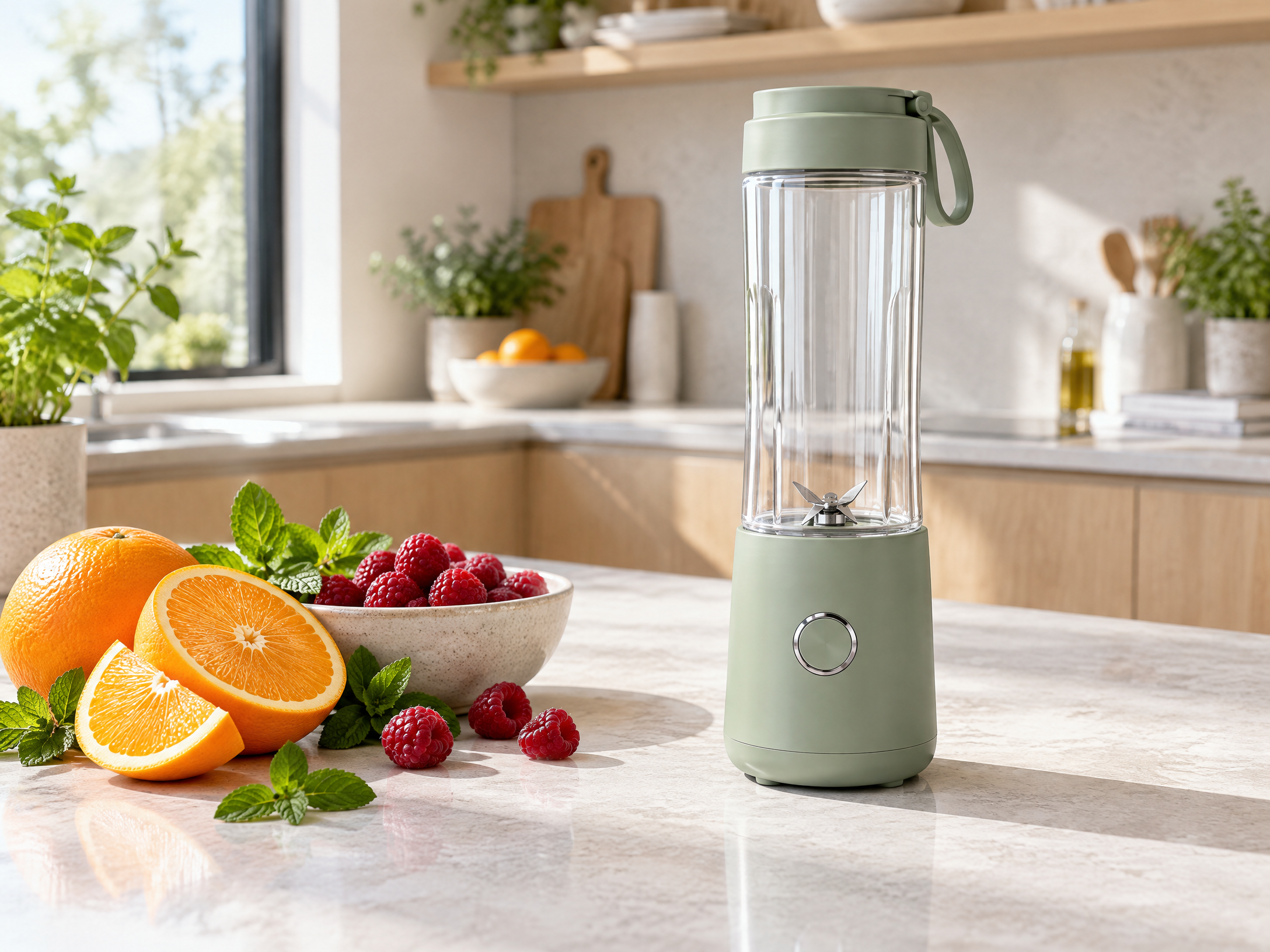
Target Keywords: portable blender blade assembly; portable blender motor speed; personal blender jar capacity; portable blender charging platform; portable blender travel lid design; portable blender food contact compliance; small appliance battery IEC 62133
Direct answer: Freeze the sellable configuration before requesting evidence. For a rechargeable portable blender, that means deciding the battery pack and its cell identity, the charging interface and supplied accessories, the jar material and capacity, the lid’s drinking and sealing functions, and the blade-base/motor arrangement. Then request documents and samples that identify those exact parts and intended uses. A report or declaration for a look-alike product is not automatically applicable. The correct evidence path depends on the final configuration, destination market, claims, and competent review; this guide is procurement guidance, not a legal determination.
A private-label portable blender is often discussed as one product decision. In practice, it is a group of linked choices: a battery and protection arrangement inside a base; charging electronics and a user-facing port; a vessel that contacts food; a lid that may be used away from the base; and a rotating mechanical system. Each choice affects the specification, documentation request, artwork, supplier controls, and launch route.
This guide deliberately concentrates on those battery-platform, jar, lid, and evidence decisions. It is not a substitute for an end-to-end portable-blender safety checklist or a laboratory test plan. Buyers needing a broader control sequence for interlocks, handling hazards, samples, and shipment checks should also read UZYVO’s portable blender safety specifications checklist. The useful commercial question here is narrower: which alternatives should be resolved early enough that the resulting evidence can truly describe the product being bought?
1. Turn a consumer concept into a controlled configuration
Begin by separating a consumer-facing concept from an approval-ready configuration: a model/revision, controlled BOM or exploded view, and market matrix. Record every part that can affect the proposition or evidence—cup resin/colourant, gasket, lid, blade base, motor, cells, battery pack, board, port, cable, adaptor, firmware, packaging and manual—and link engineering-sample photographs to that revision. “Same mould” or “same battery type” is not adequate identity control.
| Decision area | Freeze before evidence is requested | Why it needs its own record |
|---|---|---|
| Use proposition | Cold-drink ingredients, intended user, fill guidance, expected cleaning and mobility scenario | Defines the intended conditions against which documents and instructions are assessed |
| Power system | Cell designation, pack layout, PCB/protection revision, input rating and charge interface | A different cell or board can break the link to battery evidence |
| Food-contact system | Cup, lid, seal, blade-adjacent wetted materials, pigments and decoration location | Materials and use conditions are not interchangeable |
| Mechanical system | Blade-base revision, motor, shaft/hub design, cup engagement and lid geometry | Changes can affect fit, function, documentation and sample comparison |
| Market presentation | Destination countries, supplied adaptor/cable, language, claims and retailer requirements | Requirements and responsibility depend on the final destination and route |
2. Choose the battery platform before approving industrial design
The phrase small appliance battery IEC 62133 is useful to a buyer only when it leads to a specific question: does the identified portable sealed lithium cell or battery and its evidence align with the final pack used in this appliance? IEC 62133-2:2017 specifies requirements and tests for portable sealed secondary lithium cells and batteries under intended use and reasonably foreseeable misuse.[1] It does not, by itself, approve every appliance built around a cell or decide every destination-market obligation.
Request the cell maker/designation, chemistry, pack arrangement, protection/BMS board revision, interconnections, relevant thermal features, and physical restraint. A report or summary must trace to the cells and pack actually installed; “a 62133 battery” does not do that. In the EU, Regulation (EU) 2023/1542 applies to batteries incorporated into products and sets safety, labelling, marking and information requirements.[2] Its application, timing and operator duties need assessment for the actual category and market.
| Buyer question | Evidence or output to request | Decision risk if left open |
|---|---|---|
| What is physically inside the base? | Controlled pack description, photographs before enclosure closure, cell and board identifiers | A report may refer to a different cell, pack or board |
| Who can change a cell or PCB? | Written change-notification and approval process | Cost or supply changes may silently alter the submitted configuration |
| What travels with the goods? | Current UN 38.3 test summary matched to the shipped battery design, plus shipment-specific confirmation | Transport preparation is delayed or based on an unmatched document |
| What can the buyer state? | Approved, bounded claim language linked to documents | Marketing turns a component document into an unsupported product claim |
PHMSA states that lithium batteries must undergo UN 38.3 design tests and explains the test-summary requirement.[3] The summary is transport evidence, not a blanket product-compliance certificate; the shipment route and carrier requirements still matter.
3. Define the portable blender charging platform as a system
A portable blender charging platform combines the port, cable, charge-control electronics, pack, any supplied adaptor/dock, indicators, instructions and expected power-source environment. Freeze whether the product ships with cable only, adaptor or dock in the BOM and packaging. A USB-C-shaped port does not establish evaluated input behaviour; a supplied adaptor is a defined accessory. Match the final label and manual to the approved input, connector, pack contents and indicator behaviour, without claims broader than the support.
For the EU, the Low Voltage Directive covers electrical equipment operating between 50–1,000 V AC or 75–1,500 V DC; the Commission identifies household appliances, cables and power supply units among the equipment in its scope.[4] A low-voltage blender base may need assessment under another applicable framework, while a mains adaptor can sit within the stated voltage range. The exact regulatory route must be mapped against the final supplied configuration and destination, rather than inferred from the product name.
| Platform decision | Procurement specification | Evidence-review prompt |
|---|---|---|
| Port/interface | Port type, ingress-protection expectation if claimed, connector placement and mechanical retention | Does the sample, drawing and manual identify the same interface? |
| Cable | Included/not included, connector ends, length tolerance if commercially material, part number and markings | Is the cable in the pack list and controlled as an approved component? |
| AC adaptor or dock | Included markets, ratings, plug variants, model number and labelling | Has the supplied accessory been assessed as part of the final market configuration? |
| Controls | Charge termination, indicator definitions, fault/user messaging and firmware revision | Are claims about charging or indication supported for this board revision? |
| Artwork | Input statement, prohibited use, support details, languages and carton contents | Does artwork introduce a promise or accessory not in the approved BOM? |
The EMC Directive addresses emissions and immunity of electrical/electronic equipment used as intended.[5] Keep the charging board, cable and supplied accessory under change control; that does not itself establish compliance.
4. Specify motor speed and the blade assembly without turning either into marketing shorthand
A buyer should not choose portable blender motor speed from a marketplace comparison. A speed figure varies with load and supply conditions and does not alone establish ingredient suitability, run time, noise, thermal behaviour, or durability. Define the intended ingredients and instructions, then have engineering or a qualified laboratory identify a relevant method and acceptance basis; do not invent a universal RPM, cycle, torque, or blending threshold.
The portable blender blade assembly is also a system, not merely a stainless-steel blade specification. Record the blade geometry, material declaration, hub/shaft connection, retention method, blade-base sealing interfaces, motor/shaft relationship, cup engagement geometry, and revision. These are the details that let the buyer decide whether a revised blade base is covered by previous evidence or needs escalation.
IEC 60335-2-14:2025 covers household and similar kitchen machines, including blenders and battery-operated appliances, and addresses electronic interlock functions.[6] It is a technical reference, not a shortcut to approval; applicability depends on the product and market.
| Requirement statement | Better buyer wording | Why it is stronger |
|---|---|---|
| “High-speed motor” | State the intended ingredients, maximum fill/use instructions, duty-cycle claim if validated, and configuration revision | Links the proposition to an evaluable use case |
| “Premium steel blades” | Identify blade/base part number, metal declaration, retention design, wetted surfaces and revision | Prevents a material label from standing in for the whole joint |
| “Safe smart start” | Describe required safe-state behaviour, cup engagement condition and controlled software version | Gives reviewers something observable and traceable |
| “Crushes anything” | Remove unless the final model has defined, supportable use instructions and evidence | Avoids a broad claim that the configuration cannot substantiate |
5. Set personal blender jar capacity around use, fill control, and evidence
Personal blender jar capacity needs three controlled values: nominal vessel volume, maximum fill line, and usable volume under instructed conditions. They may differ because of headspace, ingredients, cleaning and transport. Finalise them with the cup geometry, lid, blade-base relationship and instructions. For each jar record the part number, resin/colourant, geometry, fill line, lid interface, gasket and decoration; a colour, supplier, sleeve or fill-line change can warrant review.
| Jar decision | Buyer acceptance question | Evidence implication |
|---|---|---|
| Nominal volume | What quantity is actually being marketed? | Ensure listing, carton and manual use a controlled expression |
| Fill line | Where is it placed and how is it made durable/readable? | Compare final samples and artwork; link it to use instructions |
| Cup geometry | Does the vessel fully engage the base and lid in the intended configuration? | A geometry revision can affect both mechanical function and sample comparability |
| Cleaning proposition | What cleaning method and temperature claims are made? | Do not assume material suitability without relevant support |
| Replacement cup | Is it interchangeable across revisions? | Define compatibility and traceability rather than relying on appearance |
6. Treat the travel lid as a separate user interface
A portable blender travel lid design can make the jar a drinking vessel, carry container, or both. Specify closure, sealing surfaces, venting, drink opening, valve/straw, carry feature, cleaning access, user instructions, and detached-jar use. Do not use “leak-resistant,” “spill-proof,” “travel-ready,” or “dishwasher-safe” by default: retain an appropriate technical basis and limits for the final lid/jar/seal combination.
Consider a small, controlled lid matrix:
| Interface | What to define | Production control to ask about |
|---|---|---|
| Cup-to-lid | Thread/bayonet geometry, start position, seal and closure feedback | Mould/revision identification and seal-lot control |
| Drink opening | Cap, flap, straw, valve or plug position; cleaning access | Assembly presence/orientation check |
| Carry feature | Intended load/use limitation and attachment geometry | Material/revision control and visual inspection criteria |
| Decoration | Location relative to food contact and abrasion | Artwork approval and material/decorator declaration |
7. Build portable blender food-contact compliance part by part
Portable blender food contact compliance should be approached as an evidence map, not a one-line “food grade” claim. The European Commission explains that food-contact materials include containers, food-processing machinery, kitchenware, and tableware; their constituents can affect food safety, taste, smell, and appearance.[7] For EU placement, the Commission describes Regulation (EC) No 1935/2004 as the framework for food-contact materials and states that such materials must also be manufactured under good manufacturing practice.[7]
Start with all wetted parts—not only the transparent jar. Map cup, lid, gasket, straw/valve, blade-adjacent components, coatings, overmoulded areas, and any surface reasonably able to contact the drink. Record each supplier, part number, resin/elastomer/metal identity, colourant or masterbatch, adhesive or decoration if relevant, intended use, and linked document. Distinguish raw-material statements, finished-article declarations, and migration evidence; they answer different questions.
For plastic FCMs in the EU, the Commission’s legislative guidance notes specific rules on composition, restrictions, migration testing, and a Declaration of Compliance supported by documentation for plastic materials and articles.[8] The appropriate simulants, time/temperature conditions, repeated-use case, and applicability of documents depend on the final material and use. A declaration that names a generic resin is not necessarily support for a coloured, assembled, reusable jar in a specific market.
The U.S. FDA defines a food-contact substance broadly to include food packaging/components, processing equipment, preparation surfaces, and cookware; it states that a food-contact substance that is a food additive must be authorised for that intended use before U.S. marketing.[9] For a U.S. program, seek materials evidence matched to intended use rather than using “FDA approved” as catch-all marketing language. Qualified regulatory advice may be appropriate where the route or evidence is uncertain.
| Food-contact part | Minimum buyer record | Question to resolve before approval |
|---|---|---|
| Jar/cup | Exact resin, colourant, supplier, part number, intended contact/use conditions | Does documentation cover this exact material and colour configuration? |
| Lid and drink port | Material, seal/valve components, decoration location and contact side | Can all drink-contact surfaces be identified, including hidden inserts? |
| Gasket | Elastomer type, pigment, supplier and use/cleaning conditions | Is the seal evidence appropriate to repeated contact and intended care? |
| Blade-base wetted area | Metal/coating/polymer identity and part drawing | Which surfaces can contact the beverage during normal use and cleaning? |
| Marketing copy | Claimed food, temperature, cleaning and reuse conditions | Does the claim remain within the documented intended use? |
Mid-article CTA — Need a configuration-led portable blender RFQ? Share the destination market, target jar/lid concept, charging arrangement, intended ingredients, and reference sample with UZYVO’s sourcing team. UZYVO can help structure the supplier discussion and document-request list; final applicability and evidence remain dependent on the sellable configuration and qualified review.
8. Sequence samples and evidence so each decision has an owner
Do not wait for the pre-production sample to discover that the jar declaration names another colour or the supplied cable differs from the documents. Create a staged decision gate. The objective is not to promise a pass; it is to expose configuration drift while a change is still manageable.
| Gate | Buyer confirms | Hold point |
|---|---|---|
| Concept brief | Target market, use case, desired jar/lid route, charging concept, claims to avoid | Do not request final reports against an undefined BOM |
| Engineering sample | Base/cup/lid engagement, preliminary component IDs, charge interface, visible markings | Record gaps and freeze a revision for evidence generation |
| Evidence review | Reports/declarations identify the correct parts, conditions, scope, date and issuer | Escalate mismatched cells, resin, cable, board or accessories |
| Pre-production sample | Tooling parts, actual colour, final artwork, pack list, manual and traceability | Compare with the frozen configuration and submitted documents |
| Shipment release | Order-level identity, cosmetic/functional checks, carton and document consistency | Inspection does not replace technical assessment or laboratory evidence |
Assign ownership: engineering owns configuration identity; sourcing owns supplier commitments and change notice; quality owns comparison records and nonconformance response; regulatory/market lead owns destination review; marketing owns bounded claims. One person should coordinate the decision register, but no single generic “certificate” should replace these responsibilities.
For facility and process questions—such as how approved components are identified, how changes are recorded, or how final assembly is compared with the golden sample—buyers can review UZYVO’s factory capabilities before arranging a supplier discussion. The result should be a documented control plan for the chosen configuration, not an assumption about every factory or model.
9. Make destination-market and logistics choices explicit
A portable blender that sells through direct-to-consumer channels, retail, or distribution may share the same hardware but not the same launch file. Make a matrix for each destination with importer/brand responsibilities, languages, product and battery markings, supplied accessories, required declarations or records, claims, retailer conditions, and transport route. Update it when the product variant changes.
Do not treat a voluntary document, a test report title, or a logo as a legal conclusion. The European Commission cautions that voluntary or other additional certificates are not recognised means of proving conformity under EU harmonisation law, and CE marking follows the applicable conformity-assessment procedure rather than appearing on a certificate.[5] Obtain competent market-specific advice where necessary.
If the product adds Bluetooth, a wireless module, or another RF function to support a dock or app, the analysis changes. In the United States, the FCC says RF devices subject to its rules must be properly authorised before marketing or importation, with the required procedure depending on the device.[10] A standard wired charging choice and an RF-enabled feature should therefore be kept separate in the product roadmap and evidence register.
| Launch-file item | Configuration dependency | Buyer action |
|---|---|---|
| Battery transport records | Cell/pack design, shipment arrangement, carrier route | Reconcile the summary and shipping information with the goods actually tendered |
| Manual and labels | Market, language, power input, pack contents and product claims | Lock artwork only after the specification and review are aligned |
| Electrical/accessory file | Base, cable, adaptor/dock, board revision and destination | Assess the sold bundle, not only the base unit |
| Food-contact file | Wet parts, colour, intended use and market | Retain the part-level evidence map with revision control |
| Retailer submission | SKU, packaging, claims, destination and channel | Give retailers only statements supported by the final file |
10. Use a buyer scorecard—and ask focused questions before a PO
A scorecard prevents a visually attractive sample from dominating the decision. Score the completeness and traceability of evidence rather than trying to score safety or compliance as a simple percentage. A “not yet confirmed” response is useful: it tells the buyer to hold, change the concept, obtain qualified input, or negotiate a supplier action.
| Approval dimension | Ready when | Not ready when |
|---|---|---|
| Configuration control | BOM, revision, photographs and samples point to one sellable build | Key parts are described generically or samples cannot be identified |
| Battery/charging | Cell/pack, board, port, cable and accessories are identified and the intended evidence is mapped | Battery evidence has no link to the actual pack or bundle |
| Jar/lid | Capacity, fill guidance, materials, contact surfaces and claims are defined | “Food grade” or “leakproof” is used without part-level support |
| Blade/motor | Blade-base/motor revision and intended-use limits are controlled | A speed claim replaces a design and evidence discussion |
| Market route | Destination, operator role, labels, languages, logistics and records are mapped | One document is assumed to cover all markets and configurations |
| Change control | Supplier must notify changes and buyer can approve/reject before use | Equivalent substitution is allowed without a written impact review |
Buyer FAQs
1. Can we launch with a generic battery test report if the capacity looks the same? Not as final approval evidence without a documented applicability review. Capacity alone does not establish that the cell designation, pack construction, protection board, charge-control arrangement, or final appliance are the same. Ask which exact configuration the report covers, then evaluate it against the frozen BOM and destination requirements. IEC 62133-2 is a battery safety standard; it is not an appliance-wide or market-wide approval.[1]
2. Is USB-C enough to define our charging platform? No. It describes only a physical interface. Define the input rating, included cable, adaptor/dock if any, control-board revision, user indicators, manual wording, and destination-specific bundle. Review whether any supplied power accessory changes the applicable assessment route. Avoid claiming universal charger compatibility unless the exact scope has been supported.
3. Does a larger jar mean a better personal blender proposition? Not necessarily. Larger nominal volume can conflict with usable fill guidance, cup geometry, lid handling, portability, and the intended ingredient/use instructions. Approve the personal blender jar capacity only after those relationships, markings, material record, and final claims are aligned.
4. Can a supplier declaration prove food-contact suitability for every market? It can be an important input, but it must identify the material and intended conditions of use, and it may need to be supplemented by other supporting documentation or testing. EU and U.S. routes differ, and a destination may add requirements. Evaluate the finished food-contact system—not just a generic resin name—and seek qualified advice where the evidence route is unclear.[7][9]
5. What should cause a re-review after sample approval? At minimum, a change to cell, pack, BMS/PCB, charge port, cable/adaptor, firmware, motor, blade base, cup resin/colour, gasket, lid, wetted coating, mould geometry, manual, or carton claim should be logged and assessed. Whether it demands retesting, document revision, a new sample, or a market review depends on the change and final destination.
For broader sourcing questions about samples, factory controls, and market launch, direct internal stakeholders to UZYVO’s Buyer FAQ. The practical output from this module is a purchase-order appendix: frozen revision, approved accessory list, change-notification terms, document index, claim boundaries, and release gates.
11. Conclusion: buy the evidence chain, not the headline feature
The strongest brief has a battery, charge interface, jar, lid, blade base, motor, documents, artwork, and market plan that all describe one final configuration. Before committing packaging or a production order, ask which cells and board are inside, which cup/seal contact the drink, which charge arrangement is supplied, and what happens after a substitution.
Keep the scope narrow: a battery test summary does not prove appliance safety, a material declaration does not substantiate every food-use claim, and a sample observation does not guarantee production. Applicability depends on the sellable configuration, destination, supporting evidence, and qualified review.
Closing CTA — Build a portable-blender brief that suppliers can quote and document. Email info@uzyvo.com with your target markets, jar capacity range, lid concept, charging preference, reference product, and planned sales channel. UZYVO can help organise an OEM/ODM RFQ and evidence-request framework for the final configuration.
AI Image Recommendations
1. Configuration-review hero image
Purpose: Show that the buying decision connects the base, jar, lid, cable, and documentation rather than presenting a consumer lifestyle claim. Insertion point: After the introduction. English caption: A procurement review aligns a portable blender base, personal jar, travel lid, and charging cable as one controlled configuration. ALT text: Unbranded rechargeable portable blender base, clear jar, travel lid and charging cable arranged beside a specification sheet on a clean desk. AI image prompt: Photorealistic B2B product-procurement photograph, unbranded rechargeable portable blender with a clear personal jar, separate travel lid and neutral charging cable arranged on a clean engineering review desk, a blank non-readable specification sheet and calipers nearby, soft daylight, modern appliance development studio, no people, no logos, no visible certification marks, no readable text, no claims, 16:9 landscape.
2. Food-contact component evidence map
Purpose: Visualise part-level documentation for wetted components without implying a laboratory result or certification. Insertion point: In Module 7 after the food-contact evidence-map discussion. English caption: Buyers map each food-contact component to its material and revision record before approving launch artwork. ALT text: Quality specialist examining an unbranded blender jar, lid, gasket and blade base on an organised ESD-safe workbench. AI image prompt: High-detail photorealistic factory quality-control scene, gloved quality specialist examining an unbranded clear blender jar, lid, silicone gasket and blade base on an orderly workbench with blank part tags and a tablet displaying no readable text, neutral factory lab, no food, no spinning blades, no logos, no certification symbols, 3:2 landscape, credible technical B2B photography.
3. Charging-system sample comparison
Purpose: Help readers see why a port, cable, battery base, and supplied adaptor must be reviewed as one sellable bundle. Insertion point: In Module 3 or Module 8. English caption: An engineering team compares the approved charging interface and included accessories with a portable-blender sample. ALT text: Engineers reviewing an unbranded portable blender base with charging port, cable and power adaptor on a test bench. AI image prompt: Photorealistic small-appliance engineering laboratory, two engineers in plain lab coats review an unbranded portable blender base with a visible charging port, neutral cable and compact power adaptor laid beside it on a safe clean test bench, blank measurement instruments in background, no energized hazard, no readable labels, no logos, no certification marks, 16:9 landscape, technical sourcing documentation style.
References
Put the buyer guide into a practical sourcing path.
Bring this framework into your next product brief.
Share your target market, appliance category, annual volume, and launch window. We will discuss a practical sample, documentation, and production path for the final configuration.
Email info@uzyvo.com