Introduction
Short answer: No. kPa alone is not enough to compare handheld-vacuum performance. kPa indicates the pressure difference a vacuum can create at a sealed or nearly sealed inlet, but it does not show how much air the unit moves when a nozzle is open to debris. For a defensible supplier comparison, require sealed suction (kPa), airflow (L/s or CFM), maximum air power/air watts, the full test condition, and a matched-sample record. ASTM F558 is a useful starting point because its scope includes hand-held vacuum cleaners and its procedures cover suction, airflow, air power, maximum air power and input power; however, the final model and test setup must be confirmed with the selected laboratory because the published scope has equipment limitations. [1]
A useful buying rule is simple: do not compare a 20 kPa headline from one supplier with a 100 AW headline from another. First establish whether both numbers describe the same product configuration, battery state, mode, inlet, filter condition, test method and operating point. Then judge whether the resulting measured performance makes sense for the intended job.
Handheld vacuum claims are particularly easy to overread. A compact product can produce an impressive sealed-pressure number while moving modest air through an open crevice tool. Another can move high free airflow but lose pressure when the inlet becomes restricted. Both may be commercially viable, but they are not interchangeable propositions. The buyer’s task is to turn a marketing number into a controlled specification, a repeatable test, and an approved claim.
1. Treat suction as a system question, not a single-number contest
A handheld vacuum removes material by creating a pressure difference and moving air through the nozzle, tool, inlet screen, dust cup, filters, ducting, fan, motor, exhaust and seals. Every restriction changes its operating point. The motor does not deliver peak pressure and peak airflow at once.
kPa is suction pressure. In a sealed-inlet test, airflow approaches zero and pressure can approach its maximum. It indicates ability to create a pressure differential against a restriction, not debris transport through an open nozzle. Treat “20 kPa suction” as a conditional engineering result, not universal cleaning performance.
Airflow is air volume per unit time: L/s, m³/min or CFM. It carries dust and crumbs into the bin. Free-air flow is useful but incomplete because it is measured with low restriction and relatively little vacuum pressure.
Air power, often air watts (AW), combines pressure and airflow at a stated operating point. In SI terms it is pressure difference in pascals times volumetric flow in cubic metres per second. AW brings both variables into the discussion, but does not replace the curve, tool, filter condition or pickup test.
ASTM F558 says its results compare maximum potential air power under its conditions, not actual cleaning air power, because tools and surfaces affect the result. [1] A valid bench figure supports a bounded claim, not identical cleaning on every surface.
| Metric | What it describes | What it can help a buyer compare | What it does not establish alone |
|---|---|---|---|
| Sealed suction, kPa | Pressure difference at near-zero airflow | Fan pressure capability; restricted-inlet behavior | Air volume, debris transport, tool losses or runtime |
| Airflow, L/s or CFM | Air volume moved per unit time, often at low restriction | Throughput potential and duct/nozzle resistance | Pressure available under restriction or cleaning effectiveness |
| Air power, AW | Pressure × airflow at a defined operating point | Combined bench air-performance potential | Actual pickup on every surface, battery endurance or filtration |
| Input power, W | Electrical power drawn at the stated condition | Electrical demand and an efficiency discussion | Air performance or pickup by itself |
| Pickup result, % or mass | Material removed in a defined application test | Use-case validation for a specific setup | Transferability to different debris, tools and surfaces |
The right decision is not “choose the highest number.” It is “choose the configuration with sufficiently verified air performance and use-case results for the promised position, while meeting runtime, noise, ergonomics, cost and compliance requirements.”
2. Know what a comparable kPa, airflow and AW claim requires
Comparison requires a matched test basis. One supplier may report bare-inlet sealed kPa in Max; another may report crevice-tool airflow in Normal. Both may be real yet incomparable.
Start by asking the supplier to define the claim in a one-page claim data sheet. The sheet should identify the model and revision, accessory/nozzle, operating mode, battery pack, battery state, filter and bin condition, instrument type, test method, ambient conditions, calculation method, sample count, individual results, result selected for marketing, date and signer. Traceability to that tested configuration—not a product photo—makes the evidence useful.
| Comparability gate | Buyer question | Acceptable evidence | Red flag |
|---|---|---|---|
| Product identity | Is it the same mechanical and electrical revision being quoted? | Model, BOM revision, motor/fan and battery identifiers | Generic report with no revision control |
| Operating mode | Was performance recorded in Eco, Standard or Max? | Mode name and control setting in report/video | “Maximum suction” with no mode stated |
| Air path | Was the tool fitted? Which inlet adapter and diameter were used? | Photo or drawing of fixture and tool | Bare motor report used to sell a finished tool |
| Filter/bin state | Was the filter clean, dry and correctly seated? Was the bin empty? | Preparation log and photos | No disclosure, or post-use sample only |
| Battery condition | What was charge state, voltage and rest period? | Charging/voltage record | Full claim based on a battery condition that cannot be repeated |
| Method and instruments | How were pressure and flow measured and calculated? | Method reference, equipment IDs and calibration status | Screenshot of a gauge without flow data |
| Population | Is the number an average, best result or minimum? | Individual sample readings and aggregation rule | One unusually high sample presented as typical |
Be exact: “Up to 20 kPa” differs from “20 kPa in normal operation,” and “100 AW” needs a visible derivation. FTC guidance says objective express and implied claims need a reasonable basis before dissemination; “tests prove” signals a stated level of support. [2] Preserve method, raw results and approved copy before artwork.
For a private-label program, the brand owner should decide in writing whether claims are published as a verified maximum, a qualified “up to” result, a nominal range, or not published at all. This is procurement and claim-control guidance, not legal advice; the applicable advertising rules and evidence threshold should be confirmed for the sales market and final creative.
3. Request the minimum test package before you rank suppliers
An RFQ need not buy every laboratory test, but it must prevent apples-to-oranges selling. Require a minimum comparable air-performance package for every shortlisted model, then deepen evidence before tooling release or PO approval.
The first package should include kPa, airflow, maximum AW, input power, a pressure-flow curve or paired points, and exact conditions. ASTM F558 is a useful request reference because its scope includes hand-held vacuums and lists those measurements. [1] A laboratory must still confirm applicability: the published scope specifies hose-attachment provisions and a series universal motor, so do not assume it covers every battery-powered brushless model. [1]
| Project stage | Minimum evidence to request | Decision it supports |
|---|---|---|
| RFQ / supplier screen | Claim data sheet; photo of product; kPa, airflow and AW; stated mode and accessory | Which candidates deserve samples |
| Engineering sample | Raw readings or curve; test video; fixture photos; battery and filter preparation log | Whether supplier numbers are reproducible |
| Golden-sample approval | Controlled report on identified sample; final BOM/configuration; approved claim wording | Packaging, PDP and retail copy lock |
| Pilot production | Repeat test across selected units; change-control review | Whether approved performance survived production transfer |
| Pre-shipment | Identity, function and workmanship checks against the approved sample and AQL/inspection plan | Whether goods may ship under the agreed specification |
Ask for the curve because isolated maxima conceal the trade-off: near a sealed inlet, pressure is high and flow low; with an open inlet, the reverse applies. The middle range is where tools, filter loading and debris act. Do not present an isolated number as a full technical comparison.
An early quote need not carry a laboratory report. Use escalating evidence: factory data for screening, then controlled evidence before claims reach a retailer, listing, carton or manual. Recheck after a motor, fan, filter, battery or nozzle change.
4. Build a realistic factory test protocol that another party can repeat
A credible factory check is a documented setup controlling variables that move the result, not merely a gauge over an inlet. Have the supplier or independent laboratory propose it, then approve it against the claim and configuration.
A typical bench uses a matched sealed adapter, pressure measurement, controlled flow or flow measurement, paired readings and, where relevant, an electrical meter. Record calibration, adapter leakage and fixture dimensions. State whether airflow is measured or normalized and the AW formula. Do not calculate AW from maximum airflow and maximum sealed pressure: they occur at different points.
Preparation controls that matter
Specify a clean, dry fitted filter; empty seated dust cup; intact seals; charged battery; selected mode; and named accessory. Record whether the unit is new or conditioned and its voltage or charge state. Never compare a dried filter with a damp or loaded one.
For cordless products, test at the specified starting condition and consider a second, timed checkpoint. This distinguishes a brief boost result from a sustained setting or a rapid drop. Match approved consumer wording to that result.
Recommended record for each run
| Record field | Why it matters |
|---|---|
| Model, serial number, BOM and firmware version | Links a reading to a traceable sample |
| Motor/fan, battery and filter identifiers | Detects silent component substitutions |
| Charge condition, voltage and selected mode | Controls cordless operating state |
| Tool/nozzle and inlet-adapter photos | Shows actual air-path geometry |
| Ambient temperature and relative humidity | Adds context to repeatability assessment |
| Instrument ID and calibration due date | Supports confidence in the measurement chain |
| Paired pressure-flow readings and AW calculation | Prevents combining incompatible maxima |
| Operator, date, repetitions and anomalies | Makes the test auditable and repeatable |
Use video only as support for a signed report and raw data. It should show product identity, preparation, mode and fixture. Retain failed or anomalous readings, not merely the best run, so divergent factory and inspection results can be investigated.
5. Translate the intended application into a performance specification
A handheld vacuum should be specified for its job. A light desktop crumb cleaner, a vehicle-detailing unit and a premium upholstery tool can all have different preferred pressure-flow balance, nozzle architecture, bin capacity, runtime and noise profile. The same kPa target can therefore produce the wrong product if its airflow, accessory and filtration choices do not match the application.
| Intended application | Relevant air-performance question | Additional application checks | Claim discipline |
|---|---|---|---|
| Vehicle crevices and seat rails | Does the crevice tool retain useful airflow under partial blockage? | Tool reach, hose stiffness, sand/crumb collection, runtime in Max | Avoid implying deep-clean performance without a defined test |
| Upholstery and fabric seams | Does the tool pick up hair and fine debris without excessive clogging? | Brush design, fabric drag, filter loading, noise | Define surface and debris in any pickup claim |
| Desktop, keyboard surrounds and drawers | Is low-to-moderate flow controllable around lightweight items? | Crevice geometry, exhaust direction, convenience, charge time | Do not use a vehicle-oriented kPa headline as sole proof of suitability |
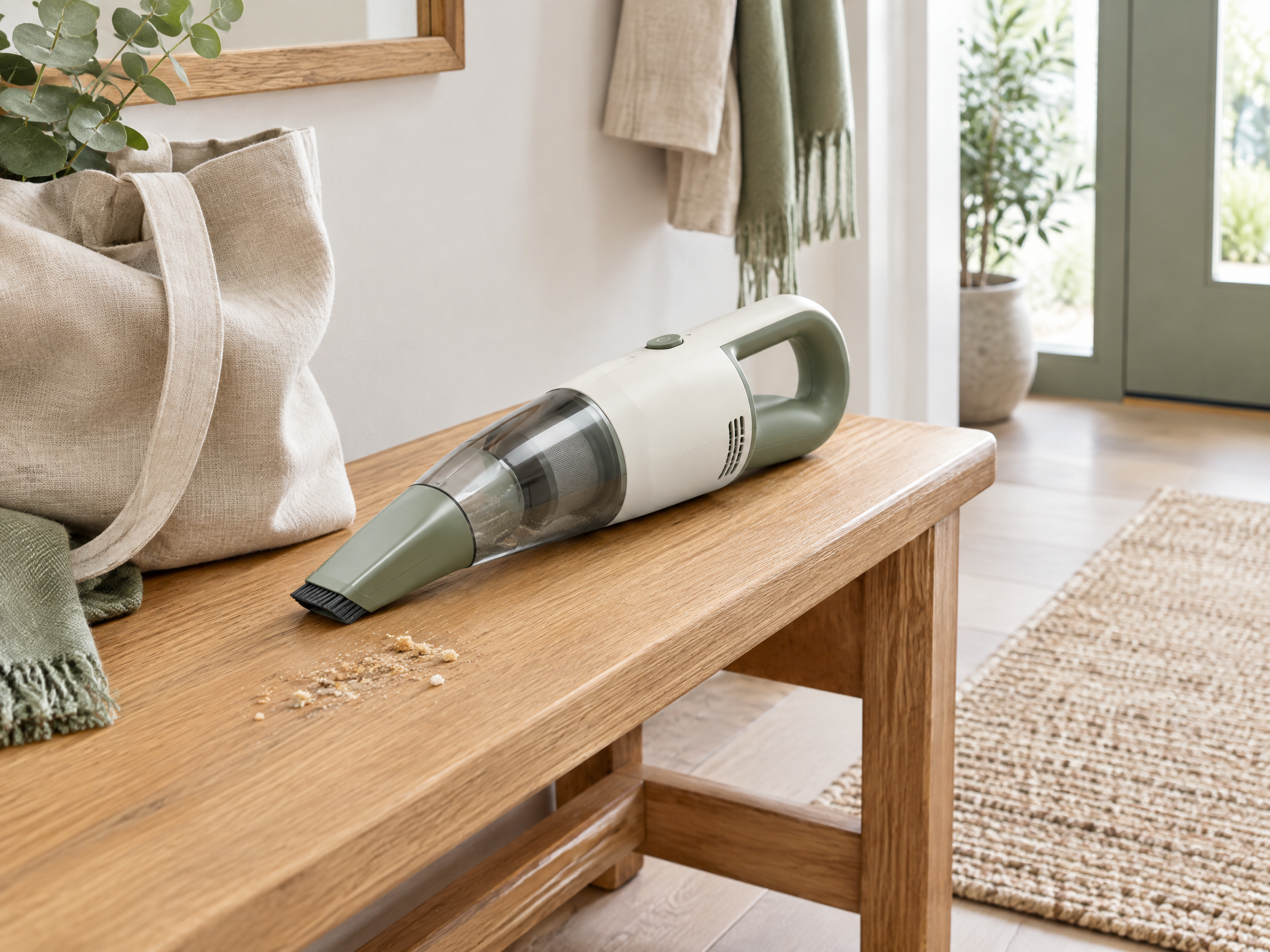
| Kitchen crumbs and dry spills | Can the nozzle ingest the target particle sizes without bridging? | Bin access, filter cleanout, food-contact assumptions where relevant | Do not imply wet pickup unless the final model is designed and validated for it |
| Pet-hair touch-ups | Does the airflow and brush/nozzle combination lift hair on the named textile? | Tangling, brush cleaning, capacity and repeatability | State fabric/debris conditions; do not generalize from one swatch |
Create an application matrix listing substrate, debris type/size, nozzle, passes, duration, mode, filter condition and pickup measure. A vehicle trial can use defined dry sand and crumbs in a seat-rail mock-up; upholstery can use hair analog material on a named textile. Keep the protocol stable across samples and suppliers.
Use the result as a commercial filter, not a universal promise. Do not turn it into “removes all pet hair” without claim-specific support for the exact wording and markets. The FTC guidance covers the overall message, including reasonable inferences. [2]
Mid-article sourcing CTA
6. Review samples as controlled evidence, not showroom demonstrations
An impressive sample is not a production claim basis. Combine a bench check, application trial, construction review and document comparison, using the same sample identity in every record.
Confirm color, tooling version, battery, charger, accessories, filter, bin latch and modes. Then charge the unit, fit the specified filter and tool, empty the bin and record settings. Treat a premium battery, upgraded fan or different filter as non-conforming—not an informal upgrade.
| Sample-review area | Questions to ask | Evidence to retain | Approval status example |
|---|---|---|---|
| Claimed suction | Does measured sealed suction meet the agreed claim basis? | Reading, fixture photo, sample serial | Pass / hold / re-test |
| Airflow and AW | Are paired data and calculation method complete? | Curve or table, calculation sheet | Pass / data gap |
| Application trial | Does it pick up defined debris on the stated surface? | Before/after photos, protocol, mass result if used | Pass / revise tool |
| Runtime | Is the tested mode and endpoint stated clearly? | Timed video/log; charge condition | Informational / acceptance item |
| Filter and bin | Are fit, removal, cleaning and seal consistency acceptable? | Photos, fit check and leakage observations | Pass / tooling action |
| Noise and vibration | Is the user experience acceptable for target retail tier? | Distance, mode and informal observation record or instrument result | Pass / benchmark review |
| Safety/compliance file | Is the documentation applicable to the final design and intended market? | Document index and revision cross-check | Legal/compliance review required |
Use a three-sample comparison: claim sample, retained reference and newly drawn engineering/pilot unit. If the claim unit is consistently stronger, investigate cell grade, charger behavior, fan tolerance, leakage, filter density, calibration and setup. Approve copy only against production-representative conditions.
Lock the golden sample with key-assembly photos, performance range/minimum, mode names, battery/charger, accessories, claim wording and change notification. Motor, fan, filter, cell, firmware, tool or seal substitutions can change both performance and claim basis.
7. Make performance claims survive production and shipment inspection
Sample approval is not the endpoint. Variation, rework, substitutions, battery aging, damage and mismatched accessories can detach a claim from shipped goods. Link the claim to the lot without treating a rapid pre-shipment check as full laboratory qualification.
Separate identity checks, functional screening, periodic performance audit and shipment release. Confirm BOM/golden-sample identity; check switching, modes, charging, basic response and abnormal noise; audit selected units on the controlled fixture; and release against quantity, carton, accessories, workmanship and sampling criteria.
| Checkpoint | Typical scope | What it should catch | What it cannot prove alone |
|---|---|---|---|
| First-article / line start | Correct components and assembly against golden sample | Wrong motor, filter, battery, tool or wiring | Long-run process stability |
| In-process functional test | Switch, mode, charging, basic airflow/suction response | Dead units, leaks, assembly faults | Claim-level AW on every unit |
| Periodic fixture audit | Sealed pressure and/or paired performance points | Drift, loose seals, fan/motor variation | Whole-lot conformity without a sampling rationale |
| Pre-shipment inspection | Quantity, appearance, carton, accessories, selected functions | Packing errors, cosmetics, obvious defects | Full regulatory or advertising substantiation |
| Incoming inspection | Delivered identity and damage review; selected verification | Transit damage, mixed cartons, wrong accessories | Root cause before goods have already left origin |
Inspection criteria need sample size, acceptance/rejection rule, product state and failure action. Define mode, battery/filter condition, tool, unit, threshold/range, retest and escalation—not “suction: pass.” If AW is too slow for final inspection, use it in first-article and periodic audits and demonstrate correlation to the line screen.
For cordless models, shipment readiness also includes battery and transport documentation. U.S. DOT guidance states that lithium cells and batteries offered for transportation must have passed the UN Manual of Tests and Criteria, Section 38.3, and that manufacturers must make the test summary available on request. [5] IATA notes that air carriage depends on battery configuration and watt-hour rating, and that identification, packing, marking, labeling and documentation are part of shipper preparation. [6] Determine the final product’s classification and all route-specific requirements with the responsible compliance, freight-forwarding and transport parties; a battery report for another pack, cell design or configuration is not enough.
8. Limitations and decision caveats buyers should state explicitly
Bench air performance is not cleaning effectiveness. ASTM says its results compare maximum potential air power under test conditions, not actual cleaning air power with tools and surfaces. [1] Use kPa, airflow and AW for technical comparison, then use application testing for the retail-use question.
A second limitation is that AW is not self-authenticating. Suppliers may use different points, formulas, rounding, inlets or pre-filter configurations. Require paired source values, units, calculation and fixture. Never derive AW from kPa without same-point airflow.
Third, battery state, temperature, filter/bin condition, blockage and tolerance change results. A full-charge maximum may be valid when accurately qualified, but should not imply sustained performance. State mode and endpoint for runtime claims.
Fourth, performance data do not answer every commercial requirement. Noise, weight, handle comfort, dust-bin emptying, filter replacement, charger compatibility, warranty economics, spare-parts availability, product safety, labeling, packaging, waste obligations and market-specific requirements need separate review. For EU sales, CE marking applies only where harmonised EU rules require it. It is the manufacturer’s declaration of conformity, not a certificate or approval by an EU authority; importers and brand owners should determine the final model’s applicable requirements, technical documentation and responsibilities. [3] [4]
Never infer battery safety or transport readiness from suction. CPSC recalls show that a rechargeable vacuum’s lithium-ion battery can create fire and burn hazards if it overheats and ignites. [7] This is not a claim about any product; treat the pack, charger, documentation, traceability and freight classification separately.
9. Use a decision scorecard to choose the right supplier offer
When prices and headlines differ, use a weighted scorecard. Score only supported evidence and record gaps. A lower-kPa model can be lower risk when its matched dataset, tool performance and change control are stronger.
| Decision criterion | Suggested evidence standard | Example buyer weighting | Decision note |
|---|---|---|---|
| Comparable air-performance data | Matched kPa, airflow, AW and test conditions | 20% | Do not award full score for an isolated kPa claim |
| Application performance | Repeatable defined-debris/surface trial | 20% | Use the target customer scenario |
| Runtime and battery transparency | Mode-specific timing plus pack identity | 15% | Evaluate against actual selling promise |
| Product usability | Sample review of ergonomics, bin, filter and tools | 15% | Include retailer return-risk observations |
| Quality system execution | Golden sample, control plan, corrective-action response | 15% | Score evidence, not assurances |
| Documentation and logistics readiness | Applicable file index, battery/transport evidence as relevant | 10% | Seek specialist review for market requirements |
| Total landed-cost fit | Quote, packaging, tooling, spares and defect-risk assumptions | 5% | Do not let cost erase evidence gaps |
Use evidence confidence as a second axis. A product may score eight out of ten on claims but two out of five on verification. This creates a clear request: provide the curve, final-configuration mapping and repeat-sample result before ranking again.
Claim copy should follow the scorecard. If support is only sealed suction in Max, use a precise qualified claim if approved. Keep application conditions internally defined; remove unsupported numbers. FTC guidance supports having evidence before dissemination, not after a retailer asks. [2]
10. Frequently asked questions about handheld-vacuum suction claims
Is 20 kPa better than 15 kPa?
Not automatically. It may indicate higher sealed suction under the stated test, but it does not reveal airflow, the air-power curve, tool losses, filter condition or pickup on the intended surface. Ask for matched airflow and AW data before deciding.
Should buyers require both kPa and air watts?
Yes, plus airflow and conditions. kPa and airflow describe different ends of the pressure-flow behavior. Air watts combine the variables at an operating point, but the buyer still needs the method, calculation and product configuration to make the number comparable.
Is a free-air CFM number enough?
No. Free airflow describes one low-restriction condition. It does not show how much pressure remains when a crevice tool, debris or filter restriction is present. Pair it with sealed suction and a curve or multi-point test record.
Can a buyer calculate AW from the supplier’s highest kPa and highest airflow?
No. Those two maxima generally occur at different operating points. Calculate air power from paired pressure and airflow values from the same point, using a disclosed method and units.
What should be on a handheld-vacuum test report?
At minimum: model and revision, sample ID, mode, battery state, filter/bin condition, accessory/fixture, method, instrument and calibration information, individual pressure-flow results, AW calculation, input power where relevant, date and signer. Add photos and video as supporting evidence.
Does an ASTM F558 reference prove real-world cleaning performance?
No. The ASTM description says the method compares maximum potential air power under its conditions and does not represent actual cleaning air power with tools and surfaces. [1] Use it for controlled air-performance comparison and add application-specific pickup testing.
Can an OEM’s internal test be used for packaging or an ecommerce listing?
Possibly, but only after the buyer verifies that the method, final configuration and evidence level substantiate the exact claim in the intended market. An internal test can be useful evidence. It is not automatically sufficient simply because it contains a number.
What changes require a claim recheck?
Any change that can affect the air path or power delivery. Typical triggers include fan or motor changes, battery/cell or BMS changes, firmware changes, filter media, seal design, dust bin, nozzle, charger behavior or a revised performance mode.
11. Conclusion: buy the evidence package, not the biggest suction headline
For European and North American importers, private-label founders, distributors and retail category teams, a handheld vacuum’s kPa claim is a starting point. It shows only one dimension of the air system and can be persuasive without being sufficiently comparable. Require sealed suction, airflow, maximum air power/air watts, paired pressure-flow data, a controlled test condition, and a sample traceable to the final configuration.
Then test the use case. A vehicle crevice tool, upholstery nozzle, desktop cleaner and kitchen-crumb product do not create the same restriction or customer expectation. A controlled application trial, sample-review record and golden-sample change-control process turn an attractive claim into a sourcing decision that production and retail teams can defend.
Finally, keep the workstreams distinct. Air performance helps compare cleaning potential. Battery, charger, transport documentation, product safety, labeling and market requirements require their own review. Apply the evidence level to the commercial risk: early factory data for screening, controlled reports for claim approval, and production/inspection controls for shipment release. That approach makes a supplier comparison more honest, more repeatable and less dependent on a single headline number.
AI Image Recommendations
1. End-use and tool-geometry context
Purpose: Establish the end-use context and show why tool geometry and application matter alongside headline suction values. Insertion point: Immediately after the introduction, before Module 1. English caption: A compact handheld vacuum used with a crevice tool for dry debris in a vehicle seat rail; the application determines the relevant performance balance. ALT text: Unbranded handheld vacuum cleaning dry crumbs from a vehicle seat rail with a narrow crevice tool. Detailed English AI image-generation prompt: Photorealistic premium B2B product-application scene in a clean modern vehicle interior, an unbranded matte charcoal handheld vacuum with a narrow crevice tool collecting a small amount of dry crumbs and sand from a seat rail, technician or consumer hand visible but no face, realistic material textures, dust cup visible, bright neutral daylight, shallow depth of field, high-end sourcing catalog photography, horizontal 16:9 composition with empty negative space on the left for editorial layout, no logos, no trademarks, no readable text, no labels, no certification marks, no watermark.
2. Controlled pressure, flow and air-power testing
Purpose: Visualize the controlled factory or laboratory evidence required for pressure, flow and air-power comparison. Insertion point: In Module 4, after the paragraph describing the bench arrangement. English caption: A documented bench setup measures pressure and airflow on an identified handheld-vacuum sample before claim approval. ALT text: Technician testing an unbranded handheld vacuum on a bench with pressure gauge, flow equipment and data tablet. Detailed English AI image-generation prompt: Photorealistic small-appliance factory quality laboratory, professional technician in plain neutral workwear operating an unbranded handheld vacuum connected through a sealed adapter to a transparent airflow test rig, analog differential pressure gauge, digital flow instrument with intentionally unreadable display shapes, data tablet without readable interface, clean calibration-minded bench, cable management, realistic stainless and anodized fixtures, documentary industrial photography, 3:2 horizontal frame, no logos, no trademarks, no readable text or numbers, no certification marks, no watermark.
3. Sample review and application validation
Purpose: Support the sample-review and application-validation discussion with a realistic procurement review scene. Insertion point: In Module 6, after the sample-review table. English caption: A sourcing team compares retained samples, accessories and test notes before approving a golden configuration. ALT text: Procurement team reviewing unbranded handheld-vacuum samples, filters and accessories at a quality table. Detailed English AI image-generation prompt: Realistic B2B sourcing review in a bright Shenzhen-style small appliance showroom or meeting room, three unbranded handheld vacuum samples in different neutral colors arranged on a clean table with crevice tools, washable filters, open dust cups and blank technical sheets with no legible characters, two diverse adult sourcing professionals examining a filter and taking notes, candid but polished corporate photography, controlled color palette, natural light, 16:9 frame, no brand logos, no trademarks, no readable text, no certification labels or marks, no watermark.
4. Shipment inspection and configuration verification
Purpose: Reinforce the shipment-inspection and configuration-verification section. Insertion point: In Module 7, after the inspection checkpoint table. English caption: Pre-shipment inspection checks model identity, accessories and carton condition against the approved configuration. ALT text: Quality inspector checking unbranded handheld vacuum accessories and export cartons in a warehouse. Detailed English AI image-generation prompt: Photorealistic export warehouse quality-inspection scene, adult inspector wearing plain high-visibility vest without branding checks an unbranded handheld vacuum, crevice tool and charger against a blank inspection checklist beside neatly stacked plain brown cartons on pallets, handheld barcode scanner with unreadable screen, clean organized loading area, daylight plus warehouse lighting, commercial logistics photography, 3:2 horizontal composition, no logos, no trademarks, no readable text, no shipping labels, no certification marks, no watermark.
References
- ASTM F558-21 Standard Test Method for Measuring Air Performance Characteristics of Vacuum Cleaners
- FTC Policy Statement Regarding Advertising Substantiation
- CE marking – EU requirements and manufacturer responsibilities
- CE marking – European Commission guidance
- Transporting Lithium Batteries – U.S. Pipeline and Hazardous Materials Safety Administration
- Lithium Batteries – International Air Transport Association guidance
- Vacuum Cleaners – U.S. Consumer Product Safety Commission recalls
UZYVO inquiry
Next step for your sourcing team. Share your target market, product category, expected volume, and launch timing. UZYVO can help structure the next factory discussion around your final product brief, sample, documentation, and quality-control requirements.
Email: info@uzyvo.com
Put the buyer guide into a practical sourcing path.
Bring this framework into your next product brief.
Share your target market, appliance category, annual volume, and launch window. We will discuss a practical sample, documentation, and production path for the final configuration.
Email info@uzyvo.com