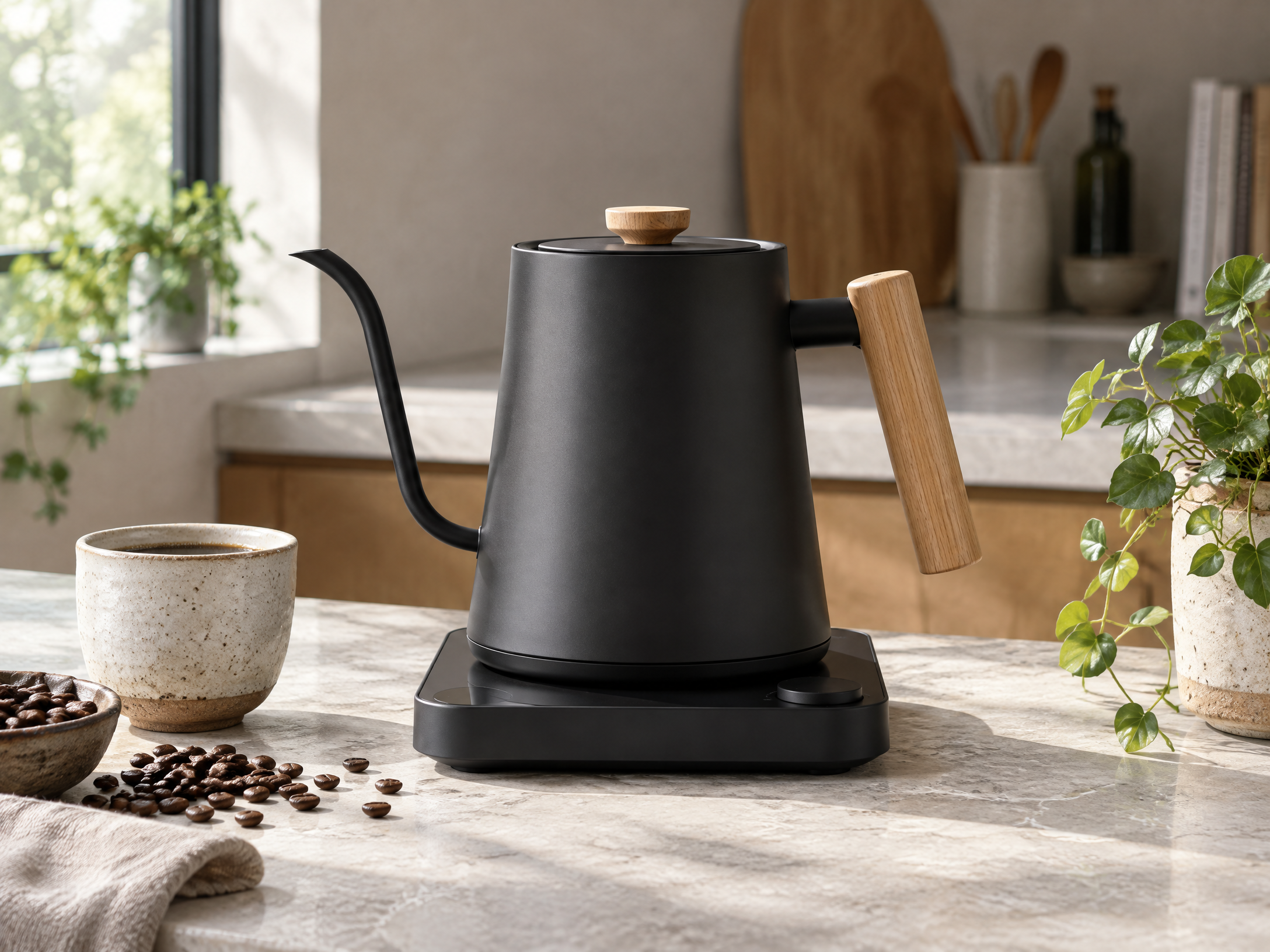
Target Keywords: electric kettle platform selection; electric kettle double wall design; electric kettle concealed heating element; electric kettle temperature presets; electric kettle keep warm function; electric kettle limescale filter; electric kettle capacity comparison
Direct answer: A coherent temperature-control kettle brief begins with one defined user occasion and one destination-market configuration—not a maximum-feature wish list. Lock the capacity, water-contact architecture, heating/base layout and core user interface first. Add temperature presets only when they have a clear use case; add hold/warm behaviour, double-wall construction and a limescale filter only when their trade-offs in cleaning, service, energy use, tooling, documentation and user instructions are accepted. Treat every final combination of body, controls, mains configuration and market as the product to validate.
A temperature-control kettle can appear simple: select a body, display, temperature buttons and finish. In practice, the brief joins thermal architecture, interaction, water-contact parts, packaging, instructions and final-configuration evidence. The buyer’s task is to decide what must work together for an assortment position and what remains out of scope.
This guide addresses electric kettle platform selection as a feature-design and commercial-brief exercise, not a market-access checklist. Requirements depend on the finished configuration, market, applicable rules, technical file, evidence and qualified review. For a separate electrical and food-contact evidence review, see UZYVO’s temperature-control kettle compliance checklist. The question here is how buyers choose coherent, controllable feature combinations before asking an OEM/ODM partner to quote.
1. Define the Job Before Selecting Features
Start with the situation in which the kettle earns its place in the range. “Premium kettle” is an aesthetic direction, not a functional brief. Name the primary preparation habits, users, countertop context, price tier, sales markets and brand promise. A tea-focused retailer may value lower-temperature settings; a family line may first value capacity, handling and simple fill/boil operation. These are different platforms even if their silhouettes look alike.
Convert the commercial idea into a ranked decision hierarchy. Use must have, beneficial, optional, and do not include rather than listing every available component. Must-haves should be few enough that the supplier can identify a stable base platform; optional features should be candidates, not implied commitments. This distinction prevents quotations from hiding unrequested changes in the display, controller, lid, water gauge or base.
| Brief question | Decision to record | Why it changes the platform |
|---|---|---|
| Who prepares what, and how often? | Core beverage/use occasions; one or multiple users | Determines whether precise setpoints solve a real user need. |
| Where will it be sold? | Named countries/regions, plug and mains configuration, language set | Changes final electrical, labelling, instruction and evidence review. |
| What is the assortment role? | Entry, core, premium, gift, or specialty | Keeps materials and interface investment proportional to the range. |
| What must a user see and touch? | Display, buttons, handle, lid, water window, finish | Couples industrial design with cleaning and serviceability questions. |
| What is explicitly excluded? | App connection, gooseneck spout, variable hold, multi-colour display, etc. | Stops scope expansion and gives engineering a firm boundary. |
The output is a one-page platform statement, not a catalogue markup. It should include a short user story, the target capacity band, required temperature behaviour, construction preference, target markets, branding/packaging scope and approvals required before production release. If the team cannot explain why a feature exists in a shopper-facing sentence or an operational use case, it probably belongs in the optional column.
2. Establish the Non-Negotiable Platform Architecture
Before discussing a display or colour, confirm the hard-to-change pieces: vessel construction, wet-side materials, heating architecture, base connection, controller location, lid/steam path, handle attachment and water-level indication. A cosmetic request may affect a gasket, sensor, wiring route, display lens or steam management.
Ask the supplier to separate fixed and configurable elements. Fixed may include the body diameter, controller family, base or lid; configurable items may include exterior finish, logo treatment, preset labels, filter or packaging. Split “custom” into existing-part changes, modified parts and changes needing new tooling or a new validation path. Otherwise, the quotation may not match the approved sample.
A basic architecture review should also map the water-contact system. Note every wetted component: inner vessel, seams, lid underside, filter frame/mesh, water-level window if present, gaskets and any coating or adhesive exposed under intended use. In the EU, food-contact materials must be produced under good manufacturing practice and must not transfer constituents to food at levels that could endanger health or unacceptably change composition, taste or odour [2]. That is a reason to name parts and intended conditions in the brief; it is not a reason to assume that a material label alone settles suitability.
For plastic water-contact components, EU rules address composition, restrictions, migration testing and documentation through the supply chain [2]. Request material identification and supporting documentation early, including the final part, colourant, processing and intended conditions it covers. Do not extrapolate evidence from another plastic, coating, supplier or configuration.
3. Choose an Electric Kettle Double Wall Design for the Right Reason
An electric kettle double wall design is commonly considered for a cooler-feeling outer surface, a more substantial visual language, acoustic character or a particular premium positioning. It may also introduce a different body assembly, added interfaces, changed weight distribution, less visible water level and altered cleaning or inspection access. The brief should therefore state the user benefit the double wall is meant to deliver, not merely instruct the supplier to “make it double-wall.”
Is the exterior metal, polymer or another finish? Must the water level be externally visible, and by what mechanism? Does an unbroken exterior outweigh a sight feature? Which surfaces need cleaning access? Answering these questions prevents a late conflict between minimal styling and a readable water level.
| Construction choice | Can support | Buyer trade-off to resolve before RFQ |
|---|---|---|
| Single-wall metal vessel | Direct, familiar metal-body expression | Exterior surface characteristics, handling cues and water-level strategy need clear consideration. |
| Double-wall metal-forward body | Insulated-looking premium proposition; more enclosed exterior | Assembly interfaces, weight, water-level visibility, cleaning access and exterior heat expectations must be designed and substantiated for the final product. |
| Polymer exterior over an inner vessel | Broad colour/texture direction and potentially cooler-feeling outer material | Polymer grade, water-contact separation, joins, finish durability and end-of-life material mix require defined controls. |
Avoid turning qualitative expectations into an unsupported claim. A buyer may specify a design intent such as “reduce perceived exterior heat compared with the defined comparator under a written test plan.” It should not become a retail claim such as “cool-touch” unless the final configuration has appropriate evidence, test conditions, wording review and destination-market assessment. The same discipline applies to “insulated,” “quiet,” “energy saving” and “safe for children.” The feature can be part of the architecture; the claim is a separate decision.
Request samples that expose the trade-off: assess empty and filled handling, pouring with the intended lid condition, fill-indicator readability and seam quality. Record observations as sample feedback, not universal results. The production configuration remains subject to final specification, change control and verification.
4. Specify the Heating and Base System Without Guesswork
The phrase electric kettle concealed heating element describes an architecture in which the heating element is not exposed within the water vessel in the familiar open-coil form. For a buyer, the relevant question is not which phrase looks better on packaging. It is how the chosen heating system interfaces with the vessel floor, thermal protection, controller, base contacts, cleaning expectations, minimum-fill/max-fill markings and temperature-sensing strategy.
A concealed layout can support a smooth-looking vessel interior. It does not establish boiling speed, durability, safety, mineral resistance or efficiency by itself; those outcomes require a defined final product and suitable evidence. Describe the architecture and acceptance process rather than writing a conclusion in advance.
IEC 60335-2-15:2024 addresses electrical appliances for heating liquids for household and similar purposes at rated voltages not more than 250 V, including DC-supplied and battery-operated appliances [1]. Buyers should use the relevant standards and market routes with competent parties to inform engineering and verification planning, not treat the name of a component as proof that a finished model meets all applicable requirements. The platform’s power input, plug, cord set, base, controls, thermal cut-outs, sensor arrangement and intended voltage all belong to the final review.
Ask for an architecture map with the following practical information:
- the intended input rating and market-specific electrical variants;
- the vessel-to-base connection and contact layout;
- the controller/sensor concept that supports boil detection and any lower setpoints;
- the max-fill/min-fill marking approach and how it is shown to the user;
- components expected to be replaceable, if any, and the approved substitution/change-control route;
- cleaning and descaling instructions proposed for the product; and
- planned samples and production-stage checks relevant to the agreed specification.
This map is especially important when an existing body receives a new digital controller. A familiar shell does not make the combined product familiar for engineering or documentation. The EU Low Voltage Directive requires technical documentation, applicable conformity assessment and series-production conformity; instructions and safety information must use the language determined by the relevant Member State [3]. Freeze the feature stack before documentation is finalized.
5. Turn Temperature Presets Into a Usable Interaction Model
Electric kettle temperature presets should correspond to chosen user actions, not a long list of numbers that increase layout complexity. Start with how a consumer will select and understand a setting: separate labelled buttons, a plus/minus sequence, a dial, or a display-driven menu. Then decide whether the chosen values match the intended drinks and whether the number of decisions is realistic for a hurried user.
A compact proposition may be more coherent with a few named presets; a specialty positioning may justify finer selection if the display, feedback and instructions make it understandable. The interaction model, labels, feedback, controller logic and instructions should tell the same story.
| Preset approach | Best when | Brief questions to settle |
|---|---|---|
| Boil only | The range prioritizes simple hot-water preparation | Is a separate power/control state needed beyond boil? How is readiness shown? |
| A small set of fixed temperatures | The buyer has a few clear beverage occasions | Which labels or values are visible? What happens if a user lifts or refills the kettle? |
| Broad selectable range | The intended user values choice and can navigate a more detailed UI | What is the control method, display readability, default state and error feedback? |
| Temperature indication without selection | Temperature visibility itself supports the positioning | What does the indication represent, when is it shown and how will wording avoid over-interpretation? |
Write behaviour scenarios, not just temperatures: after a button press, reaching selection, removal from base, power interruption and refill. Define audible/visual feedback, but do not promise sound levels, heating times or temperature accuracy without an agreed method and evidence. Ask which scenarios the existing controller supports and which change hardware, firmware or validation.
Temperature control also increases the importance of instructions. A user needs to understand what each preset represents, how to cancel, how to refill safely, whether a setting must be reselected and how to clean the product. In the EU, relevant apparatus must be accompanied by intelligible instructions and information in the language determined by the Member State [4]. Treat language and icon review as part of the design gate, not as artwork after the mould and controller are locked.
6. Decide Whether an Electric Kettle Keep Warm Function Belongs in the Brief
An electric kettle keep warm function is valuable only for a real repeat-pour or shared-use occasion. It adds interface choices, control logic, instructions and questions about duration, reactivation, boil cycles and energy messaging. The buyer should explain the use case in one sentence.
State the operating policy rather than vaguely asking for “keep warm.” Define manual or preset activation, eligible temperature states, visible indication, end condition, removal/replacement behaviour and independent cancellation. Ask what is standard controller behaviour and what requires a change.
Avoid unsupported environmental or cost claims. A keep-warm feature uses energy when it operates, but the overall comparison with reheating depends on actual user patterns, capacity filled, thermostat strategy, insulation, ambient conditions and test method. Do not label it “energy efficient” or calculate savings without a defined, verified basis. Instead, choose an interaction design that helps users intentionally invoke the feature and gives clear status feedback.
A useful acceptance plan is behavioral. Request a review sample with final UI, draft instructions and settings; then test boil, lower selection, hold, interruption, lift/return, cancellation and cleaning. Log confusing states, button ambiguity and display-visibility issues. This catches use-case/interface mismatch before packaging copy expands the promise.
Need a feature brief translated into an OEM/ODM discussion? Share the target markets, user occasion and must-have feature list with UZYVO’s OEM / ODM team, or email info@uzyvo.com to begin a configuration-focused review.
7. Treat the Limescale Filter as a Water-Experience Component
An electric kettle limescale filter can address visible particles in poured water or support a cleaner-looking pour. It is not a solution to water quality, mineral content, descaling frequency or taste. Do not position a simple spout filter as a purifier or as preventing scale. Its mesh, frame, spout fit, removal and cleaning instructions matter more than “filter included.”
Can the filter be removed/reinstalled without tools and visibly seated correctly? If it includes polymer, mesh, coatings or clips that contact water or steam, list them in the wet-side map. Food-contact frameworks focus on final materials/articles in normal or foreseeable use and on traceability/documentation [2].
| Filter question | Preferred brief statement | What not to assume |
|---|---|---|
| Purpose | “Removable spout filter intended to catch visible scale particles during pouring.” | That it softens water, removes all minerals or improves health outcomes. |
| Cleaning | “Removal and cleaning procedure to be included in draft instructions and sample review.” | That users will understand how to remove it without guidance. |
| Fit | “Retention and alignment checked on the final spout/lid geometry.” | That a filter from another body fits or pours identically. |
| Materials | “Supplier to identify water-contact materials and evidence applicable to final use/market.” | That stainless appearance or a generic ‘food-grade’ statement completes the review. |
Build the descaling message separately. Hard-water environments may make guidance important, but wording, cleaning agents, frequency and end-user safety need final-instruction and destination-market review. Distinguish cleaning the removable filter from descaling the vessel and avoid water-treatment language.
8. Use an Electric Kettle Capacity Comparison to Protect the Use Case
An electric kettle capacity comparison should start with usable volume and household behaviour, not the largest number that fits the silhouette. Capacity affects countertop footprint, filled weight, handle feel, heating habits, minimum-fill marking, packaging, shipping cube and the appeal of keep-warm. It also shapes the user story: a single person who makes two cups occasionally has a different need from a family that prepares several drinks together.
Do not equate nominal capacity with every outcome. A larger vessel does not automatically suit every user; a compact one does not automatically save energy. Select a capacity band, define fill markings and ask for body alternatives, dimensions, handling characteristics and packaging concept. Treat these as supplier-specific data, not industry-wide claims.
| User scenario | Capacity direction to investigate | Feature implications |
|---|---|---|
| Individual or couple, limited counter space | Compact or mid-size platform | Clear minimum-fill guidance, smaller footprint, simple controls may be more valuable than many presets. |
| Family/shared breakfast use | Mid-size or larger platform | Handle ergonomics at fill, legible water indication, multi-serve logic and lid opening merit early review. |
| Specialty tea or coffee routine | Capacity matched to repeated small batches | Preset usability, pouring control and a clear temperature story can outweigh maximum volume. |
| Giftable premium line | Capacity based on the intended gifting/user story | Exterior construction, presentation packaging and intuitive onboarding must remain consistent. |
Evaluate filled handling only under safe, controlled sample-review conditions and product instructions. Record selected volume, typical fill occasions, marking artwork, user group, handle criterion, confirmed carton dimensions and exclusions. This prevents approving a visually attractive body before testing whether its capacity makes the feature set relevant.
Packaging needs its own early conversation. EU packaging rules cover packaging and packaging waste irrespective of material or origin; Regulation (EU) 2025/40 has been in force since 11 February 2025 and is scheduled to apply from 12 August 2026 [7]. This is not a substitute for market-specific advice, but it is a reason to identify the destination countries, packaging components and artwork timeline before final release. Do not request a “sustainable carton” as an unqualified claim; define materials, structure, damage-prevention needs, local obligations and the evidence/copy-review process.
9. Build a Feature Stack That Can Be Quoted and Controlled
Combine the individual choices into a controlled configuration. A common failure is approving body, controller, filter, capacity and packaging separately without confirming that they are an available combination. Require the supplier to distinguish the base model, differences, dependencies and open engineering questions.
Use one configuration matrix so every change has a visible impact on the final model and evidence package.
| Area | Locked decision | Open choice / supplier confirmation | Release evidence to request |
|---|---|---|---|
| Body | Selected single- or double-wall direction | Exterior finish, water-level treatment, handle geometry | Approved drawing/sample and finish reference. |
| Wet side | Named vessel, lid, gasket and filter architecture | Final material grade/colour/part supplier | Part list and relevant supporting information for final market. |
| Heat/base | Chosen platform family | Electrical variants, cord/plug, thermal/control arrangement | Final configuration identification and verification plan. |
| UI | Selected preset/hold interaction | Display wording, icons, sounds, firmware version | UI specification, artwork approval and scenario test record. |
| Capacity | Target nominal volume and markings | Platform dimensions and carton relationship | Sample review record and approved artwork. |
| Pack | Target pack hierarchy and contents | Insert structure, instructions, destination-language versions | Packaging artwork and destination-market review. |
Version-control the matrix. Identify the approved sample, controller/firmware where relevant, artwork and packaging revisions. If a lid polymer, filter mesh, controller board, display, plug, coating or water-level method changes, use a formal change request. The final configuration and destination market determine reassessment.
In the EU, RoHS restricts ten named substances in electrical and electronic equipment unless an exclusion applies [5]. WEEE obligations can include registration, reporting and collection/treatment financing in each sales country [6]. These points reinforce why the commercial owner, importer/producer role and destinations must be clear. Do not treat a generic supplier statement as a legal conclusion.
10. Ask the Buyer Questions That Expose Over-Specification
The final review should challenge the brief, not merely restate it. Invite product, sourcing, quality, design, packaging, customer-service and market teams to answer the same questions from their perspective. If two teams give different answers, that is valuable information to resolve before tooling, artwork or a purchase order.
Buyer checklist
- Can we name the principal user and three everyday use scenarios?
- Does each requested feature have a user benefit, an interaction definition and a packaging/instruction implication?
- Have we selected the capacity before committing to the body silhouette and outer carton?
- Does the proposed electric kettle double wall design support a defined exterior, water-level and cleaning decision rather than only a premium adjective?
- Has the electric kettle concealed heating element been described as part of a complete vessel/base/control architecture, without unverified performance claims?
- Are electric kettle temperature presets limited to values and labels a user can understand at a glance?
- Does the electric kettle keep warm function have a defined activation, end condition and status indicator?
- Is the electric kettle limescale filter described accurately as a removable scale-particle feature rather than water treatment?
- Does the electric kettle capacity comparison use actual intended occasions and fill handling, rather than a capacity number alone?
- Are the final destination markets, electrical variants, languages and accountable parties documented?
- Has the supplier marked every requested change as standard, modified, new-tooling, or not available on the proposed platform?
Buyer FAQs
1. Should every temperature-control kettle include a keep-warm feature? No. Include it only when a user benefits from repeat pours and the team can define activation, status and cancellation. A simple boil-and-pour proposition may be clearer without it.
2. Is double-wall construction automatically a premium upgrade? No. It can support a visual and handling proposition, but introduces choices about exterior materials, water-level visibility, assembly, weight, cleaning and claims. Premium positioning is a consistent total experience, not one construction term.
3. Can a limescale filter be marketed as water purification? Not without substantiation and appropriate review, and a typical removable spout filter should not be assumed to perform that role. Describe the intended physical function accurately: catching visible scale particles during pouring. Keep descaling guidance distinct from water-treatment claims.
4. What is the first decision in electric kettle platform selection? Define the user occasion and destination markets, then select capacity and the stable vessel/base architecture. Those choices constrain later decisions about controls, water indication, materials, packaging and evidence more than colour or a display theme does.
5. When should a buyer request a new controller instead of changing preset labels? Ask the supplier to compare requested behaviour with supported states. A label change may be simple; a change to setpoints, hold, feedback, safety logic or firmware may not be. Obtain a written assessment and representative sample.
11. Conclude With a Focused Release Decision
A strong kettle brief does not maximize available features. Body construction, heating architecture, capacity, temperature selection, hold, filter, instructions and pack should support the same person and use occasion. Remove any feature lacking a user story, control definition, engineering rationale or destination-market path.
Before release, convert the brief into a signed configuration matrix and sample-review plan. Identify the final platform, electrical variants, water-contact parts, UI/firmware behaviour, fill markings, filter, artwork, packaging and sale markets. Obtain appropriate technical, documentation and market review for that final configuration.
Explore the Artisan Temperature-Control Kettle platform as a configuration discussion point, and use UZYVO’s buyer FAQ for wider sourcing questions. When your team has a ranked feature list and target markets, email info@uzyvo.com to begin a focused OEM/ODM conversation.
Contextual AI Image Recommendations
- Purpose and insertion point: After Module 2, to visualize a buyer’s architecture review without implying a specific factory or test result.
Caption: “Mapping the vessel, lid, filter, base and control interface before feature decisions are locked.” ALT text: “Exploded-view style temperature-control kettle showing vessel, lid, removable spout filter, base and display control.” AI image prompt: “Editorial B2B product-design illustration of a modern temperature-control electric kettle in an exploded technical view, stainless inner vessel, removable spout filter, lid, ergonomic handle, circular base and minimal digital control panel, neutral white studio background, unlabeled components, no brand logos, clean realistic industrial-design rendering, no performance claims.”
- Purpose and insertion point: After Module 5, to make the preset/interaction discussion easier to scan.
Caption: “A short, clearly signposted preset journey can be more useful than an overloaded control panel.” ALT text: “Close-up of a temperature-control kettle interface with clearly separated boil, warm and temperature selection controls.” AI image prompt: “Close-up editorial product photograph style image of an unbranded premium electric kettle control panel, simple tactile buttons and a readable temperature display, hand nearby but not pressing, soft kitchen-counter lighting, no numeric performance claims, no logos, realistic material textures.”
- Purpose and insertion point: Before Module 9, to support the configuration-matrix and sample-approval concept.
Caption: “Feature decisions become controllable when the approved sample, component list and packaging artwork point to one configuration.” ALT text: “Product manager reviewing an unbranded kettle sample beside a feature matrix and packaging artwork.” AI image prompt: “Professional B2B sourcing meeting scene, diverse product manager and engineer reviewing an unbranded temperature-control electric kettle sample on a table beside printed configuration matrix, component swatches and blank packaging artwork, bright design studio, no visible proprietary data, no factory claims, documentary editorial photography style.”
References
Put the buyer guide into a practical sourcing path.
Bring this framework into your next product brief.
Share your target market, appliance category, annual volume, and launch window. We will discuss a practical sample, documentation, and production path for the final configuration.
Email info@uzyvo.com