
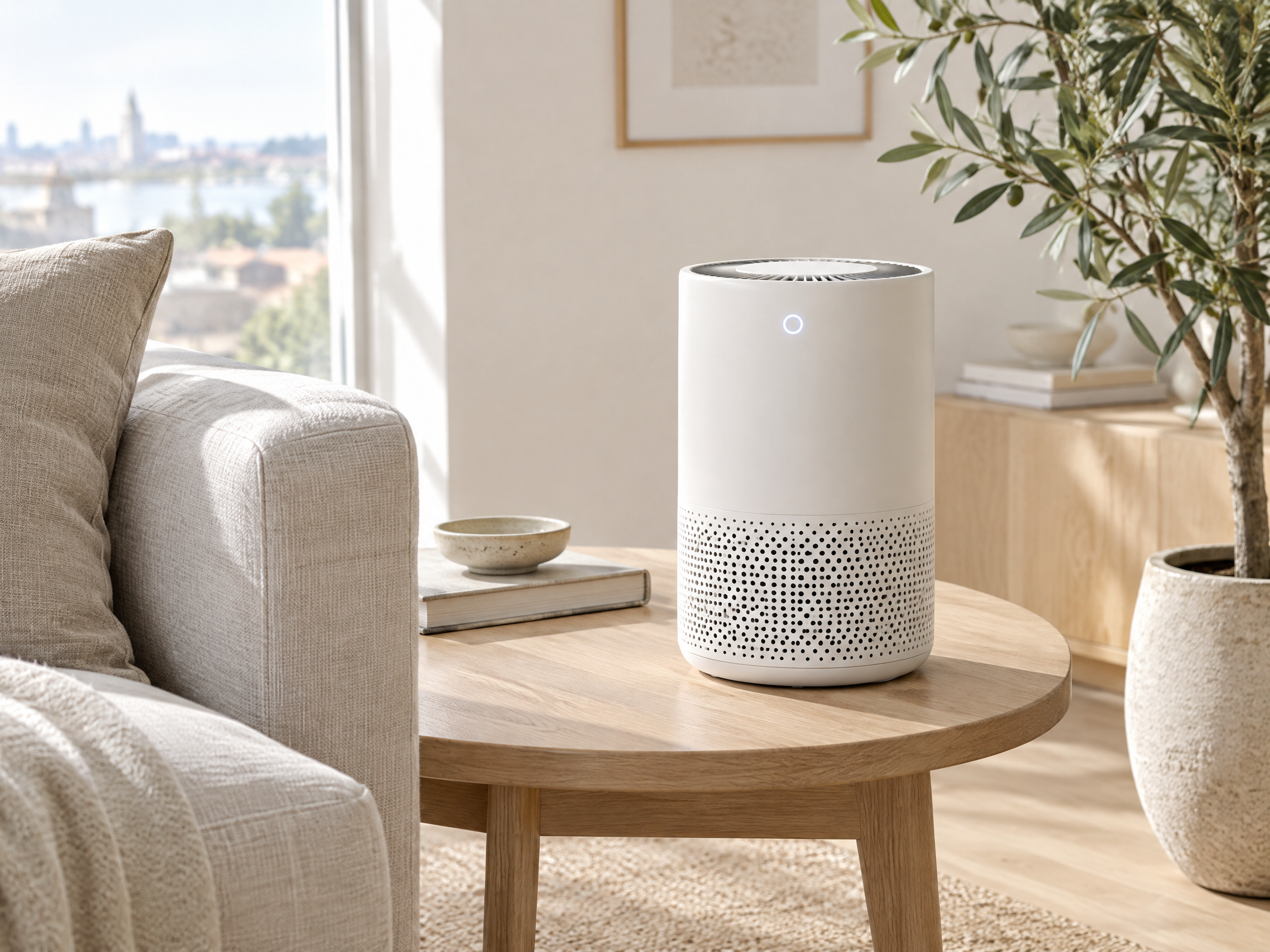
Target Keywords: air purifier manufacturer; air purifier supplier; air purifier OEM; air purifier private label; HEPA air purifier supplier; air purifier white label; air purifier filter manufacturer
Direct answer: Qualify a prospective manufacturer as a controlled system, not as a catalogue. Start with the exact target market and product configuration; then connect the factory, filter source, bill of materials (BOM), test evidence, sample, serial traceability, service plan, and change-control process. A credible supplier can identify who owns each control, show configuration-specific records, and explain how an unapproved substitution is stopped before shipment. The final product, destination market, supporting evidence, and qualified review determine what is applicable.
A private-label air purifier can look simple: a fan, housing, controls, and replaceable filter. The buyer risk is not simple. A product may be assembled by one company, use a purchased fan and controller, rely on a separate filter converter, and be sold under a buyer’s brand. Each handoff can change fit, airflow, instructions, electrical behavior, labels, evidence, and availability of replacement filters.
This guide deliberately focuses on manufacturer and filter-source qualification, not on choosing a headline performance specification. For a separate configuration-led discussion of CADR, filter, noise, and ozone questions, see UZYVO’s private-label air purifier requirements guide. Here, the practical question is whether a supplier relationship can repeatedly deliver the approved configuration into the intended destination market.
1. Define the qualification decision before requesting quotations
The right question is not “Which air purifier manufacturer has the nicest brochure?” It is “Which organisation and supply chain can make *our defined configuration* with controlled evidence and a usable replacement-filter path?” That distinction makes the RFQ comparable.
Create a one-page qualification brief before approaching factories. It should state the sales countries, sales channels, buyer brand, intended user environment, required plug and voltage variants, connectivity scope if any, planned filter replacement proposition, packaging route, forecast band, and approval authorities inside your company. It should also state what is still undecided. A factory cannot responsibly confirm compliance or capability against a vague “EU/US model.”
For a branded launch, identify the economic-operator role early. EU guidance says that a business that has a product made and sells it under its own name or brand is considered the manufacturer for CE-marking purposes and is responsible for the entire product, including supplied components or systems.[2] This is a reason to build evidence ownership into sourcing—not a reason to assume that a factory’s generic certificate transfers to every branded version.
| Qualification question | Buyer evidence to request | Why it changes the decision |
|---|---|---|
| Which exact model and variants are proposed? | Model-variant matrix, photos or drawings, BOM revision | Prevents evidence from being attached to a merely similar unit. |
| Who designs and controls the product? | Organisation chart, engineering responsibility, change workflow | Shows whether the seller can authorize technical answers. |
| Which market is first? | Destination and channel matrix | Determines the documentation, labelling, and review path. |
| Who supplies replacement filters? | Approved-source list and part-number map | Tests whether the consumable offer is traceable after launch. |
| What may change without buyer approval? | Written change-control proposal | Converts an oral assurance into a release gate. |
This is the moment to choose the engagement route. A fully developed catalogue unit may be appropriate when the buyer wants limited changes and accepts the limits of its existing architecture. A more tailored route needs more design, evidence, and release discipline. Compare this decision with UZYVO’s OEM / ODM workflow before treating a logo change as a complete product-development plan.
2. Separate the factory role, the trading role, and the air purifier OEM role
An air purifier supplier may be a factory, a trading company, a brand owner, or a combination. None is automatically unacceptable. The risk comes from assuming the commercial contact is also the technical owner. Map the chain in writing: legal seller, assembly site, design owner, filter source, laboratory contact, freight packer, and after-sales spare-parts contact.
An air purifier OEM should be evaluated on the controls it actually owns. Ask who releases drawings, changes the BOM, buys critical electronics and filter components, programs the controller, performs incoming checks, and approves finished-goods release. If the candidate coordinates several outside parties, ask how it verifies them. “Our partner handles that” is an invitation to ask for the approved supplier, specification, records, and escalation owner.
A practical supplier due-diligence review examines product control and evidence, not only the factory’s appearance. The review can be remote or on site, but it should trace one proposed model from incoming components through final packing. A factory capability statement is useful background; the buyer still needs configuration-specific proof. UZYVO’s factory capabilities overview describes the types of development, quality, and shipment-control discussions to bring into this review.
| Supplier model | Potential buyer advantage | Qualification focus |
|---|---|---|
| Direct assembler with internal engineering | Shorter technical communication path | Verify authority over purchased parts and filter source. |
| Trading company coordinating a factory | May consolidate communication or sourcing | Identify every production and evidence owner; avoid undocumented relays. |
| Brand-owner platform offered for relabelling | Faster route for limited branding | Establish which changes invalidate existing evidence or packaging approvals. |
| Multi-site supply chain | Alternative capacity or regional assembly may be possible | Lock the approved site, model, BOM, and evidence scope to the PO. |
Ask candidates to answer in the language of documents and responsibilities. For example: “Who signs the drawing release?” is better than “Are you a real factory?” The response should establish accountability without requiring the supplier to disclose proprietary details that are unnecessary to your purchase decision.
3. Qualify the filter supply chain as a product subsystem
The filter is not a generic accessory. It is a fitted subsystem that affects the sellable configuration, replacement proposition, labelling, instructions, and certain product claims. Therefore, the buyer should qualify the air purifier filter manufacturer or filter-conversion source with nearly the same seriousness used for the final assembler.
If the brief calls for a HEPA air purifier supplier, first make the terminology auditable. Do not accept a marketing phrase as a substitute for a defined filter construction, part number, verification method, applicable standard or customer requirement, and approved source. Request a filter drawing or construction specification that identifies dimensions, sealing surfaces, media type description, frame, prefilter and carbon elements where used, adhesive or sealant controls where relevant, identification marking, and packaging. The buyer does not need to prescribe a factory’s proprietary recipe to control the approved interface and revision.
EPA guidance is a useful scope reminder: portable cleaners commonly use a high-efficiency particulate air filter to achieve high particle CADR, filters require regular replacement, and particle CADR does not rate gas removal.[1] That does not make every “HEPA” label equivalent, and it does not prove a particular supplier’s finished product. It means the filter claim and the replacement path deserve document-based scrutiny.
Request the chain of custody for the replacement item: final air purifier model, filter part number, approved filter source(s), incoming inspection criteria, production-lot identification, retail replacement SKU, instruction reference, and service contact. The most valuable answer is a controlled map, not a promise that filters are “available.”
| Filter-control checkpoint | Evidence to examine | Red flag requiring clarification |
|---|---|---|
| Physical fit | Approved drawing, sample fit check, revision level | A filter is described only by nominal dimensions. |
| Source identity | Supplier name, approved-source list, part number | The assembler cannot name the converter or source. |
| Incoming control | Inspection instruction and receiving record example | Filter lots are mixed without identification. |
| Replacement continuity | SKU map, packaging artwork draft, service process | Replacement filter has no controlled part number. |
| Change notification | Written trigger list and re-approval workflow | “Equivalent material” may be substituted at the supplier’s discretion. |
4. Decide whether white label is a safe commercial route
An air purifier white label offer usually means a supplier’s existing platform is sold with a buyer’s brand, cosmetic selection, packaging, or instruction changes. It can be commercially sensible, but it is not a compliance shortcut and it does not eliminate buyer control duties. A new label, plug, Wi-Fi module, power supply, housing colour, filter designation, instruction, or country set may create a new version that needs a documented review.
Use a variation register. Put the base model on one line and list every proposed difference. For each difference, identify the drawing and BOM impact, safety or EMC evidence impact, label and manual impact, packaging impact, firmware impact, filter compatibility impact, and sign-off owner. This discipline stops the common error of treating a platform report as a blank cheque for all derivatives.
For EU routes, CE marking is not a certificate issued by a central EU body. The manufacturer must identify applicable requirements, assemble technical documentation, complete the relevant conformity process, and sign an EU declaration of conformity before affixing the marking.[2] Electrical equipment within the scope of the Low Voltage Directive must be designed and manufactured to its safety objectives; its manufacturer must prepare technical documentation, carry out the applicable conformity assessment, retain documentation and the declaration for ten years, and keep series production conforming as design or standards change.[3]
This guide is not legal advice. A responsible buyer should have the actual product, connected functions, market route, and documentation reviewed by appropriately qualified people. What is applicable depends on the final configuration and destination market—not on a generic “CE” icon in an RFQ deck.
5. Build an evidence request list that connects to the actual configuration
A document request should be precise enough to be verified and narrow enough to be useful. Start by asking for an evidence index, then sample the underlying records. The index should identify document title, issuing body or owner, issue date, model designation, revision, standards or requirements addressed, product configuration, and any limitations. It should also point to the relevant BOM and artwork revision.
For EU electrical and electronic equipment, the evidence package may need to address several applicable obligations. The EMC Directive requires manufacturers to prepare technical documentation, conduct the relevant conformity assessment, keep technical documentation and the EU declaration of conformity for ten years, and ensure series production remains in conformity.[4] Its technical documentation can include a general apparatus description, drawings, standards applied, design calculations or examinations, and test reports.[4] RoHS likewise places design/manufacture, technical documentation, production-control, traceability, and corrective-action responsibilities on manufacturers of covered electrical and electronic equipment.[5]
That is a framework for asking good questions, not a universal document checklist. Avoid claiming a document is valid for a configuration merely because its title resembles the model name. Match the identifier, power arrangement, control board, motor/fan, filter assembly, external power supply if present, country plug, and claimed features to the final BOM.
| Evidence item | Buyer matching rule | Decision use |
|---|---|---|
| Product drawings and BOM | Revision and variant must match the quoted configuration | Basis for sample and change control. |
| Test reports or assessments | Model and critical construction must be traceable | Assess suitability with qualified review. |
| Declaration and labels | Legal manufacturer, model, market and artwork must align | Prevents generic or inconsistent documentation. |
| Component records | Link critical components to approved BOM lines | Supports substitution prevention. |
| Production and complaint procedures | Confirm procedure applies to the actual site | Tests ongoing-control maturity. |
Do not ask a supplier to “guarantee worldwide certification.” Ask for an evidence gap list against named markets and a plan for closing it. That response is more decision-useful and less likely to disguise uncertainty.
6. Use samples to validate identity, interface, and control—not to waive evidence
A sample is a reference point, not proof that every future unit will match it. Before any sample is approved, give it a unique sample ID and record the model, BOM revision, filter part number, firmware version where relevant, plug or voltage variant, housing colour, labels, carton, accessories, and observed exceptions. Retain photographs and the signed approval record. If a feature cannot be confirmed, record it as open rather than approving by silence.
The sample review should be led by the buyer’s use case: Does the product identity match the documents? Does the correct filter fit and seal as specified? Are labelling and instruction drafts consistent with the market route? Is the replacement filter clearly identified? Does the carton protect the approved configuration and communicate the right contents? These are control questions, not claims of a universal test outcome.
EU manufacturer obligations explicitly include procedures to keep series production conforming, consideration of design or standard changes, traceability by type, batch or serial number, and clear instructions and safety information in languages determined by the Member State.[3] Those duties make sample-to-production linkage commercially important. A buyer should agree how the approved sample, drawings, and release record will be referenced at production.
Mid-article CTA — turn the qualification brief into a supplier comparison. Share the intended market, model concept, filter-replacement plan, and proposed changes with UZYVO at info@uzyvo.com to discuss a configuration-led OEM/ODM review. No outcome should be assumed until the final product and market route are assessed.
7. Audit process capability through traceability and change control
A site visit or remote audit should follow a product path rather than a presentation schedule. Select the proposed unit or a closely related controlled model. Trace its critical incoming parts, BOM release, work instruction, in-process records, final inspection, serial or batch marking, packing, and nonconformance process. If a factory cannot produce records for a selected lot, its system may be less mature than its certificate wall suggests.
Critical air-purifier controls often include filter part number and fit, fan/motor identity, power components, control board and firmware, safety-relevant construction, labels, and carton contents. The exact list belongs to the final risk review; do not copy this list into every product blindly. The key is to name which parts require prior written approval for changes and which records prove that the approved part was used.
A sound change clause normally defines a trigger, notice, buyer review, evidence review, sample requirement where appropriate, written release, effective-lot identification, and preservation of prior records. It should cover supplier changes, part revisions, material changes, software or firmware changes, site changes, process changes, pack changes, and changes to documents or claims. It must also say who has authority to approve a deviation.
| Control state | Practical meaning | Buyer action |
|---|---|---|
| Approved | Matches released configuration and evidence scope | Permit production against the controlled reference. |
| Proposed change | Supplier identifies a difference before use | Assess effect; request documents or a sample as appropriate. |
| Temporary deviation | A defined, time-bounded exception is requested | Approve or reject in writing with lot traceability. |
| Unapproved substitution | A different part or process is used without release | Quarantine, investigate scope, and decide disposition. |
This protects both parties. It gives a capable factory a clear route to improve the product while preserving the buyer’s ability to assess the resulting configuration. It also avoids the fiction that an initial sample controls an indefinite future supply chain by itself.
8. Compare commercial proposals on controlled total scope
Commercial investigation works best when price is only one column. Quote comparisons should normalize the configuration, filter content, spare-filter approach, inclusions, packaging, evidence responsibility, tooling ownership where relevant, inspection plan, and Incoterm proposal. A low quotation for an undefined model cannot be responsibly compared with a controlled offer.
Ask suppliers to state assumptions and exclusions in their own words. Examples include filter grade description, included prefilter or carbon layer, outer box contents, adapter or plug, language set, app/cloud scope, replacement-filter packaging, buyer artwork responsibility, and destination-market documentation support. The objective is not to force a promise; it is to surface scope differences before selecting a supplier.
The replacement-filter proposition deserves an independent commercial review. Does the purchase order identify the initial installed filter and the retail replacement filter separately? Who owns the service SKU and artwork? What information is needed to distinguish an old and revised filter? How will the buyer forecast replenishment? The right answers depend on the brand strategy and market, but ambiguity is predictable after-sales risk.
| Comparison dimension | Weak RFQ response | Decision-ready RFQ response |
|---|---|---|
| Unit scope | “Standard model” | Model, BOM revision, included accessories and variant assumptions. |
| Filter | “HEPA filter included” | Controlled filter part number, construction reference, replacement SKU path. |
| Documentation | “Certificates available” | Indexed evidence with configuration scope and known gaps. |
| Production control | “QC before shipment” | Identified release points, records, defect escalation and traceability. |
| Change management | “Equivalent parts acceptable” | Written triggers, approval owner and effective-lot control. |
Treat marketing, financial, and regulatory claims separately. A supplier’s ability to quote a platform does not prove it can support every future claim, market, or channel. The final configuration and destination market remain the decision boundary.
9. Plan market access, claims, and destination-specific review early
Market access is a workstream, not a final label exercise. Build a destination matrix that maps countries and channels to the proposed electrical configuration, language, importer or responsible-party arrangements where applicable, product and packaging marks, disposal or packaging obligations where applicable, claim substantiation, and evidence owner. Have qualified regulatory and legal advisers review the final route where needed.
Do not infer health, allergen, antimicrobial, medical, or pollution-removal outcomes from a component name or generic report. EPA says portable air cleaners can reduce indoor air pollution but cannot remove all pollutants; source control and ventilation remain important, and particle filters and gas filters serve different functions.[1] This is why buyer-facing copy should be limited to claims the final configuration can support in the intended market.
Where the intended sale includes California, verify the current rule and model status rather than relying on a supplier statement. CARB says portable indoor air-cleaning devices sold to people or businesses in California must be certified; electronic devices are also tested for ozone emissions and must meet the stated limit. CARB also cautions that its certification does not evaluate effectiveness and does not imply that a device is safe to use.[6] That distinction is especially important when a supplier proposes ionizing, UV, plasma, or other electronic functions.
The buyer’s task is to establish what applies, who owns the evidence, and when a change requires re-review. It is not to convert a third-party listing, an EPA resource, or a component paper into a blanket claim for the finished branded unit.
10. Ask buyer FAQs before supplier nomination
Can I qualify one air purifier manufacturer for multiple countries with one document set?
Possibly, but do not assume so. Start with a country-and-configuration matrix. Electrical arrangements, connected features, language, importer roles, labels, packaging, claims, and local obligations can vary. EU rules require the manufacturer to keep relevant documentation and the EU declaration current; changes to the product or applicable legislation are reasons to review and update them.[2] Ask qualified advisers to assess the actual destination routes.
Is a filter test report enough to approve an air purifier filter manufacturer?
No. A report may be part of the evidence, but it does not by itself show that the supplied filter is the approved construction, fits the assembled unit, is traceable by lot, will be controlled in incoming inspection, or will remain available as a replacement SKU. Qualify the source, interface, revision control, and replacement path alongside the supporting records.
What is the fastest way to screen an air purifier supplier without choosing on price alone?
Send every candidate the same concise qualification brief and score their first response: model identity, chain-of-responsibility map, filter-source disclosure, evidence index, change-control proposal, sample traceability plan, and open-risk list. A supplier that asks precise configuration questions may be more useful than one that immediately offers an unconditional claim.
Does a white-label model eliminate our documentation responsibility?
No. A white-label platform may reduce development work, but branding or configuration changes can alter the documents and responsibilities required. In the EU, a company selling a product made for it under its own name or trademark is considered the manufacturer for CE-marking purposes.[2] Determine responsibilities for the exact business model with qualified review.
Should we approve a shipment just because it passes a pre-shipment inspection?
No. Inspection is one release input, not a substitute for configuration validation, market-access evidence, or change control. Agree in advance what inspection samples, critical checks, records, and escalation rules apply. A shipment decision should reference the approved configuration and any documented deviations.
11. Conclude with a controlled nomination and launch gate
The strongest supplier nomination is a controlled decision, not a declaration that a factory is “qualified forever.” Name the approved legal seller and assembly site, base model and variants, released BOM and filter part number, permitted branding changes, documentation owner, market assumptions, sample ID, inspection plan, change-control process, and replacement-filter responsibilities. Put unresolved items in a dated action register with an accountable owner.
A practical launch gate asks four questions. First, does the production configuration match the approved reference? Second, does the available evidence map to the intended market and the exact configuration? Third, can the supplier trace critical components and control changes? Fourth, can the brand support the replacement-filter and after-sales proposition it intends to sell? If an answer is uncertain, it is better to keep the item open than convert uncertainty into a marketing promise.
A capable air purifier manufacturer may be a valuable long-term partner, but qualification should always follow the final configuration and destination market. Maintain the approved-source map, evidence index, sample record, change log, and corrective-action trail through the product lifecycle. Those controls are more durable than a brochure comparison.
Closing CTA — discuss your qualification path. For a structured review of an air purifier OEM, filter-source map, sample controls, or a private-label launch brief, email info@uzyvo.com. UZYVO can help frame the questions; final technical, compliance, and legal applicability should be confirmed for the actual configuration and destination market.
AI Image Recommendations
- Purpose and insertion point: Place after Module 2 to visualize a transparent manufacturer-qualification workflow.
- Caption: “A buyer-led review links the assembler, filter source, BOM, and approval record.”
- ALT text: “Procurement team reviewing an air purifier component map with factory and filter-supply checkpoints.”
- AI image prompt: “Editorial B2B procurement illustration, diverse team around a table reviewing a clean technical air purifier exploded-view sheet, subtle supply-chain lines connecting factory, filter cartridge, quality documents and carton, modern neutral office, blue and charcoal palette, realistic, no logos, no certifications, no numerical claims, landscape.”
- Purpose and insertion point: Place after Module 3 to make filter-source traceability tangible without implying tested performance.
- Caption: “A replacement-filter program needs identifiable parts, controlled fit, and source traceability.”
- ALT text: “Unbranded air purifier filters with part-number labels beside a technical fit-check drawing.”
- AI image prompt: “Photorealistic B2B product-sourcing scene, unbranded cylindrical and rectangular air purifier replacement filters on a quality-control bench, simple generic part-number tags, open technical drawing showing dimensions and seal interface, gloved inspector hand, factory background softly blurred, no brand names, no performance claims, landscape.”
- Purpose and insertion point: Place before Module 11 to support the controlled nomination message.
- Caption: “Supplier nomination is a release decision supported by configuration, evidence, and change-control records.”
- ALT text: “Quality manager reviewing a controlled air purifier production checklist and serialized carton label.”
- AI image prompt: “Realistic industrial quality-assurance scene, quality manager reviewing a generic controlled-production checklist next to a boxed unbranded portable air purifier and a non-readable serialized label, clean assembly area, no visible brand logos, no compliance marks, professional documentary style, landscape.”
References
Put the buyer guide into a practical sourcing path.
Bring this framework into your next product brief.
Share your target market, appliance category, annual volume, and launch window. We will discuss a practical sample, documentation, and production path for the final configuration.
Email info@uzyvo.com