
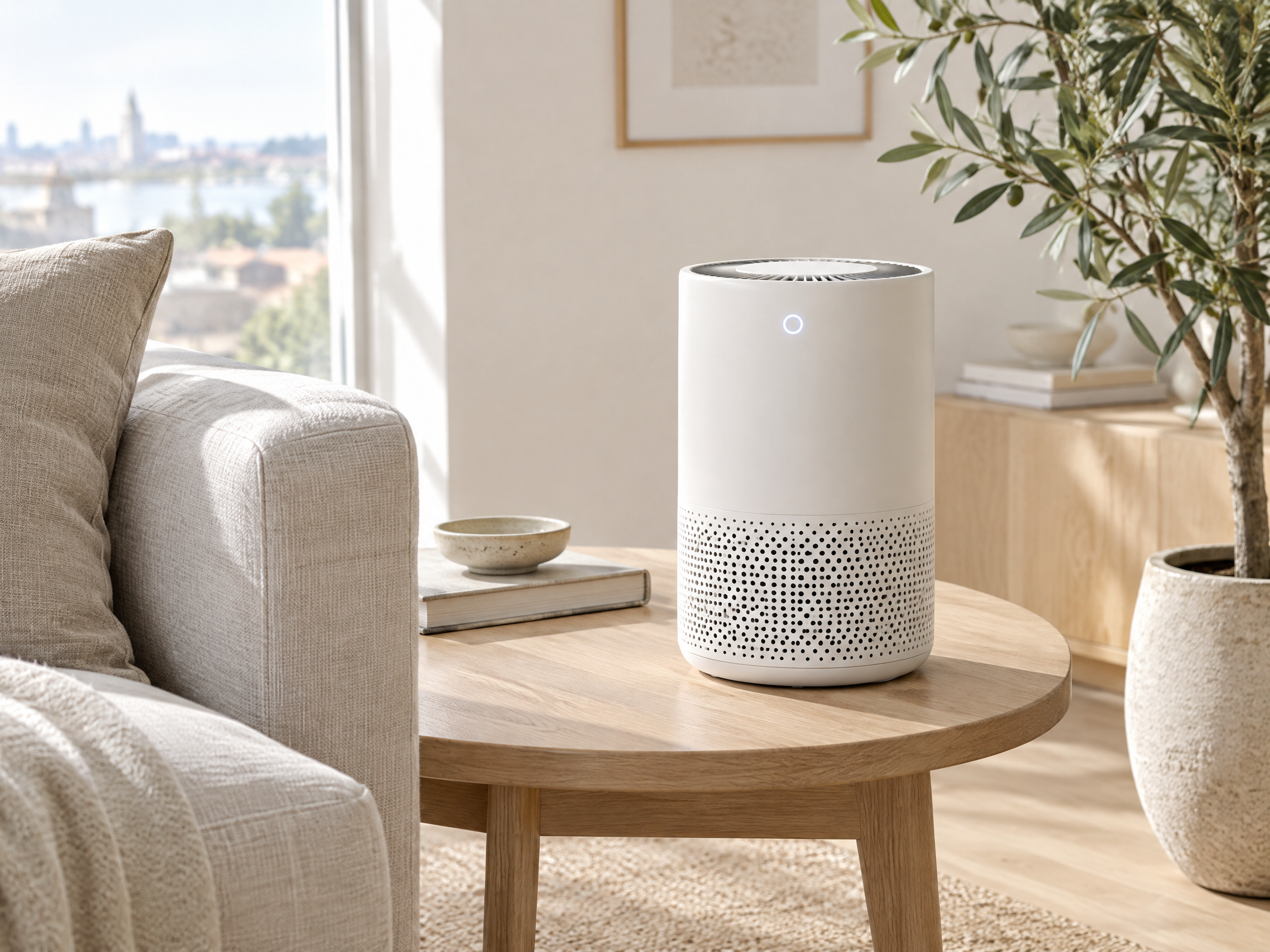
Target Keywords: air purifier certification; air purifier requirements; small appliance ozone emission testing; air purifier ozone standard; air purifier particulate test method; air purifier filter efficiency testing; air filter certification
Direct answer: An air purifier buyer should not approve a generic “certificate pack.” Build a SKU-and-market evidence file that connects the final bill of materials, electrical variant, filter, firmware, claims, label, and instruction manual to the appropriate conformity route and test reports. Prioritize electrical safety and EMC evidence where applicable, verify whether ozone testing or a jurisdictional program applies, and keep particulate and filter evidence distinct from legal market-access evidence. The right file depends on the final configuration, destination market, intended claims, and qualified regulatory review—not on a supplier’s broad product-family statement.
Introduction. A fan motor substitution, power adapter, Wi-Fi board, ionization feature, filter media, control logic, or retail claim can change the required evidence. A credible report is useful only if the delivered unit is demonstrably the tested unit.
This buyer-side method addresses air purifier certification and test evidence before launch. It does not prescribe CADR, room-size, filter-life, noise, or platform specifications; see UZYVO’s private-label air purifier CADR requirements guide. The narrower decision is what evidence exists, what it proves, and how the team controls it through launch.
1. Start with a configuration-controlled evidence map
The first artifact should be an evidence map, not a folder of PDFs. Give the proposed retail unit a buyer model code, then list every identity element that could affect testing or claims: housing, motor, power supply, PCB, radio module, UV source if present, ionizer or electrostatic stage if present, filter frame and media, sensors, firmware revision, rating label, carton, manual, and country plug. Add the intended destinations and exact claim copy alongside them.
This discipline matters because a branded buyer that has a product made for it may be treated as the manufacturer for EU CE-marking purposes and bears responsibility for the entire product, including supplied components.[1] A seller cannot solve that responsibility by showing an unrelated family report. Ask the supplier to identify precisely which model, electrical rating, revision, and critical components each report covers.
A useful reference point is the PureFlow 360 smart air purifier platform, but any product page is only a starting point for configuration. The final approved configuration and destination-market route decide what can support a launch. Put the following fields in the map before samples are released for formal testing:
| Evidence-map field | Buyer question | Release control |
|---|---|---|
| Final SKU identity | Is the model name and revision consistent across unit, report, manual, and declaration? | Approved label artwork and configuration sheet |
| Electrical architecture | Which input rating, plug, adapter, motor, and control board are sold? | Locked BOM and critical-component list |
| Air-treatment route | Is it mechanical filtration only, or are UV, ionization, plasma, or electrostatic functions enabled? | Feature matrix and firmware status |
| Filter identity | What finished filter, media, gasket, and replacement part number are used? | Filter drawing, material specification, change control |
| Claim set | What is said about particles, allergens, odors, ozone, or coverage? | Claim-to-evidence matrix and marketing approval |
| Market route | Which jurisdictions and sales channels are planned? | Destination matrix and qualified compliance review |
The result identifies the product that each document supports.
2. Turn destination markets and claims into air purifier requirements
There is no single worldwide checklist of air purifier requirements. The appropriate route may differ between a corded mechanical-filter model sold in one jurisdiction and a connected, ionizing model sold elsewhere. Start with the market, then work backwards to the applicable legal framework, voluntary program, retailer condition, and claim substantiation that may be relevant to that configuration. Obtain qualified local advice where the route is uncertain.
For an EU launch, CE marking is required only where harmonised EU rules mandate it; the manufacturer must identify requirements, assemble technical documentation, undertake the required assessment, and draw up an EU declaration of conformity before affixing the mark.[1] The Low Voltage Directive requires covered equipment to meet its safety objectives and requires technical documentation and a declaration after the appropriate assessment.[2] The EMC Directive addresses emissions and immunity when equipment is used as intended.[3]
That is different from treating a test-lab logo as a universal passport. A report, listing, declaration, certificate, registration, or marketplace upload has a distinct issuer, scope, and legal effect. The Commission cautions that unregulated voluntary certificates are not recognised proof for EU market-surveillance or customs checks under harmonised product law.[3]
Use a destination-and-claim matrix to avoid conflating evidence:
| Decision | Evidence to request | What to verify before approval |
|---|---|---|
| Electrical product placement | Applicable safety and EMC records, declarations, technical file inputs | Exact model, ratings, critical parts, standards edition, report conditions |
| California sale of an indoor air cleaner | CARB-specific certification file where applicable | Current certification status, model/brand identity, required label and sales controls |
| Particle-removal statement | Defined test method and report matched to the final unit | Test particles, settings, filter state, result expression, claim wording |
| Filter performance statement | Media or finished-filter test evidence matched to wording | Whether evidence concerns media, element, or assembled appliance |
| Connected features | Radio-module/product evidence and user documentation where applicable | Module identity, antenna/integration conditions, enabled functions |
For electrical and electronic equipment in the EU, restrictions on certain hazardous substances can also be relevant; the Commission states that, unless specifically excluded, products with an electrical/electronic component must comply with the RoHS restrictions.[8] Do not assume that an RoHS declaration replaces a safety, EMC, ozone, or performance report.
3. Separate conformity evidence from marketing assurance
Give each document a specific job. A declaration identifies the product, responsible party, legislation, specifications, and signatory. A laboratory report records a defined sample and method. A listing may show that a program’s conditions were met within its scope. A marketing claim needs evidence appropriate to its meaning.
Request original, legible documents, not screenshots. Compare report number, issue date, laboratory, client, product photographs, model, rating, and construction details. If the enclosure, PCB, fan, filter, power supply, radio module, or purification feature changes, ask whether prior evidence remains applicable. Do not decide by visual similarity.
For EU work, retain the traceability link from the declaration to the technical documentation. The Commission explains that the declaration and supporting documentation must be kept current and retained for at least 10 years after placement on the EU market; changes in legislation, the product, or relevant contact details require review and update.[1] This is a document-governance control, not a promise that a particular model is compliant in every country.
A practical review log looks like this:
| Document type | It can help establish | It cannot establish by itself |
|---|---|---|
| Test report | Results for the named sample under stated conditions | That every production unit or variant performs identically |
| Declaration of conformity | Responsible party’s conformity statement for identified product | A substitute for the supporting technical file |
| Third-party listing/certificate | Status within its named program and scope | Global approval or applicability to altered versions |
| Filter supplier datasheet | Supplier-stated material or component properties | Finished appliance particle-removal performance |
| Marketing artwork | Intended consumer-facing statement | The evidence behind that statement |
Treat the evidence map as a live record. Version the report register and require procurement, engineering, quality, and marketing to sign off on scope rather than leaving a sales team to infer it.
4. Build an ozone decision tree before approving any air-treatment function
Ozone needs a dedicated route because architecture and market can both change the question. Declare whether the final SKU intentionally or incidentally generates ozone, or uses mechanical filtration with no enabled electronic treatment stage. Do not accept “ozone free” without identifying the modes, accessories, firmware, and test context behind it.
In California, air cleaning devices sold to consumers or businesses must be CARB certified for electrical safety. Electronic portable and in-duct air cleaners also require ozone testing, with emissions no higher than 50 ppb.[4] CARB distinguishes mechanical filtration and certain UVGI configurations from portable electronic air cleaners.[4] Therefore, small appliance ozone emission testing is a configuration-specific deliverable when the product and destination call for it—not a generic RFQ add-on.
The buyer’s ozone test brief should state the model, revision, voltage/frequency, installed filter, enabled modes, accessories, preconditioning if defined by the method, laboratory, method/standard, result units, and any deviations. It should also identify how the tested condition relates to the product that will be sold. A report with an unrecognisable model, an excluded ionizer mode, or a different filter configuration cannot be assumed to support the final retail item.
An air purifier ozone standard is not a universal marketing phrase. Name the jurisdiction, product category, method, and current program status. California’s submission calls for electrical-safety and, where applicable, ozone reports, plus an authorization to mark, manual, laboratory directory listing, and English-labeled exploded diagram.[4] Confirm current requirements with the authority or qualified advisor before launch.
Ozone claims deserve restraint. EPA states that inhaled ozone can damage lungs and that, at concentrations not exceeding public-health standards, available evidence shows little potential to remove indoor contaminants.[5] An ozone report does not establish broad health, antimicrobial, odor-elimination, or pollutant-removal claims. Review each claim against the test and applicable advertising rules.
5. Review an ozone report as evidence, not as a badge
A credible review asks whether a report answers the buyer’s question—not merely whether it contains a low headline number. Obtain the complete report and verify a relevant program’s current record and model designation rather than relying on a copied mark.
Use the following report-review sequence:
- Identity: Match brand, model, electrical rating, serial/sample ID, and test date to the controlled SKU.
- Configuration: Confirm the tested unit carried the same air-treatment technologies, firmware modes, filter, adapter, and accessory state as the intended unit.
- Method: Read the named method, laboratory status where relevant, test setup, instrument references, operating modes, and deviations.
- Result: Record the reported result, units, limit or acceptance criterion only where the cited route states one, and the conclusion exactly as written.
- Scope: Note what the report does not cover—other markets, changed electronics, untested modes, later production, or non-ozone performance claims.
- Traceability: Link report number and revision to the BOM, artwork, declaration, and production-change log.
CARB’s instructions identify electrical-safety and ozone records for relevant devices, plus labeling and documentation elements.[4] That is a California route, not evidence of every global approval.
The same care applies to “zero ozone” language. Unless the exact test scope, detection context, configuration, and allowed wording have been assessed for the target market, prefer factual internal language such as “ozone evidence received for review” over an unqualified consumer claim. Escalate intended public claims to qualified legal/regulatory and advertising review.
6. Specify a particulate test method without confusing it with certification
An air purifier particulate test method should support the decision at hand: comparative performance, a public claim, a retailer requirement, or a voluntary program. It must identify the tested unit and conditions, not simply state “PM tested.” Review particles used, how decay/removal was measured, chamber or environment, settings, filter condition, data treatment, and metric.
AHAM describes CADR as the volume of filtered air delivered, with separate scores for tobacco smoke, pollen, and dust.[6] One performance term can therefore contain pollutant-specific conditions. Do not transpose a particle category, speed, or tested configuration into a broader claim. CADR-style results are not filter-media efficiency, electrical-safety certification, or ozone evidence.
A request-for-test table can make the gaps visible:
| Buyer objective | Brief the laboratory to identify | Evidence review question |
|---|---|---|
| Substantiate a particle-removal claim | Unit configuration, particle challenge, settings, duration, metric, method | Does the claim mirror the reported metric and condition? |
| Compare two approved configurations | Same method, settings, filter state, and report format for both | Are the results comparable, or did the test conditions change? |
| Support a voluntary verification program | Program scope and current participation requirements | Is the exact branded model listed and current? |
| Validate production continuity | Defined sample selection and controlled critical components | Does a sample check complement—not replace—conformity assessment? |
Keep performance evidence and consumer language under change control. A new prefilter, carbon stage, motor calibration, app-controlled mode, or filter supplier may alter airflow or particle-removal behavior. The right response is not automatically to retest everything; it is to run a documented change assessment and obtain qualified direction on whether existing evidence can still be relied on.
7. Distinguish filter efficiency from finished-appliance evidence
Air purifier filter efficiency testing is valuable only when the buyer knows the test object. It may refer to flat media, a finished replacement-filter element, or the assembled air purifier. These objects answer related but different questions. A high-efficiency material result does not by itself demonstrate the room performance of an appliance, because fan flow, bypass, sealing, geometry, filter loading, installation, and operating mode may affect the finished system.
Similarly, air filter certification can refer to a supplier’s quality program, a filter classification test, a branded replacement-filter verification program, or an appliance program. Ask the supplier to define the issuer, exact document, model/part number, test object, standard/method, classification or result, issue date, and permitted use of the mark or wording. Never infer that a media claim equals a compliant retail air purifier.
ISO 29463-1 illustrates why precise language matters: it establishes a filter classification based on performance determined under the related parts of the ISO 29463 series and covers assessment, marking, and documentation of test results.[9] The ISO listing shows that the 2017 edition is withdrawn, so a buyer should verify the current standard edition and applicable market expectations rather than rely on a historical document title.[9]
For the supplier file, request the filter drawing, material declaration, part-number cross-reference, supplier and manufacturing site, incoming acceptance specification, and change-notification commitment. Pair it with an installed-filter sample check where appropriate. This builds traceability without overstating what a component document proves.
Mid-article CTA: Need a configuration-led evidence checklist for a private-label air purifier? Send the intended markets, model architecture, and claim set to info@uzyvo.com so UZYVO can discuss an OEM/ODM evidence-review workflow.
8. Close the electrical, EMC, materials, and connected-product gaps
Ozone and particles are only part of a launch file. The final air purifier may also need electrical-safety, electromagnetic-compatibility, materials, labeling, instructions, energy, recycling, radio, or other evaluation depending on configuration and destination. Build those questions into the same matrix so one document does not mask another missing route.
For EU electrical equipment within scope, the Low Voltage Directive requires manufacturers to draw up technical documentation and perform or arrange the conformity assessment; its safety objectives include protection against hazards and suitable insulation for foreseeable conditions.[2] The EMC Directive aims to ensure electrical/electronic equipment neither generates unacceptable disturbance nor is unduly affected by disturbance when used as intended.[3] The buyer should ask the responsible technical party to map the final appliance and supplied components to the applicable route, standards, and declaration—not assume a mains plug, motor, or adapter report automatically covers the assembled appliance.
A smart air purifier introduces a further branch. The FCC states that RF devices subject to its rules must be properly authorized before U.S. marketing or importation, and that the required procedure depends on the device functions.[7] A pre-certified radio module may simplify engineering, but integration, antenna, firmware, labelling, and product responsibilities still need to be evaluated for the actual product. Keep wireless changes in the evidence-map change-control process.
For materials, request supplier declarations and supporting evidence appropriate to the destination and components. The European Commission notes that EU RoHS restricts ten listed substances in EEE and applies to products with an electrical/electronic component unless specifically excluded.[8] This does not establish every material, packaging, or chemical obligation in every market. It is a prompt to map the actual product route, not a reason to make unqualified “eco-safe” claims.
9. Make supplier, laboratory, and factory controls auditable
The evidence file is only as reliable as its chain of custody. Ask the manufacturer to nominate an owner for each report and to provide controlled copies, report authorization where relevant, and the underlying model/configuration references. Confirm that a laboratory name on a report is real, but do not assume the laboratory endorses a different model or altered report. When scope is unclear, ask the responsible issuer or qualified technical reviewer to resolve it.
Build three contractual/process controls into the sourcing plan:
| Control | Buyer implementation | Why it matters |
|---|---|---|
| Critical-component register | Lock named components and alternates for items affecting evidence | Makes unreviewed substitutions visible |
| Change notification | Require advance written notice and impact assessment for design, firmware, filter, supplier, label, or claim changes | Triggers review before shipment |
| Retained reference sample | Identify the approved sample and its configuration record | Gives quality and engineering a common comparison point |
These controls belong in the supplier workflow from RFQ through shipment—not after a retailer asks for documents. Explore UZYVO’s OEM / ODM workflow for the connection between buyer brief, sample confirmation, and controlled production. For production-process context, the factory capabilities route can help frame inspection and documentation discussions; it does not replace an independent assessment of a particular factory or item.
During a factory visit or remote review, trace one finished unit backwards: serial or batch identity, rating label, BOM, motor, PCB, filter lot, firmware version, in-process checks, final functional test, carton artwork, manual, and document file. Record gaps as actions with owners and due dates. Sampling and shipment inspection can help confirm consistency, but they do not substitute for appropriate product design validation, conformity assessment, or complete technical documentation.
10. Use a buyer-release checklist and resolve common questions
Before issuing a production release, run one cross-functional meeting with procurement, engineering, quality, marketing, and the accountable market-access owner. Each should sign the same version of the matrix. If the team cannot state what a document covers, it is not ready to be used as launch evidence.
Buyer-release checklist
- [ ] Final SKU, revision, electrical rating, destination countries, and sales channels are identified.
- [ ] BOM, drawing, filter part number, firmware, adapter, radio module, label, manual, and claims are configuration-controlled.
- [ ] Applicable market routes have been identified with qualified review where needed.
- [ ] Safety, EMC, radio, ozone, materials, and other evidence has been assessed for the final configuration—not simply collected.
- [ ] Ozone-feature status and all operating modes are declared; jurisdiction-specific testing/certification is addressed where applicable.
- [ ] Particle and filter statements use an identified method and do not extend beyond the test object or conditions.
- [ ] Declarations, reports, program records, labels, and manuals identify compatible model and brand information.
- [ ] Report originals, revisions, issuer details, and traceability references are retained in a controlled register.
- [ ] Marketing claims are approved against evidence and destination-specific requirements.
- [ ] A written process exists for component, firmware, supplier, artwork, and claim changes after launch.
Buyer FAQs
Does a CE mark mean an EU authority issued an air purifier certificate? No. The European Commission says there is no central EU body that grants permission or a certificate to use CE marking. The manufacturer must identify applicable requirements, assemble evidence, complete the required conformity assessment, and issue the declaration of conformity before affixing CE where applicable.[1] Confirm the final product and route with qualified advice rather than requesting a generic “CE certificate.”
Does every air purifier need an ozone report? Not necessarily. The need depends on product technology and destination-market requirements. In California, CARB states that electronic portable and in-duct air cleaners require ozone testing, while its guidance differentiates certain mechanical-filtration/UVGI cases and electrical-safety routes.[4] Determine the final feature set, modes, and market before defining the test plan.
Can an air-filter test report support a claim for the whole purifier? Usually not without further analysis. A material or filter-element test and an assembled-appliance particulate test concern different test objects. Keep the evidence and claim at the same level: media, finished filter, or complete appliance. Review bypass, airflow, filter fit, settings, and stated method before making any public statement.
What triggers review after a sample is approved? Any potential evidence-relevant change: motor, PCB, adapter, firmware, wireless module, ionizer status, filter media or gasket, supplier, rating label, manual, or claim. Document the change and have the responsible technical/compliance party decide whether existing records remain applicable or further assessment is needed.
Does a Wi-Fi or Bluetooth option belong only in the app team’s scope? No. It is part of the marketed electrical product. The FCC’s route for an RF device depends on its functions and includes testing, appropriate approval, labeling/user information, and record retention where subject to its rules.[7] Review the final integration and destination rules; do not rely on a module name alone.
11. Release a defensible evidence package, then keep it current
A buyer-ready evidence package should tell a coherent story: this defined SKU, in this electrical and feature configuration, was assessed and documented for these intended markets and these claims. It should let a new team member trace a public statement back through the product file to the relevant report, with any limitations clearly visible. That is more useful than a large unstructured folder and more defensible than a supplier assertion.
At minimum, retain a controlled index, configuration sheet, BOM/critical-component list, copies of relevant declarations and reports, applicable program records, label and manual artwork, claim matrix, supplier change commitments, approved sample record, and a change-assessment log. Set a recurring review whenever markets, laws, standards, components, firmware, or claims change. Do not represent the package as a legal conclusion: market access remains dependent on the final product, destination, evidence, and competent review.
Conclusion. The best air-purifier launch decision is not “the factory has certificates.” It is “the buyer can show what the final SKU is, which documents apply to it, what each document actually proves, and how changes will be controlled.” That approach keeps ozone evidence, particulate testing, filter evidence, electrical safety, EMC, radio, and public claims in their proper lanes. It also respects the fact that evidence is configuration- and market-specific.
Closing CTA: If you are preparing a destination-specific evidence matrix or want to align your sample, documents, and claims before production, email info@uzyvo.com. UZYVO can discuss a configuration-led OEM/ODM review for your planned air purifier range.
AI Image Recommendations
- Purpose: Make the evidence-map concept tangible near Module 1. Insertion point: Immediately after the configuration-control table. Caption: “A buyer evidence map links the final air purifier configuration to its documentation and claims.” ALT text: “Procurement specialist reviewing an air purifier bill of materials, test-report index, and label proof at a desk.” AI image prompt: “Photorealistic B2B procurement scene, unbranded compact air purifier on a clean desk, technical BOM sheet, neutral test-report folders, label artwork and a laptop spreadsheet, modern quality office, natural daylight, no logos, no seals, no compliance claims, landscape editorial photography.”
- Purpose: Clarify the boundary between ozone testing and marketing claims near Module 4. Insertion point: After the ozone decision-tree discussion. Caption: “Ozone evidence should be reviewed against the final device mode, test method, and destination-market route.” ALT text: “Laboratory technician viewing an unbranded air cleaner in a controlled test chamber with measurement instruments.” AI image prompt: “Realistic independent laboratory environment, unbranded room air cleaner positioned in a controlled transparent test chamber, technician checking instruments from outside, neutral equipment screens without readable values, no lab logos, no certification marks, technical documentary style, wide horizontal composition.”
- Purpose: Reinforce post-approval change control near Module 9. Insertion point: After the supplier-control table. Caption: “Component and firmware changes should be assessed before they reach production.” ALT text: “Factory quality engineer comparing an approved air purifier component list with finished production units.” AI image prompt: “Photorealistic small-appliance factory quality station, quality engineer comparing an unbranded air purifier component list on a clipboard with finished units on a line, visible filter cartridge and circuit board in the background, orderly professional setting, no brand names, no performance claims, landscape format.”
References
Put the buyer guide into a practical sourcing path.
Bring this framework into your next product brief.
Share your target market, appliance category, annual volume, and launch window. We will discuss a practical sample, documentation, and production path for the final configuration.
Email info@uzyvo.com